
[논문 리뷰] CLIP-S$^4$: Language-Guided Self-Supervised Semantic Segmentation
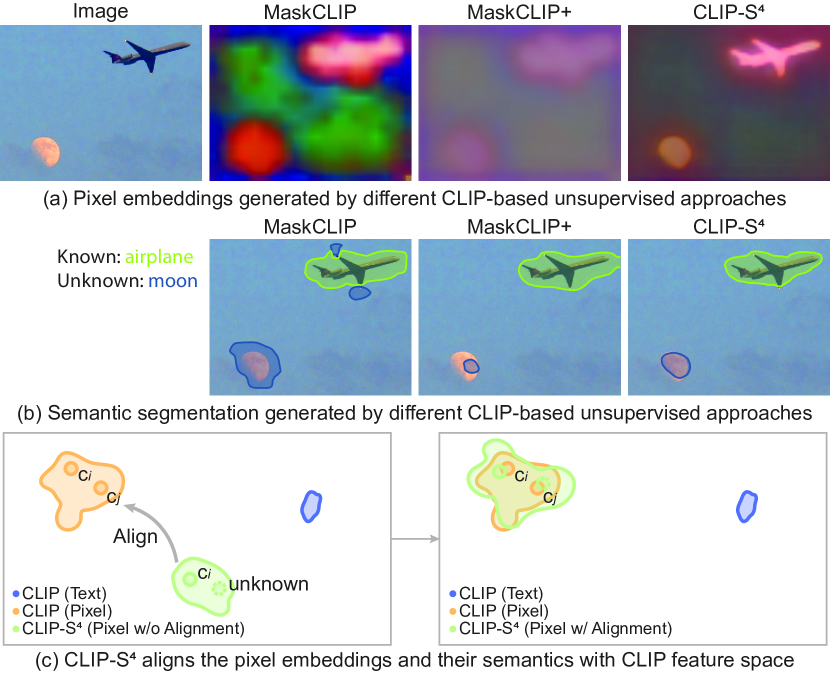
CLIP-S⁴는 인간의 레이블 없이도 고품질의 언어 일반화 가능한 픽셀 표현을 학습할 수 있도록 CLIP의 시각-언어 임베딩을 활용하는 자기지도 학습 기반의 의미 분할 프레임워크를 제안한다. CLIP의 임베딩 일관성과 기존 및 미지 클래스 간의 의미 일관성을 강제함으로써, 특히 미지 클래스를 인식하는 데서 무인도의 의미 분할 및 언어 유도 의미 분할에서 최신 기술 수준의 성능을 달성한다.
Existing semantic segmentation approaches are often limited by costly pixel-wise annotations and predefined classes. In this work, we present CLIP-S$^4$ that leverages self-supervised pixel representation learning and vision-language models to enable various semantic segmentation tasks (e.g., unsupervised, transfer learning, language-driven segmentation) without any human annotations and unknown class information. We first learn pixel embeddings with pixel-segment contrastive learning from different augmented views of images. To further improve the pixel embeddings and enable language-driven semantic segmentation, we design two types of consistency guided by vision-language models: 1) embedding consistency, aligning our pixel embeddings to the joint feature space of a pre-trained vision-language model, CLIP; and 2) semantic consistency, forcing our model to make the same predictions as CLIP over a set of carefully designed target classes with both known and unknown prototypes. Thus, CLIP-S$^4$ enables a new task of class-free semantic segmentation where no unknown class information is needed during training. As a result, our approach shows consistent and substantial performance improvement over four popular benchmarks compared with the state-of-the-art unsupervised and language-driven semantic segmentation methods. More importantly, our method outperforms these methods on unknown class recognition by a large margin.
연구 동기 및 목표
- 의미 분할에서 픽셀 단위 인간 레이블의 높은 비용과 제약을 해결하기 위해.
- 기존 방법이 사전 클래스 정보 없이도 미지 클래스를 인식할 수 없는 한계를 극복하기 위해.
- 학습 시 레이블 없이도 언어 기반 의미 분할을 가능하게 하기 위해.
- 학습 시 어떤 클래스 이름도 필요로 하지 않는 클래스 없는 의미 분할 설정을 개발하기 위해.
- 자기지도 학습과 일관성 정규화를 통해 픽셀 임베딩 품질 향상 및 CLIP의 통합 시각-언어 임베딩 공간과의 정렬을 향상시키기 위해.
제안 방법
- 증강된 이미지 뷰에서 픽셀-세그먼트 대비 학습을 통해 시각적으로 유사한 픽셀을 그룹화하는 방식으로 初기 픽셀 임베딩을 학습한다.
- 모델이 생성한 픽셀 임베딩과 CLIP의 통합 이미지-텍스트 임베딩 간의 거리 최소화를 통해 임베딩 일관성을 강제한다.
- 모델 예측을 기존 및 미지 프로토타입을 포함한 타겟 클래스에 대해 CLIP의 예측과 정렬함으로써 의미 일관성을 강제한다.
- 학습 중에 CLIP의 최상위 활성화 세그먼트를 사용하여 기존 및 미지 클래스의 프로토타입을 생성한다.
- 대비, 임베딩 일관성, 의미 일관성 손실의 조합을 사용하여 세그먼트 헤드를 엔드 투 엔드로 훈련한다.
- 클래스 이름이나 레이블 없이도 CLIP의 제로샷 능력을 기반으로 하여 클래스 없는 의미 분할을 지원한다.
실험 결과
연구 질문
- RQ1시각-언어 모델 가이드를 활용하여 자기지도 학습 기반 픽셀 표현 학습을 향상시킬 수 있는가? 이는 인간 레이블 없이도 의미 분할 성능 향상에 기여하는가?
- RQ2학습 시 클래스 정보가 제공되지 않을 경우, 모델이 의미 분할에서 얼마나 잘 미지 클래스로 일반화할 수 있는가?
- RQ3모델 임베딩과 CLIP의 통합 임베딩 공간 간의 일관성 강제가 분할 성능 및 제로샷 일반화에 어떤 영향을 미치는가?
- RQ4의미 일관성 손실에 기존 및 미지 클래스 프로토타입을 모두 사용할 경우, 모델의 강인성과 일반화 능력에 어떤 영향을 미치는가?
- RQ5통합 프레임워크가 어떤 감독 없이도 무인도, 전이 학습, 언어 기반 분할 작업 전반에서 최신 기술 수준의 성능을 달성할 수 있는가?
주요 결과
- 무인도 의미 분할에서 CLIP-S⁴는 Pascal VOC에서 평균 IoU 72.2%를 기록하여 이전 무인도 방법보다 영역 유사도에서 1.9% 이상 뛰어나다.
- 언어 기반 분할에서 CLIP-S⁴는 Pascal Context에서 33.6% mIoU를 기록하여 MaskCLIP+를 2.9% mIoU 뛰어넘으며, 특히 미지 클래스 인식 능력이 크게 향상되었다.
- 모델는 CLIP의 임베딩과 강력한 정렬을 유지하여, 세그먼트 임베딩과 CLIP의 임베딩 간 평균 코사인 유사도가 0.66에 도달하여 효과적인 다중 모odal 일관성을 보였다.
- 절단 실험 결과, 임베딩 일관성과 의미 일관성 손실을 병합한 조합이 가장 뛰어난 성능(53.7% pAcc, 33.6% mIoU)을 기록했으며, 개별 손실보다 뛰어났다.
- 모델 성능은 미지 클래스 프로토타입 수에 대해 강인했으며, 16에서 256개의 프로토타입 사이에서 mIoU가 오직 0.6% 이내로 변동했다.
- 프로토타입 생성에 상위 32~64개 세그먼트를 사용할 경우 안정적이고 고품질의 임베딩을 확보했으며, 기준 프로토타입과의 코사인 유사도가 0.99를 초과했다.

이 논문 읽기
누빈트 뷰어에서 원문을 열고, 읽으면서 궁금한 곳을 바로 물어보세요.
누빈트에서 이 논문 읽기이 리뷰는 AI가 논문 원문을 바탕으로 만들었습니다. 인용하기 전에 원문을 확인해 주세요.