
[논문 리뷰] Continual Diffusion: Continual Customization of Text-to-Image Diffusion with C-LoRA
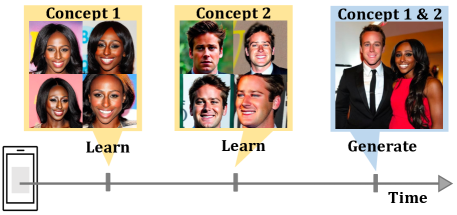
C-LoRA를 소개합니다. 이는 Stable Diffusion의 교차 주의에서 지속적으로 자기 정규화된 저랭크 어댑터를 사용하여 과거의 개념을 잊지 않으면서 미세한 개념을 순차적으로 학습하고, 무작위 토큰 커스터마이제이션 전략도 함께 제시합니다. 지속적 텍스트-이미지 커스터마이제이션에서 최첨단 성능을 입증하고 지속적 이미지 분류로의 전이에 대한 성과도 보여줍니다.
Recent works demonstrate a remarkable ability to customize text-to-image diffusion models while only providing a few example images. What happens if you try to customize such models using multiple, fine-grained concepts in a sequential (i.e., continual) manner? In our work, we show that recent state-of-the-art customization of text-to-image models suffer from catastrophic forgetting when new concepts arrive sequentially. Specifically, when adding a new concept, the ability to generate high quality images of past, similar concepts degrade. To circumvent this forgetting, we propose a new method, C-LoRA, composed of a continually self-regularized low-rank adaptation in cross attention layers of the popular Stable Diffusion model. Furthermore, we use customization prompts which do not include the word of the customized object (i.e., "person" for a human face dataset) and are initialized as completely random embeddings. Importantly, our method induces only marginal additional parameter costs and requires no storage of user data for replay. We show that C-LoRA not only outperforms several baselines for our proposed setting of text-to-image continual customization, which we refer to as Continual Diffusion, but that we achieve a new state-of-the-art in the well-established rehearsal-free continual learning setting for image classification. The high achieving performance of C-LoRA in two separate domains positions it as a compelling solution for a wide range of applications, and we believe it has significant potential for practical impact. Project page: https://jamessealesmith.github.io/continual-diffusion/
연구 동기 및 목표
- 지속적 확산의 문제 정의: 과거의 개념에 대해 재학습 없이 텍스트-이미지 확산에서 순차적이고 미세한 개념 맞춤화를 수행한다.
- C-LoRA 제안: 교차 주의에서 지속적, 자기 정규화된 저랭크 어댑터와 비명시적(이름 기반이 아닌) 개인화 토큰을 도입한다.
- C-LoRA가 재앙적 망각을 완화하고 지속적 확산 벤치마크에서 baselines를 능가함을 보인다.
- C-LoRA가 예행 연습 없이 이미지 분류(ImageNet-R)에서 최첨단 성과를 달성하는 지속적 학습을 보여준다.
제안 방법
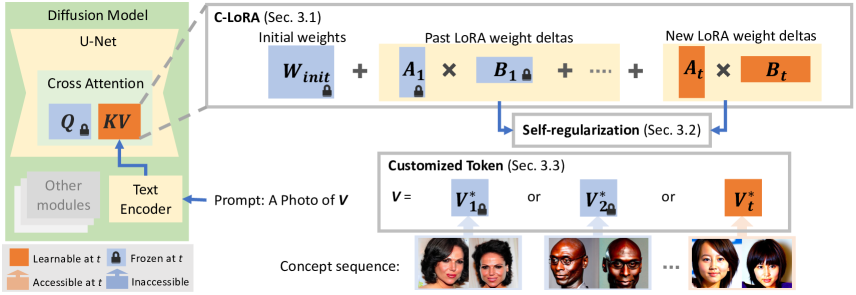
- Stable Diffusion에서 교차 주의의 키(K)·값(V) 프로젝션만 LoRA 스타일의 저랭크 어댑터로 수정한다.
- 과거에 적응된 가중치의 변화를 페널티하는 지속적 자기 정규화 손실을 도입한다(과거 LoRA 델타의 합을 이용한 Hadamard-정규화).
- 각 작업별 LoRA 매개변수를 사용하고 이를 원래 가중치와 융합하여 W^{K,V}_{t}=W^{K,V}_{init} + sum_{t'<t} A_{t'}^{K,V} B_{t'}^{K,V} + A_{t}^{K,V} B_{t}^{K,V}로 표현한다.
- 간섭을 줄이기 위해 N개의 개인화 토큰을 무작위로 초기화하여 추가하고 프롬프트에서 명시적 개념 단어를 제거하는 커스터마이즈 토큰 전략을 채택한다.
- 정규화 강도를 간단한 지수적 스윕으로 학습하고 LoRA 매개변수만 업데이트하여 매개변수 비용을 낮게 유지한다(저장된 재생 데이터 없음).
- Multi-concept 생성 능력을 시연하고 Textual Inversion, DreamBooth, Custom Diffusion, 재연습 없이 지속적 학습 벤치마크와 비교한다.
실험 결과
연구 질문
- RQ1연속적으로 도입되는 개념에서도 재학습 없이 지속적이고 미세한 텍스트-이미지 컨셉 커스터마이즈가 가능하는가?
- RQ2교차 주의에서의 자기 정규화된 저랭크 어댑테이션(C-LoRA)이 지속적 확산에서 기존 커스터마이제이션 방법을 능가하는가?
- RQ3개인화 토큰의 무작위 초기화와 개념 단어의 제거가 지속적 학습 성능을 향상시키고 다중 개념 생성을 가능하게 하는가?
- RQ4C-LoRA의 이점이 ImageNet-R와 같은 이미지 분류 벤치마크에서 rehearsal-free 지속적 학습으로 확장되는가?
- RQ5기존 접근법(Custom Diffusion, LoRA, 재생(replay) 기반 방법)과 비교했을 때 C-LoRA의 매개변수 및 프라이버시 영향은 어떠한가?
주요 결과
- C-LoRA는 잊음을 크게 줄이고 Celeb-A HQ 및 Google Landmarks 데이터셋에서 순차적으로 학습된 개념에 대한 최종 생성 품질을 향상시킨다.
- Textual Inversion, DreamBooth, 및 Custom Diffusion(순차/병합)과 비교할 때 C-LoRA는 더 적은 학습 가능한 매개변수로 MMD 기반 망각을 낮추고 작업 간 일관성을 높인다.
- 무작위의 비명시적 개인화 토큰 전략과 객체 단어 제거가 개념 간 간섭을 줄이고 다중 개념 생성성을 향상시킨다.
- 이 방법은 ImageNet-R에서 rehearsal-free 지속적 학습의 최첨단 성능을 달성하여 LwF, L2P, DualPrompt, CODA-Prompt 및 애벌레이션 변형들을 능가한다.
- C-LoRA는 여분의 매개변수 비용이 미미하고 재생 데이터 없이 자체 정규화 메커니즘을 포함하며 얼굴 및 랜드마크 도메인에서 최소 10개의 순차적 개념으로 확장 가능하다.
이 논문 읽기
누빈트 뷰어에서 원문을 열고, 읽으면서 궁금한 곳을 바로 물어보세요.
누빈트에서 이 논문 읽기이 리뷰는 AI가 논문 원문을 바탕으로 만들었습니다. 인용하기 전에 원문을 확인해 주세요.