
[논문 리뷰] Continuously Learning, Adapting, and Improving: A Dual-Process Approach to Autonomous Driving
LeapAD는 인간 인지에서 영감을 얻어 빠른 히وري스틱 프로세스(시스템-I)와 느린 분석 프로세스(시스템-II)를 사용하는 이중 프로세스, 밀폐형 자율주행 시스템을 제안한다. 자기 반성과 고품질 주행 경험의 증가하는 메모리 백업을 활용하여, 이전 방법들보다 1–2개 정도의 지수 차수 적은 레이블 데이터로도 지속적인 개선을 가능하게 하며, CARLA 시뮬레이션에서 다양한 환경으로의 강력한 일반화 성능을 달성한다.
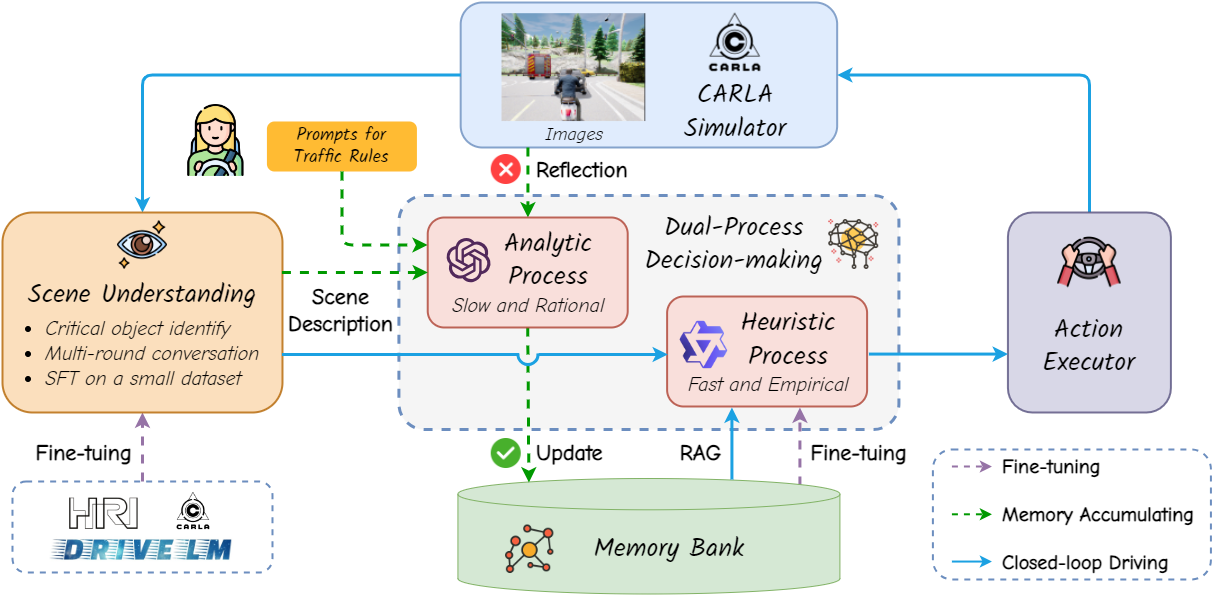
Autonomous driving has advanced significantly due to sensors, machine learning, and artificial intelligence improvements. However, prevailing methods struggle with intricate scenarios and causal relationships, hindering adaptability and interpretability in varied environments. To address the above problems, we introduce LeapAD, a novel paradigm for autonomous driving inspired by the human cognitive process. Specifically, LeapAD emulates human attention by selecting critical objects relevant to driving decisions, simplifying environmental interpretation, and mitigating decision-making complexities. Additionally, LeapAD incorporates an innovative dual-process decision-making module, which consists of an Analytic Process (System-II) for thorough analysis and reasoning, along with a Heuristic Process (System-I) for swift and empirical processing. The Analytic Process leverages its logical reasoning to accumulate linguistic driving experience, which is then transferred to the Heuristic Process by supervised fine-tuning. Through reflection mechanisms and a growing memory bank, LeapAD continuously improves itself from past mistakes in a closed-loop environment. Closed-loop testing in CARLA shows that LeapAD outperforms all methods relying solely on camera input, requiring 1-2 orders of magnitude less labeled data. Experiments also demonstrate that as the memory bank expands, the Heuristic Process with only 1.8B parameters can inherit the knowledge from a GPT-4 powered Analytic Process and achieve continuous performance improvement. Project page: https://pjlab-adg.github.io/LeapAD.
연구 동기 및 목표
- 기존 데이터 기반 자율주행 시스템이 새로운 시나리오, 원인 분석, 해석 가능성에 대해 유연하게 대응하지 못하는 한계를 해결하기 위해.
- 밀폐형 루프, 인간에게 영감을 받은 인지 프레임워크를 통해 자동차의 지속적 학습과 적응을 가능하게 하기 위해.
- 고용량의 추론 모델과 경량 실시간 추론 간 격차를 해소하기 위해, 대규모 분석 프로세스에서 소형 히وري스틱 프로세스로 지식을 전이함으로써.
- 이식 가능한 메모리 백업과 반성 메커니즘을 활용해 다양한 주행 환경에서의 일반화와 강건성을 향상시키기 위해.
- 실세계 구현을 고려한 클라우드-에지 아키텍처와 호환되는 시스템을 개발하기 위해.
제안 방법
- LeapAD는 인간처럼 주의를 기울여 핵심 객체에 집중함으로써 환경 입력을 단순화하고 의사결정에 활용하는 장면 이해 모듈을 적용한다.
- 이중 프로세스 의사결정 아키텍처를 구현한다: 논리적 추론을 위한 느린, 이성적인 분석 프로세스(시스템-II)와 실시간 추론을 위한 빠른, 경험 기반의 히وري스틱 프로세스(시스템-I)이다.
- 분석 프로세스는 언어 기반 주행 경험을 축적하고 고품질의 의사결정 궤적을 생성하며, 이는 지도 미세조정(SFT)을 통해 이식 가능한 메모리 백업으로 압축된다.
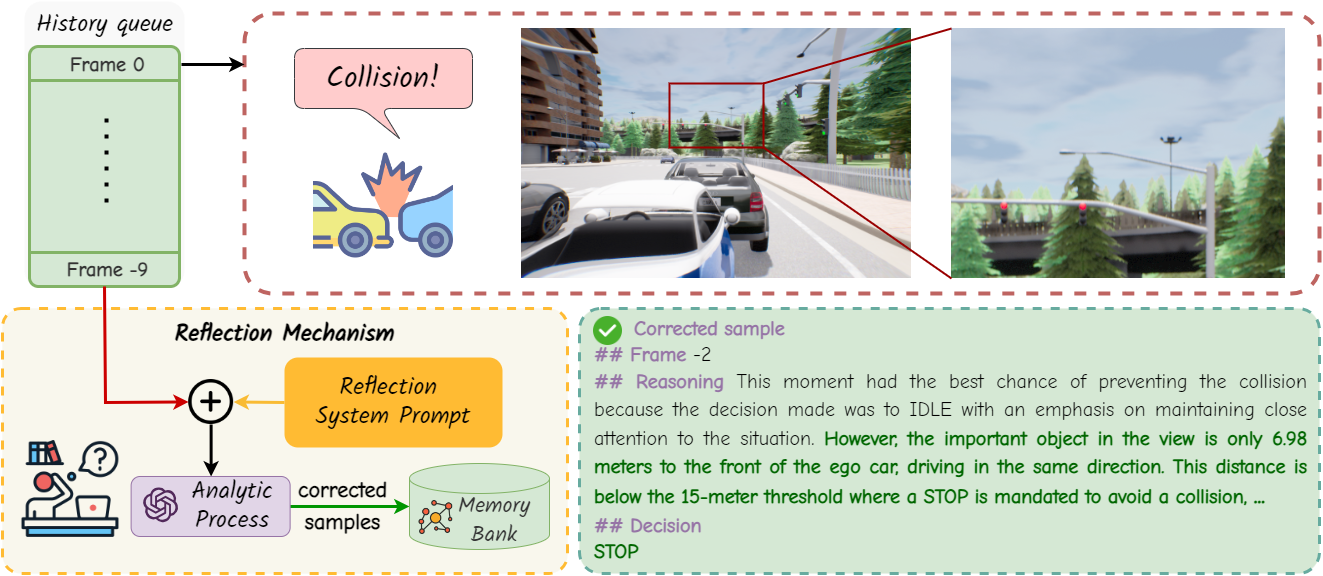
- 반성 메커니즘은 사고를 식별하고 분석하여 교훈을 도출하고 메모리 백업을 업데이트함으로써, 밀폐형 루프 환경에서 자기 향상을 가능하게 한다.
- 히وري스틱 프로세스는 메모리 백업을 활용한 소수의 프롬프트를 사용하여 새로운 시나리오에 신속하게 적응하고, 엣지에서 실시간 의사결정을 수행한다.
- 시스템은 밀폐형 CARLA 시뮬레이션에서 훈련 및 평가되어 동적 상호작용과 피드백을 보장하며, 개방형 평가와는 달리 상호작용이 지속된다.
실험 결과
연구 질문
- RQ1이중 프로세스 인지 아키텍처가 자율주행 시스템의 지속적 학습과 적응 능력을 향상시키는가?
- RQ2지식 정제를 통해 소형 히وري스틱 프로세스가 대규모 분석 프로세스의 복잡한 추론 능력을 얼마나 효과적으로 습득하는가?
- RQ3반성 기반 메모리 백업이 다양한 주행 환경에서 성능과 일반화 능력을 얼마나 향상시키는가?
- RQ4LeapAD는 기존 카메라 전용 방법에 비해 훨씬 적은 레이블 데이터로도 뛰어난 성능을 달성할 수 있는가?
- RQ5메모리 백업 수집 시에 본 바 없는 도시에서 테스트했을 때 시스템은 어떻게 일반화되는가?
주요 결과
- LeapAD는 CARLA에서 모든 카메라 전용 방법보다 뛰어난 성능을 보이며, 밀폐형 평가에서 최신 기술 수준의 성능을 달성한다.
- 효율적인 지식 전이와 지속적 학습 덕분에 이전 방법들보다 1–2개 정도의 지수 차수 적은 레이블 데이터가 필요하다.
- 메모리 백업이 커질수록 1.8B 파라미터의 히وري스틱 프로세스는 지도 미세조정을 통해 GPT-4 기반 분석 프로세스와 유사한 성능을 달성한다.
- 반성 메커니즘이 주행 점수를 크게 향상시키며, 어려운 루트에서 여러 라운드의 자기 향상 과정을 거쳐 평균 성능이 증가한다.
- 메모리 백업은 강력한 일반화 능력을 보이며, 다른 도시에서 수집한 메모리로 Town05에서 높은 성능을 달성하고, 반대로도 동일한 결과를 보여, 환경 간 강력한 이식성 전이 능력을 입증한다.
- 저품질 샘플이 메모리 백업에 포함되어 있어도 시스템은 뛰어난 성능을 유지하며, 노이즈 데이터에 대한 강건성을 보여준다.
이 논문 읽기
누빈트 뷰어에서 원문을 열고, 읽으면서 궁금한 곳을 바로 물어보세요.
누빈트에서 이 논문 읽기이 리뷰는 AI가 논문 원문을 바탕으로 만들었습니다. 인용하기 전에 원문을 확인해 주세요.