
[논문 리뷰] Conv-Adapter: Exploring Parameter Efficient Transfer Learning for ConvNets
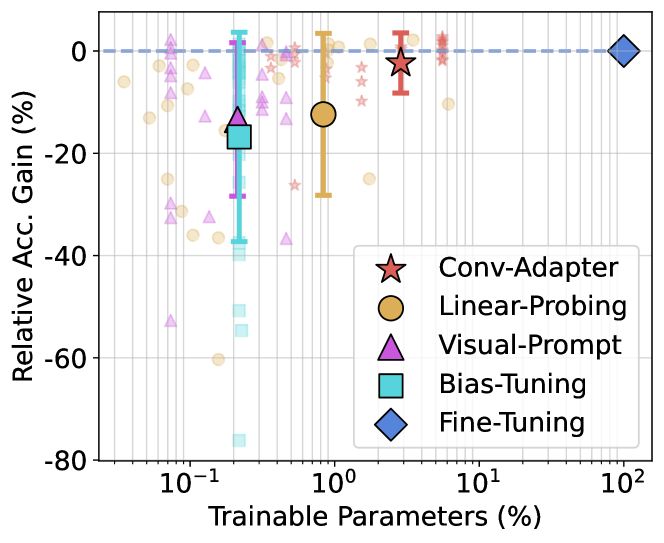
이 논문은 ConvNets를 위한 경량이며 아키텍처에 관계없이 적용 가능한 파rameter 효율적 튜닝(PET) 모듈인 Conv-Adapter를 제안한다. 이 모듈은 ResNet-50의 전체 미세조정 파라미터의 3.5%만을 투입한다. 잔차 블록 내에서 깊이 분리형 합성곱을 통해 작업별 특징 조절을 학습함으로써, 23개의 이미지 분류 작업에서 전체 미세조정과 비교할 만한 성능을 달성하며, 객체 검출 및 세그멘테이션 작업으로의 일반화도 효과적으로 수행되며 파라미터 수를 50% 이상 감소시킨다.
While parameter efficient tuning (PET) methods have shown great potential with transformer architecture on Natural Language Processing (NLP) tasks, their effectiveness with large-scale ConvNets is still under-studied on Computer Vision (CV) tasks. This paper proposes Conv-Adapter, a PET module designed for ConvNets. Conv-Adapter is light-weight, domain-transferable, and architecture-agnostic with generalized performance on different tasks. When transferring on downstream tasks, Conv-Adapter learns tasks-specific feature modulation to the intermediate representations of backbones while keeping the pre-trained parameters frozen. By introducing only a tiny amount of learnable parameters, e.g., only 3.5% full fine-tuning parameters of ResNet50. It can also be applied for transformer-based backbones. Conv-Adapter outperforms previous PET baseline methods and achieves comparable or surpasses the performance of full fine-tuning on 23 classification tasks of various domains. It also presents superior performance on the few-shot classification with an average margin of 3.39%. Beyond classification, Conv-Adapter can generalize to detection and segmentation tasks with more than 50% reduction of parameters but comparable performance to the traditional full fine-tuning.
연구 동기 및 목표
- 자연어처리(NLP)에서의 성공에도 불구하고, 컴퓨터 비전 분야에서 ConvNets에 대한 효과적인 파라미터 효율적 튜닝(PET) 방법의 부족을 해결한다.
- 대규모 ConvNets를 위한 경량이며 도메인 이식 가능하고 아키텍처에 관계없이 적용 가능한 PET 모듈을 개발한다.
- 사전 학습된 백본 가중치를 동결한 채로 최소한의 학습 가능한 파라미터로 높은 성능을 달성할 수 있도록 한다.
- PET을 NLP를 넘어서 다양한 컴퓨터 비전(CV) 작업, 즉 이미지 분류, 객체 검출, 세그멘테이션 등으로 일반화한다.
- 특징 국소성과 비전 작업에서의 도메인 이동을 고려한 PET 모듈의 설계 선택 사항과 적응 가능성에 대해 연구한다.
제안 방법
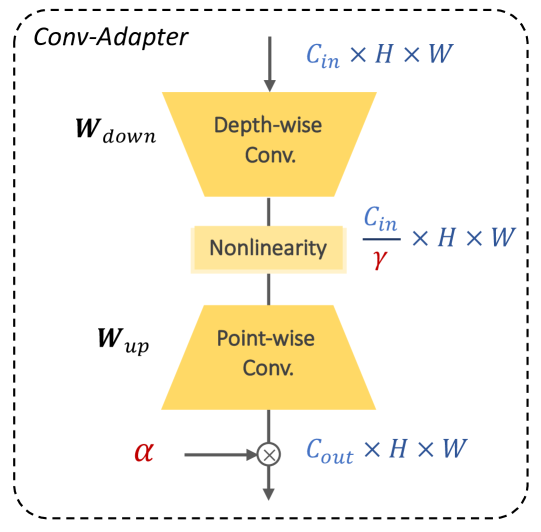
- 깊이 분리형 합성곱과 비선형성을 사용하여 잔차 블록 내 중간 특징을 조절하는 블록 구조를 가진 PET 모듈인 Conv-Adapter를 제안한다.
- 적응 표현(채널 대비 공간)과 삽입 형태(블록 단위 대 기능 단위)의 두 가지 설계 차원을 도입하고, 최적의 구성 요건을 규명하기 위해 분석을 실시한다.
- He 등(2022)과 같은 NLP PET 방법과 동일한 수학적 프레임워크에 기반하여 Conv-Adapter를 수립함으로써 다중 모odal 일관성을 확보한다.
- 특징 조절을 제어하기 위해 학습 가능한 스케일링 벡터 α와 압축 인자 γ를 사용하며, 초기화 및 하이퍼파ram터 민감도에 대한 분석을 실시한다.
- 사전 학습된 ResNet-50과 ConvNeXt-S에 모듈을 적용하고, 백본 가중치는 모두 동결한 채 어댑터만 미세조정한다.
- ImageNet, VTAB-1k, FGVC 데이터셋을 포함한 표준 벤치마크를 사용하여 다양한 후행 작업에서 평가를 수행한다.
실험 결과
연구 질문
- RQ1아키텍처 및 데이터 분포의 차이가 있는 컴퓨터 비전 분야에서 NLP에서의 PET 기법을 ConvNets에 효과적으로 적용할 수 있는가?
- RQ2합성곱 유형, 삽입 형태, 표현 적응 등의 설계 선택 사항 중에서 ConvNet PET에서 성능과 파라미터 효율성을 극대화하는 것은 무엇인가?
- RQ3큰 도메인 이동 상황에서 Conv-Adapter는 어떻게 성능을 내며, 이러한 환경에서의 이식 가능성에 제한 요소는 무엇인가?
- RQ4분류, 검출, 세그멘테이션 작업 전반에서 Conv-Adapter는 훨씬 적은 학습 가능한 파라미터로 전체 미세조정 성능을 어느 정도 재현할 수 있는가?
- RQ5스케일링 벡터 α의 초기화와 압축 인자 γ의 하이퍼파ram터에 대해 Conv-Adapter의 성능는 얼마나 민감한가?
주요 결과
- Conv-Adapter는 ResNet-50의 학습 가능한 파라미터의 3.5%만을 사용하여 23개의 도메인 간 이미지 분류 작업에서 전체 미세조정과 비교해 유사하거나 더 높은 성능를 달성한다.
- 소수의 샘플이 있는 분류 작업에서 Conv-Adapter는 베이스라인 대비 평균 정확도 3.39%의 여유를 확보하여 낮은 데이터 환경에서의 강력한 일반화 능력을 입증한다.
- 객체 검출 및 세그멘테이션 작업에서 Conv-Adapter는 파라미터 수를 50% 이상 감소시키면서도 전체 미세조정 수준의 성능를 유지한다.
- 분석 결과, 채널 기반 적응과 함께 깊이 분리형 합성곱이 성능와 파라미터 효율성 사이의 최적의 트레이드오프를 제공하는 것으로 확인되었다.
- Conv-Adapter는 스케일링 벡터 α의 초기화에 가장 민감하며, 초기값을 1로 설정할 경우 가장 높은 성능를 기록하지만, 압축 인자 γ의 변동에는 뚜렷한 영향 없이 안정적인 성능를 유지한다.
- CKA 유사도 분석 결과, 사전 학습 및 미세조정 가중치가 매우 유사한 경우(고 CKA), Conv-Adapter가 전체 미세조정을 초월하는 것으로 나타나, 소규모 분포 이동 상황에서 더 나은 일치를 보임을 시사한다.
이 논문 읽기
누빈트 뷰어에서 원문을 열고, 읽으면서 궁금한 곳을 바로 물어보세요.
누빈트에서 이 논문 읽기이 리뷰는 AI가 논문 원문을 바탕으로 만들었습니다. 인용하기 전에 원문을 확인해 주세요.