
[논문 리뷰] Deep neural operator for learning transient response of interpenetrating phase composites subject to dynamic loading
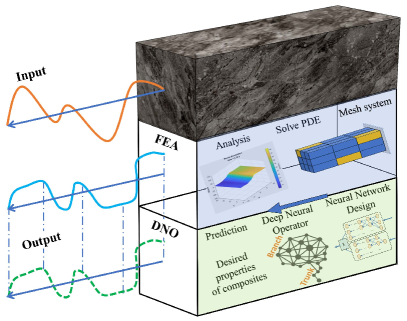
이 논문은 동적 하중 하에서 상호관통 상호작용 복합재료(IPCs)의 일시적 기계적 거동을 예측하기 위해 유한요소해석(FEA)을 대체하는 딥 뉴럴 옵저버(DNO)를 제안한다. JAX에서 순차적 시퀀스-투-시퀀스 학습을 통해 5,000개의 랜덤 변형률 하중에 대해 훈련된 DNO는 1초 이내에 반력 및 응력 분포를 98% 정확도로 예측하며, 표준 DeepONet 모델 대비 100배 빠르게 작동하여 3D 프린팅된 IPC의 빠르고 정확하고 강건한 설계 탐색을 가능하게 한다.
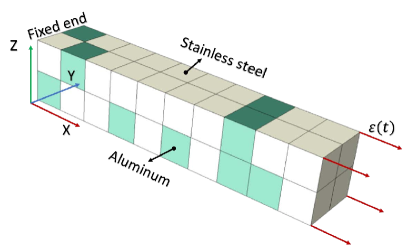
Additive manufacturing has been recognized as an industrial technological revolution for manufacturing, which allows fabrication of materials with complex three-dimensional (3D) structures directly from computer-aided design models. The mechanical properties of interpenetrating phase composites (IPCs), especially response to dynamic loading, highly depend on their 3D structures. In general, for each specified structural design, it could take hours or days to perform either finite element analysis (FEA) or experiments to test the mechanical response of IPCs to a given dynamic load. To accelerate the physics-based prediction of mechanical properties of IPCs for various structural designs, we employ a deep neural operator (DNO) to learn the transient response of IPCs under dynamic loading as surrogate of physics-based FEA models. We consider a 3D IPC beam formed by two metals with a ratio of Young's modulus of 2.7, wherein random blocks of constituent materials are used to demonstrate the generality and robustness of the DNO model. To obtain FEA results of IPC properties, 5,000 random time-dependent strain loads generated by a Gaussian process kennel are applied to the 3D IPC beam, and the reaction forces and stress fields inside the IPC beam under various loading are collected. Subsequently, the DNO model is trained using an incremental learning method with sequence-to-sequence training implemented in JAX, leading to a 100X speedup compared to widely used vanilla deep operator network models. After an offline training, the DNO model can act as surrogate of physics-based FEA to predict the transient mechanical response in terms of reaction force and stress distribution of the IPCs to various strain loads in one second at an accuracy of 98%. Also, the learned operator is able to provide extended prediction of the IPC beam subject to longer random strain loads at a reasonably well accuracy.
연구 동기 및 목표
- 현재 FEA나 실험을 통해 매번 수시간에서 수일이 소요되는 동적 하중 하에서의 상호관통 상호작용 복합재료(IPCs)의 일시적 기계적 거동 예측을 가속화하기 위해.
- 다양한 3D 마이크로구조와 동적 변형률 하중에 대해 일반화 가능한 데이터 기반 대체 모델을 개발하여 적층 제조된 IPC의 빠른 설계 반복을 가능하게 하기 위해.
- 반복적인 FEA의 계산적 병목 현상을 해결하기 위해, 임의의 동적 하중 입력에 대해 즉각적인 반응을 예측할 수 있는 단일 딥 뉴럴 옵저버(DNO)를 훈련함으로써.
- 훈련 윈도우 외부의 장기 하중 지속 시간과 노이즈가 있는 데이터 상황에서 DNO 모델의 강건성과 일반화 능력을 평가하기 위해.
- JAX에서의 순차적 학습과 시퀀스-투-시퀀스 훈련이 표준 DeepONet 구현 대비 DNO 훈련을 어떻게 크게 가속화하는지 입증하기 위해.
제안 방법
- DNO는 3D IPC 빔에 대해 두 금속(탄성율 비율 2.7)을 포함한 동적 하중 조건을 시뮬레이션하기 위해 가우시안 프로세스 커널을 사용해 생성한 5,000개의 시간에 따라 변하는 변형률 하중에 대해 훈련된다.
- 각 하중 조건에 대해 유한요소해석(FEA)을 사용해 기저 진리 반력 및 응력 장을 계산하여 훈련 데이터셋을 구성한다.
- DNO 훈련 중 유사한 요소들 간의 인접성에 기반한 순차적 학습 전략을 적용하여 수렴성과 정확도를 향상시킨다.
- 시간에 따라 변화하는 기계적 거동의 진화를 모델링하기 위해 JAX에서 시퀀스-투-시퀀스 훈련을 구현하여 입력-출력 역학의 엔드 투 엔드 학습을 가능하게 한다.
- 일반화 능력을 테스트하기 위해, 훈련 데이터 분포 외부의 새로운 하중 유형, 즉 장기 지속 랜덤 과정, 정현파 입력, 조각별 선형 시퀀스를 포함한 테스트를 수행한다.
- 훈련 중 출력 데이터에 가우시안 화이트 노이즈(β = 0.05에서 0.2)를 주입하여, 오염된 데이터 상황에서의 예측 정확도를 평가함으로써 강건성을 테스트한다.
실험 결과
연구 질문
- RQ1임의의 동적 변형률 하중 하에서 3D 상호관통 상호작용 복합재료(IPCs)의 일시적 기계적 거동을 정확하고 신속하게 예측할 수 있는 딥 뉴럴 옵저버(DNO)를 훈련시킬 수 있는가?
- RQ2요소 유사성에 기반한 순차적 학습 전략은 DNO 모델의 훈련 효율성과 예측 정확도를 어떻게 향상시키는가?
- RQ3훈련 데이터 분포 외부의 새로운 하중 유형, 예를 들어 정현파 또는 조각별 선형 변형률 입력에 대해 DNO는 어느 정도 일반화할 수 있는가?
- RQ4DNO 모델은 노이즈가 있는 출력 데이터에 대해 얼마나 강건한가? 그리고 어느 정도의 노이즈 수준까지도 높은 예측 정확도를 유지할 수 있는가?
- RQ5훈련 윈도우의 지속 시간을 초월해 예측할 수 있는가(예: 1초 훈련 윈도우에서 2초 분량의 반응을 예측할 수 있는가)?
주요 결과
- DNO 모델은 1초 이내에 반력 및 응력 분포 예측 정확도가 98%에 이를 정도로 매우 정확하며, IPC의 실시간 설계 탐색을 가능하게 한다.
- JAX에서 요소 유사성 기반 순차적 학습을 적용한 DNO 모델은 텐서플로우로 구현된 표준 DeepONet 모델 대비 약 100배 빠르게 훈련된다.
- 모델은 정현파 및 조각별 선형 변형률 입력과 같은 새로운 하중 유형에 대해 잘 일반화되며, 다양한 입력 패tern에서도 높은 정확도를 유지한다.
- 노이즈가 있는 데이터의 경우, β = 0.15 이하일 때 90% 이상의 정확도를 유지하며, β = 0.2일 때도 86.48%의 정확도를 기록하여 강력한 강건성을 입증한다.
- DNO는 장기 하중 지속 시간(최대 2초)으로의 외삽도 성공적으로 수행하여 재훈련 없이도 장기 예측에 대한 잠재력을 보여준다.
- 요소 유사성에 따라 훈련이 이루어질 경우 모델 성능이 향상됨을 확인하여, 입력 도메인 내의 구조적 일관성이 학습 효율성과 정확도 향상에 기여함을 시사한다.
더 나은 연구,지금 바로 시작하세요
논문 읽기부터 검토까지, 연구 시간을 획기적으로 줄여보세요.
카드 등록 없음 · 무료 플랜 제공
이 리뷰는 AI가 만들고, 인간 에디터가 검토했습니다.