
[논문 리뷰] DERA: Enhancing Large Language Model Completions with Dialog-Enabled Resolving Agents
DERA는 연구자와 의사결정자 두 에이전트의 대화 프레임워크를 도입해 LLM 출력물을 임상 과제에 대해 반복적으로 다듬고, 기저 GPT-4 대비 의학 대화 요약 및 치료 계획 생성에서 개선을 보이며, 개방형 의학 질의에서 mixed gains를 보인다.
Large language models (LLMs) have emerged as valuable tools for many natural language understanding tasks. In safety-critical applications such as healthcare, the utility of these models is governed by their ability to generate outputs that are factually accurate and complete. In this work, we present dialog-enabled resolving agents (DERA). DERA is a paradigm made possible by the increased conversational abilities of LLMs, namely GPT-4. It provides a simple, interpretable forum for models to communicate feedback and iteratively improve output. We frame our dialog as a discussion between two agent types - a Researcher, who processes information and identifies crucial problem components, and a Decider, who has the autonomy to integrate the Researcher's information and makes judgments on the final output. We test DERA against three clinically-focused tasks. For medical conversation summarization and care plan generation, DERA shows significant improvement over the base GPT-4 performance in both human expert preference evaluations and quantitative metrics. In a new finding, we also show that GPT-4's performance (70%) on an open-ended version of the MedQA question-answering (QA) dataset (Jin et al. 2021, USMLE) is well above the passing level (60%), with DERA showing similar performance. We release the open-ended MEDQA dataset at https://github.com/curai/curai-research/tree/main/DERA.
연구 동기 및 목표
- 임상 NLP 출력물의 사실성 및 완전성을 개선하기 위해 대화 가능 해결 에이전트의 사용을 촉진한다.
- 구조화된 대화를 통해 출력을 반복적으로 다듬는 두 에이전트(연구자와 의사결정자) 프레임워크를 도입한다.
- DERA를 의학 대화 요약, 치료 계획 생성 및 개방형 의학 질의 응답에 대해 평가한다.
- 장문 생성 과제에서 전문가 합의 품질의 향상을 보이고, 개방형 MedQA 데이터 세트의 공개를 제공한다.
제안 방법
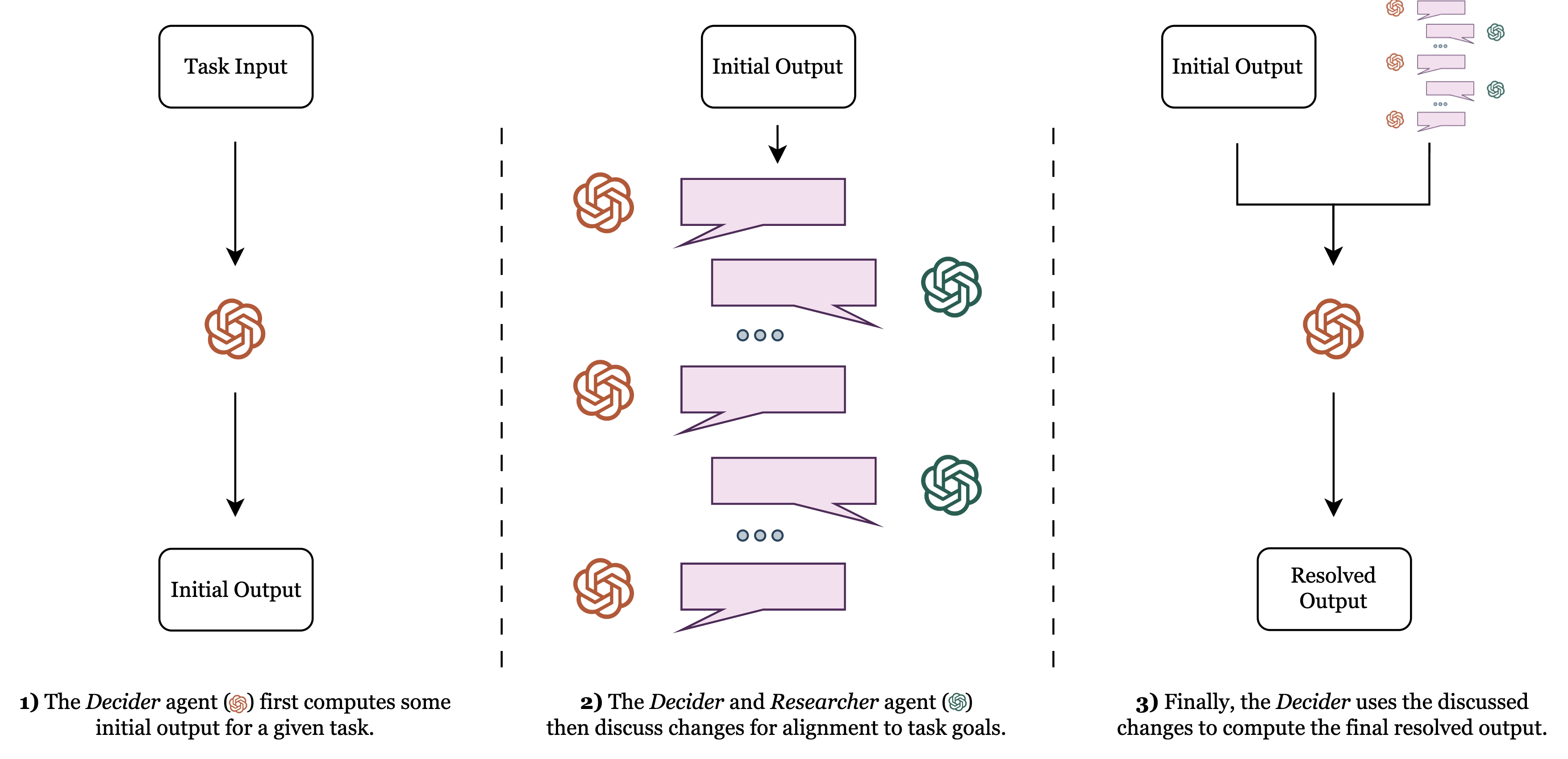
- 연구자(연구자는 중요한 문제 구성요소를 식별하고 의사결정자(Decider)가 정보를 통합하여 최종 출력을 생성하는 두 에이전트 대화 프레임워크를 제안한다.
- 초기 의사결정자 생성 출력 후 연구자가 차이점을 강조하고 의사결정자가 공유 스크래치패드를 업데이트하는 반복 대화를 사용한다.
- 연구자에 전적으로 의존하지 않으면서 최종 판단을 내리도록 의사결정자를 허용하고, 역할 정의된 반복적 다듬기를 가능하게 한다.
- DERA를 의학 대화 요약, 치료 계획 생성 및 개방형 의학 질의 응답의 세 가지 작업에 적용한다.
- 작업 특화 프롬프트와 제한된 대화 길이로 GPT-4를 활용하여 반복 보정을 이끌어낸다(예시 프롬프트 및 프롬프트 정제 설명).
- 손상된 요약의 수정 및 계획의 완전성을 평가하기 위해 의사 평가자 등 인간 전문가 평가와 정량적 지표(GPT-F1)를 제공한다.
실험 결과
연구 질문
- RQ1두 에이전트 대화(연구자 및 의사결정자)가 기저 GPT-4 프롬프트에 비해 임상 LLM 출력의 사실적 완전성을 향상시키고 현혹을 줄일 수 있는가?
- RQ2DERA가 임상 환경에서 장문 출력(요약 및 치료 계획)에서 단문형 개방형 QA보다 일관되게 향상시킬 수 있는가?
- RQ3대화를 통한 반복적 오류 수정이 의학 요약의 합성된 손상을 어느 정도 교정할 수 있는가?
- RQ4질문을 비다지선다형으로 재구성했을 때 개방형 의학 QA 데이터셋에서 DERA의 성능은 어떠한가?
- RQ5모델 기반 의학 QA 연구를 촉진하기 위한 개방형 MedQA 데이터 공개의 잠재력은 무엇인가?
주요 결과
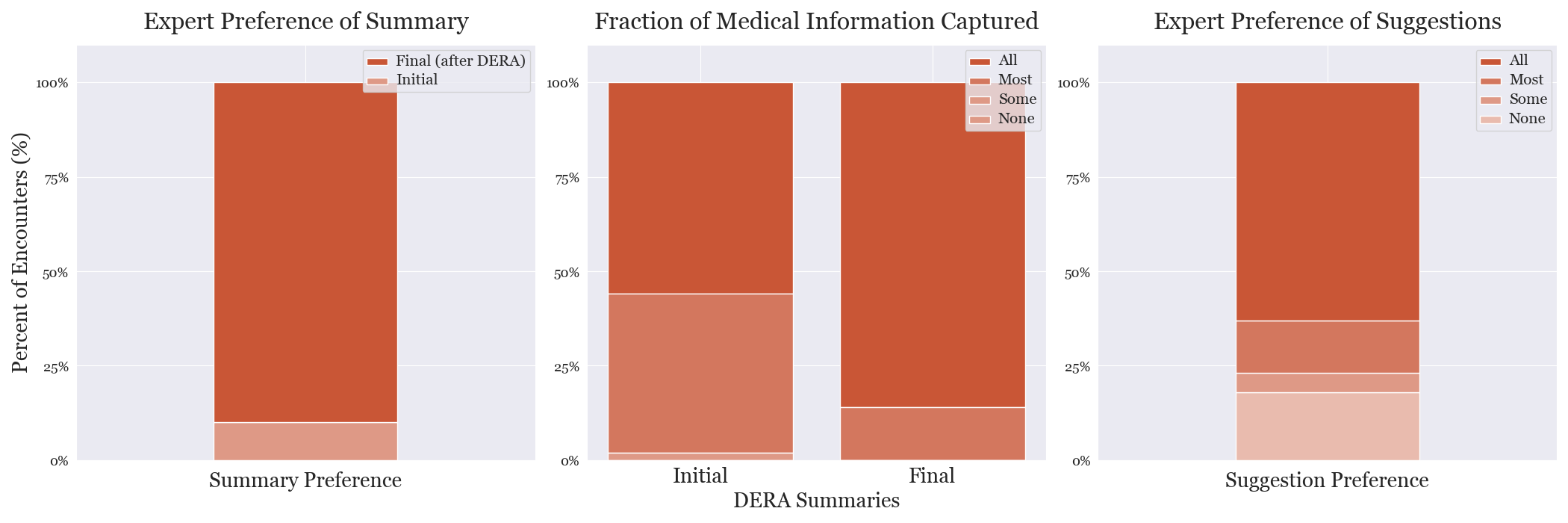
- DERA가 의사 전문의 선호도에 따라 의료 대화 요약에서 기본 GPT-4를 능가한다.
- DERA가 생성한 요약은 의사들이 초기 GPT-4 출력보다 더 많은 관련 의학 정보를 포착한다고 평가한다.
- DERA가 치료 계획 생성을 개선하고, 의사들이 최종 DERA 계획을 초기 GPT-4 계획보다 선호하며 완전성을 더 높게 평가한다.
- 손상된 요약을 이용한 정량적 평가에서 DERA가 낮음/중간/높음 손상 수준에서 GPT-F1 점수를 크게 향상시킨다.
- DERA가 개방형 MedQA 유사 QA에서 거의 전문가 수준의 성능을 달성하여 대화 기반 정제가 지식 추론 과제에도 확장될 수 있음을 시사한다.
- 저자들은 DERA를 이용한 의학 QA 연구를 촉진하기 위해 개방형 MEDQA 데이터세트를 공개한다.
이 논문 읽기
누빈트 뷰어에서 원문을 열고, 읽으면서 궁금한 곳을 바로 물어보세요.
누빈트에서 이 논문 읽기이 리뷰는 AI가 논문 원문을 바탕으로 만들었습니다. 인용하기 전에 원문을 확인해 주세요.