
[논문 리뷰] Designing BERT for Convolutional Networks: Sparse and Hierarchical Masked Modeling
SparK는 계층적 UNet 유사 디코더를 사용한 희소 마스킹을 도입하여 컨벌루션 네트워크에서 BERT 스타일의 마스킹 모델링을 가능하게 하며, 백본 변경 없이 ImageNet, COCO 탐지 및 분할에서 강력한 성능 향상을 달성한다.
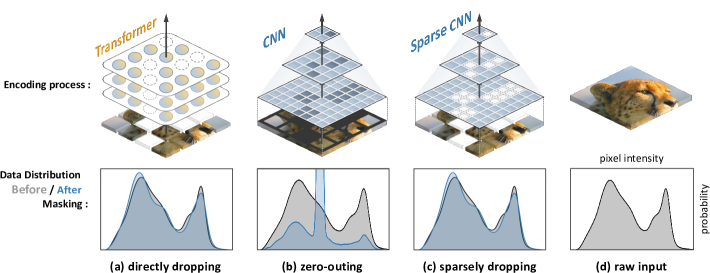
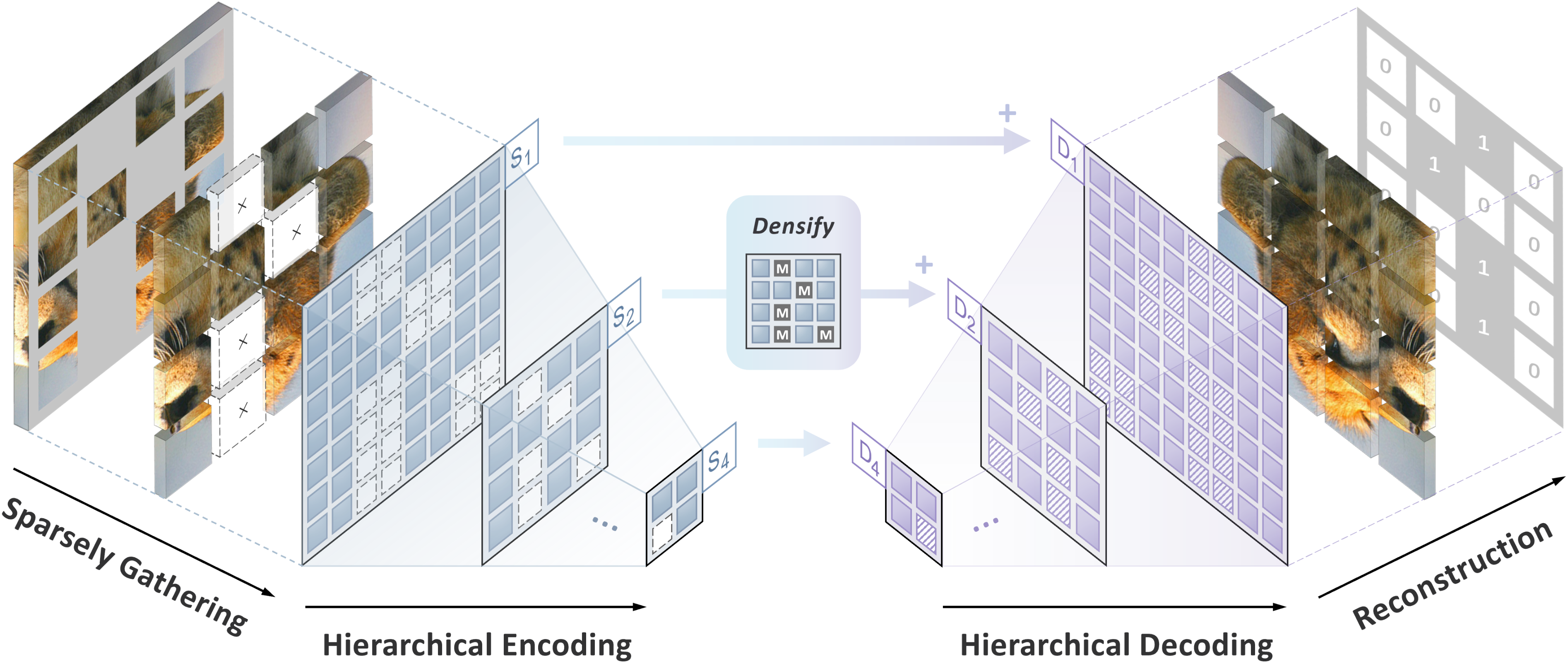
We identify and overcome two key obstacles in extending the success of BERT-style pre-training, or the masked image modeling, to convolutional networks (convnets): (i) convolution operation cannot handle irregular, random-masked input images; (ii) the single-scale nature of BERT pre-training is inconsistent with convnet's hierarchical structure. For (i), we treat unmasked pixels as sparse voxels of 3D point clouds and use sparse convolution to encode. This is the first use of sparse convolution for 2D masked modeling. For (ii), we develop a hierarchical decoder to reconstruct images from multi-scale encoded features. Our method called Sparse masKed modeling (SparK) is general: it can be used directly on any convolutional model without backbone modifications. We validate it on both classical (ResNet) and modern (ConvNeXt) models: on three downstream tasks, it surpasses both state-of-the-art contrastive learning and transformer-based masked modeling by similarly large margins (around +1.0%). Improvements on object detection and instance segmentation are more substantial (up to +3.5%), verifying the strong transferability of features learned. We also find its favorable scaling behavior by observing more gains on larger models. All this evidence reveals a promising future of generative pre-training on convnets. Codes and models are released at https://github.com/keyu-tian/SparK.
연구 동기 및 목표
- Identify why BERT-style pre-training struggles for convnets and how to adapt masked modeling to irregular masked inputs.
- Develop a generative pre-training framework that works natively with convolutional backbones without modifications.
- Incorporate multi-scale hierarchical decoding to leverage convnets’ hierarchy for image reconstruction.
- Demonstrate transferability of learned features to downstream tasks like classification, object detection, and segmentation.
제안 방법
- Mask images patch-wise and gather unmasked patches into a sparse 3D-like representation for sparse convolution encoding.
- Use a UNet-inspired hierarchical decoder to reconstruct images from multi-scale encoded features by densifying sparse maps with mask embeddings.
- Optimize with an L2 reconstruction loss on masked patches, enabling end-to-end pre-training of the encoder while discarding the decoder at fine-tuning.
- Show that SparK can be applied to any convnet backbone (e.g., ResNet, ConvNeXt) without backbone modifications.
- Experiment with 1.28M ImageNet-1K unlabeled images, 1600 pretraining epochs, 60% mask ratio, 32 patch size, and LAMB optimizer.
실험 결과
연구 질문
- RQ1Can convnets be effectively pre-trained with BERT-style masked modeling without backbone changes?
- RQ2How can irregular masked inputs be handled in convnets without distribution shift or loss of masking effectiveness?
- RQ3Does hierarchical (multi-scale) decoding improve reconstruction and learned representations for convnets?
- RQ4Do convnet-based pre-trained features transfer to downstream tasks such as object detection and instance segmentation as well as or better than transformer-based methods?
주요 결과
- SparK outperforms state-of-the-art contrastive and transformer-based masked modeling on ImageNet when using convnet backbones, with around +1.0% top-1 gains for ConvNeXt-S/B and larger gains for larger models.
- On COCO object detection and instance segmentation, SparK yields up to +3.5% AP improvements over baselines.
- SparK demonstrates favorable scaling, with larger models showing greater gains over non-pretrained counterparts.
- SparK achieves overall superiority among self-supervised methods while being the only generative pre-training approach for convnets in the reported comparisons.
이 논문 읽기
누빈트 뷰어에서 원문을 열고, 읽으면서 궁금한 곳을 바로 물어보세요.
누빈트에서 이 논문 읽기이 리뷰는 AI가 논문 원문을 바탕으로 만들었습니다. 인용하기 전에 원문을 확인해 주세요.