
[논문 리뷰] Diffusion Model-Augmented Behavioral Cloning
이 논문은 행동 복제(BC)와 확산 모델을 조합하여 전문가 데이터의 조건부 $p(a|s)$ 및 결합 $p(s,a)$ 분포를 함께 학습하는 새로운 암시 학습 프레임워크인 Diffusion Model-Augmented Behavioral Cloning(DBC)을 제안한다. BC 손실과 전문가 데이터에 일치하도록 행동을 유도하는 확산 모델 손실을 동시에 최적화함으로써, DBC는 연속 제어 과제에서 최신 기술 수준(SOTA) 성능을 달성하며, 특히 제한된 전문가 데이터를 가진 경우에 Diffusion Policy 및 BC와 같은 베이스라인을 능가한다.
Imitation learning addresses the challenge of learning by observing an expert's demonstrations without access to reward signals from environments. Most existing imitation learning methods that do not require interacting with environments either model the expert distribution as the conditional probability p(a|s) (e.g., behavioral cloning, BC) or the joint probability p(s, a). Despite the simplicity of modeling the conditional probability with BC, it usually struggles with generalization. While modeling the joint probability can improve generalization performance, the inference procedure is often time-consuming, and the model can suffer from manifold overfitting. This work proposes an imitation learning framework that benefits from modeling both the conditional and joint probability of the expert distribution. Our proposed Diffusion Model-Augmented Behavioral Cloning (DBC) employs a diffusion model trained to model expert behaviors and learns a policy to optimize both the BC loss (conditional) and our proposed diffusion model loss (joint). DBC outperforms baselines in various continuous control tasks in navigation, robot arm manipulation, dexterous manipulation, and locomotion. We design additional experiments to verify the limitations of modeling either the conditional probability or the joint probability of the expert distribution, as well as compare different generative models. Ablation studies justify the effectiveness of our design choices.
연구 동기 및 목표
- 행동 복제(BC)의 일반화 한계를 해결하기 위해, 훈련 안정성은 유지하면서도 분포 외 상태에서 어려움을 겪는 문제를 해결한다.
- 암시 학습에서 결합 확률 모델링의 비효율성과 다양체 과적합 문제를 해결한다.
- 조건부 모델링($p(a|s)$)의 효율성과 결합 모델링($p(s,a)$)의 일반화 이점을 하나의 프레임워크에서 통합한다.
- 환경 상호작용 없이도 확산 모델을 활용해 정책 학습을 향상시키는 방법을 개발한다.
- 확산 모델을 통한 결합 모델링의 효과를 실증적으로 검증한다.
제안 방법
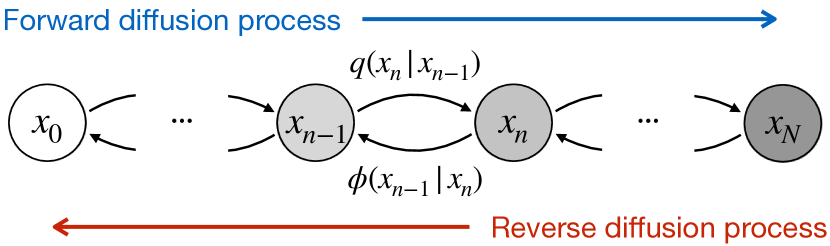
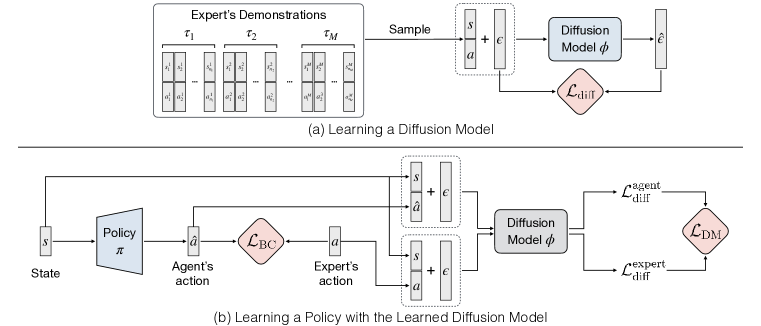
- 프레임워크는 표준 BC 손실과 예측 행동이 전문가 분포와 일치하도록 유도하는 새로운 확산 모델 손실을 동시에 최소화하도록 정책을 훈련한다.
- 확산 모델은 전문가 데이터의 상태-행동 쌍의 가능도를 추정하여, 전문가 데이터의 결합 분포 $p(s,a)$를 모델링한다.
- 확산 손실 $\mathcal{L}_{\text{diff}}$ 는 전문가 데이터 $(s,a)$ 와 예측 행동 $(s,\hat{a})$ 에 대해 계산되며, 대조적 목적 함수를 사용한다: $\mathcal{L}_{\text{DM}} = \mathbb{E}_{(s,a)\sim D,\hat{a}\sim\pi(s)}[\max(\mathcal{L}_{\text{diff}}^{\text{agent}} - \mathcal{L}_{\text{diff}}^{\text{expert}}, 0)]$.
- 최종 목적함수는 하이퍼파rameter $\lambda$ 를 통해 BC 손실과 확산 손실의 기여도를 균형 잡는다.
- 이 방법은 내비게이션, 로봇 암만지, 로코모션을 포함한 연속 제어 과제에서 평가되었으며, 전체 데이터셋과 감소된 데이터셋 크기를 모두 사용하였다.
- 제거 분석은 다양한 생성 모델을 비교하고 하이퍼파rameter 및 데이터 희소성의 영향을 분석한다.
실험 결과
연구 질문
- RQ1환경 상호작용 없이도 전문가 데이터의 조건부 및 결합 분포를 함께 모델링하면 암시 학습의 일반화 능력이 향상되는가?
- RQ2낮은 데이터 환경에서 제안된 확산 모델 보강 BC 프레임워크가 표준 BC 및 확산 정책 베이스라인보다 어떻게 성능을 냈는가?
- RQ3확산 모델을 사용해 $p(s,a)$ 를 모델링할 경우 정책의 일반화 능력과 데이터셋 크기 변화에 대한 강건성에 어떤 영향을 미치는가?
- RQ4확산 손실 및 하이퍼파rameter $\lambda$ 와 같은 프레임워크의 다양한 구성 요소가 성능에 어떤 영향을 미치는가?
- RQ5이 방법은 BC 및 결합 모델링 접근법에서 흔히 발생하는 다양체 과적합 및 누적 오차 문제를 완화하는가?
주요 결과
- DBC는 내비게이션, 로봇 암만지, 로코모션 과제에서 BC, Implicit BC, Diffusion Policy를 모두 능가하여 가장 높은 성공률를 기록했다.
- 미로 환경에서 전체 데이터셋(100%)을 사용할 경우 DBC는 95.4% ± 1.7%의 성공률를 기록했으며, Diffusion Policy(95.5% ± 1.9%)를 능가하고 BC(92.1% ± 3.6%)를 크게 앞섰다.
- 전체 데이터셋의 25%만 사용했을 경우 DBC는 71.2% ± 3.9%의 성공률를 기록했으며, Diffusion Policy(72.7% ± 9.2%)를 능가했고, 데이터 부족에 대한 강건성도 높았다.
- 제거 분석 결과, 확산 손실이 성능 향상에 핵심적인 역할을 하며, 다양한 설정에서 하이퍼파rameter $\lambda$ 에 대해 강건함을 입증했다.
- 특히 데이터가 적은 환경에서 DBC는 BC 및 Implicit BC가 심한 성능 저하를 보이는 것과 대비해 뛰어난 일반화 능력을 보였다.
- 결과는 확산 모델을 통한 조건부 및 결합 모델링의 통합이 샘플 효율성과 정책 성능 향상에 모두 기여함을 검증한다.
이 논문 읽기
누빈트 뷰어에서 원문을 열고, 읽으면서 궁금한 곳을 바로 물어보세요.
누빈트에서 이 논문 읽기이 리뷰는 AI가 논문 원문을 바탕으로 만들었습니다. 인용하기 전에 원문을 확인해 주세요.