
[논문 리뷰] Dimension-agnostic inference using cross U-statistics
이 논문은 크로스 U-통계량을 사용한 차원에 관계없는 추론 프레임워크를 제안하며, 표본 크기 $n$에 대해 차원 $d$가 어떻게 증가하는지에 관계없이 정규 근사 분포를 달성한다. 샘플 분할, 자기정규화, 검정 통계량의 변분 표현을 활용하여 고정, 고차원, 초고차원 설정 모두에서 유효한 추론을 제공하며, 차원에 특화된 U-통계량의 성능에 비해 $√{2}$ 요인 이내로 유사한 검정력 확보.
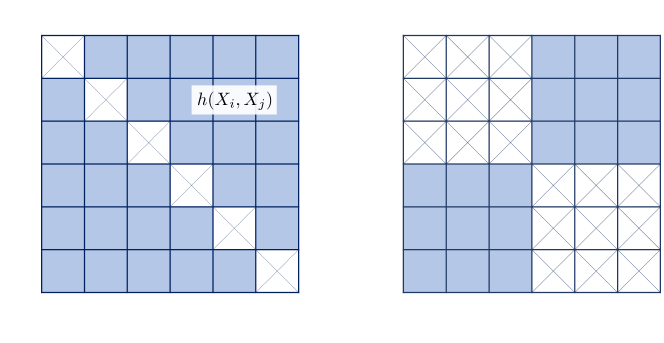
Classical asymptotic theory for statistical inference usually involves calibrating a statistic by fixing the dimension $d$ while letting the sample size $n$ increase to infinity. Recently, much effort has been dedicated towards understanding how these methods behave in high-dimensional settings, where $d$ and $n$ both increase to infinity together. This often leads to different inference procedures, depending on the assumptions about the dimensionality, leaving the practitioner in a bind: given a dataset with 100 samples in 20 dimensions, should they calibrate by assuming $n \gg d$, or $d/n \approx 0.2$? This paper considers the goal of dimension-agnostic inference; developing methods whose validity does not depend on any assumption on $d$ versus $n$. We introduce an approach that uses variational representations of existing test statistics along with sample splitting and self-normalization to produce a refined test statistic with a Gaussian limiting distribution, regardless of how $d$ scales with $n$. The resulting statistic can be viewed as a careful modification of degenerate U-statistics, dropping diagonal blocks and retaining off-diagonal blocks. We exemplify our technique for some classical problems including one-sample mean and covariance testing, and show that our tests have minimax rate-optimal power against appropriate local alternatives. In most settings, our cross U-statistic matches the high-dimensional power of the corresponding (degenerate) U-statistic up to a $\sqrt{2}$ factor.
연구 동기 및 목표
- 표본 크기 $n$에 비해 차원 $d$의 크기에 대한 가정에 따라 캘리브레이션 방법을 선택해야 하는 실무적 딜레마를 해결하기 위해.
- 차원 $d$가 표본 크기 $n$에 대해 어떻게 증가하는지에 관계없이 항상 유효한 단일 추론 절차를 개발하기 위해.
- 차원 $d$와 표본 크기 $n$의 증가 비율을 사전에 알지 못하더라도 다양한 점근적 설정에서 최소 최대 속도 최적의 검정력을 달성하기 위해.
- 변분 표현과 샘플 분할을 활용한 차원에 관계없는 추론을 위한 일반화 가능한 방법론적 프레임워크를 제안하기 위해.
제안 방법
- 샘플 분할을 사용하여 데이터를 상호배타적인 부분집합으로 나누어 조건부 기대값을 독립적으로 추정한다.
- U-통계량에 자기정규화를 적용하여 분산을 안정화하고 정규 분포로의 수렴을 보장한다.
- 검정 통계량의 변분 표현을 활용하여 유사성과 차원에 대한 의존성을 분리한다.
- 대각 블록을 제거하고 오직 비대각 블록에 해당하는 U-통계량 성분만 유지하여 정교한 검정 통계량을 구성한다.
- 일반적인 $d_n/n$ 척도 하에서 크로스 U-통계량의 점근적 정규성을 도출하며, 고정, 고차원, 초고차원 설정 모두 포함.
- 타입 I 및 타입 II 오류를 균일하게 제어하기 위해 마르코프 및 체비셰프 부등식을 정교한 농도 경계와 결합한다.
실험 결과
연구 질문
- RQ1차원 $d_n$이 표본 크기 $n$에 대해 고정, 고차원, 초고차원 설정 모두에서 증가하는 방식에 관계없이 단일 통계적 검정이 점근적으로 유효성을 유지할 수 있는가?
- RQ2차원의 실제 크기를 사전에 알지 못하더라도, 차원에 적응하는 최적의 검정력을 갖는 추론 절차를 설계할 수 있는가?
- RQ3철저한 구성으로 인해 $d/n$ 설정에 관계없이 검정 통계량의 점근적 분포를 근사적으로 정규 분포로 만들 수 있는가?
- RQ4차원에 관계없는 추론의 검정력은 차원에 특화된 U-통계량 방법과 비교해 어떻게 되는가?
- RQ5특정 검정 통계량을 넘어서, 차원에 관계없는 추론을 가능하게 하는 일반적인 방법론적 원칙은 무엇인가?
주요 결과
- 제안된 크로스 U-통계량은 모든 $d_n/n$ 척도 설정 하에서 정규 점근 분포를 달성하여 보편적인 캘리브레이션 가능.
- 차원에 대한 가정과 관계없이 수준 $\alpha$ 검정과 $1-\alpha$ 신뢰구간의 점근적 유효성을 보장.
- 지역 대립가설에 대해 최소 최대 속도 최적의 검정력을 유지하며, 열거된 U-통계량의 성능에 비해 $√{2}$ 요인 이내로 유사.
- 모든 설정에서 타입 I 오류가 균일하게 제어되며, $\min\{m_1, m_2\} \to \infty$일 때 타입 II 오류는 사라진다.
- $d_n$ 또는 $n$에 대한 $d_n$의 증가율을 알지 못하더라도 균일한 점근적 유효성을 확보.
- 농도 불등식과 변분 표현을 통한 이론적 보장으로 다양한 고차원 설정에서의 강건성을 확보.
이 논문 읽기
누빈트 뷰어에서 원문을 열고, 읽으면서 궁금한 곳을 바로 물어보세요.
누빈트에서 이 논문 읽기이 리뷰는 AI가 논문 원문을 바탕으로 만들었습니다. 인용하기 전에 원문을 확인해 주세요.