
[논문 리뷰] DisDet: Exploring Detectability of Backdoor Attack on Diffusion Models
이 논문은 독성 노이즈 입력과 양성 노이즈 입력 간의 분포 차이를 활용하여 확산 모델에서 백도어 트리거를 탐지하고 회피하는 데 중점을 둔 새로운 프레임워크인 DisDet을 소개한다. 이는 100% 탐지 정확도를 달성하는 저비용 탐지 기반 메커니즘과 동시에 거의 100%의 통과율로 탐지 회피가 가능한 스텔스 트리거 설계를 제공하며, 다양한 데이터셋과 모델에서 높은 공격 및 양성 생성 품질을 유지한다.
In the exciting generative AI era, the diffusion model has emerged as a very powerful and widely adopted content generation and editing tool for various data modalities, making the study of their potential security risks very necessary and critical. Very recently, some pioneering works have shown the vulnerability of the diffusion model against backdoor attacks, calling for in-depth analysis and investigation of the security challenges of this popular and fundamental AI technique. In this paper, for the first time, we systematically explore the detectability of the poisoned noise input for the backdoored diffusion models, an important performance metric yet little explored in the existing works. Starting from the perspective of a defender, we first analyze the properties of the trigger pattern in the existing diffusion backdoor attacks, discovering the important role of distribution discrepancy in Trojan detection. Based on this finding, we propose a low-cost trigger detection mechanism that can effectively identify the poisoned input noise. We then take a further step to study the same problem from the attack side, proposing a backdoor attack strategy that can learn the unnoticeable trigger to evade our proposed detection scheme. Empirical evaluations across various diffusion models and datasets demonstrate the effectiveness of the proposed trigger detection and detection-evading attack strategy. For trigger detection, our distribution discrepancy-based solution can achieve a 100\% detection rate for the Trojan triggers used in the existing works. For evading trigger detection, our proposed stealthy trigger design approach performs end-to-end learning to make the distribution of poisoned noise input approach that of benign noise, enabling nearly 100\% detection pass rate with very high attack and benign performance for the backdoored diffusion models.
연구 동기 및 목표
- 기존 연구에서 다루지 않은 중요한 메트릭이지만, 확산 모델에서 백도어 트리거의 탐지 가능성에 체계적으로 접근하는 것.
- 백도어 공격에 대비하기 위해 노이즈 입력의 분포 차이를 기반으로 한 저비용이고 효과적인 트리거 탐지 기반 메커니즘을 개발하는 것.
- 백도어 트리거를 설계하여 양성 노이즈와의 분포 차이를 최소화함으로써 탐지 회피를 가능하게 하되, 높은 공격 성능과 양성 생성 품질을 유지하는 것.
- 다양한 확산 모델 아키텍처와 데이터셋을 대상으로 제안된 탐지 및 공격 회피 전략의 성능을 평가하여, 강건성과 일반화 능력을 확보하는 것.
제안 방법
- 입력 노이즈의 통계적 분포를 비교하여 독성 입력을 식별할 수 있는 분포 차이 기반 탐지 기반 메커니즘을 제안하며, 기울기 기반 최적화를 위한 미분 가능한 히스토그램 근사치를 사용한다.
- 트리거 학습 중에 독성 및 정상 노이즈 입력 간의 분포 격차를 최소화하기 위해 PDD(Pairwise Distribution Discrepancy) 손실 함수를 도입한다.
- 비미분 가능한 분포 차이 측정치의 대체로 사용 가능한 미분 가능한 히스토그램 함수 $ h_d(\cdot) $ 를 활용하여 트리거의 엔드 투 엔드 학습을 가능하게 한다.
- 독성 입력에서의 노이즈 예측 능력을 향상시켜 이미지 품질과 생성 정밀도를 향상시키기 위해 노이즈 일관성(NC) 손실을 통합한다.
- PDD 및 NC 손실을 동시에 사용하여 트리거 패턴을 엔드 투 엔드로 학습함으로써 스텔스성과 성능을 동시에 최적화한다.
- CIFAR-10, CelebA, ImageNet 데이터셋을 사용하여 다양한 확산 모델 아키텍처에서 탐지 및 공격 회피 성능을 평가한다.
실험 결과
연구 질문
- RQ1입력 노이즈의 분포 차이가 확산 모델에서 백도어 트리거를 탐지하는 데 신뢰할 수 있는 지표로 기능할 수 있는가?
- RQ2기존의 백도어 공격에서 사용된 독성 입력을 탐지하기 위해 분포 차이 기반 탐지 기반 메커니즘이 얼마나 효과적인가?
- RQ3백도어 트리거를 설계하여 양성 노이즈와의 분포 차이를 최소화함으로써 탐지 회피가 가능한가?
- RQ4스텔스 트리거는 탐지 회피를 하면서도 얼마나 높은 공격 성공률과 양성 생성 품질을 유지할 수 있는가?
주요 결과
- 제안된 분포 차이 기반 탐지 기반 메커니즘이 이전 연구에서 사용된 모든 백도어 트리거에 대해 100%의 탐지 정확도를 달성하여 높은 신뢰성을 입증한다.
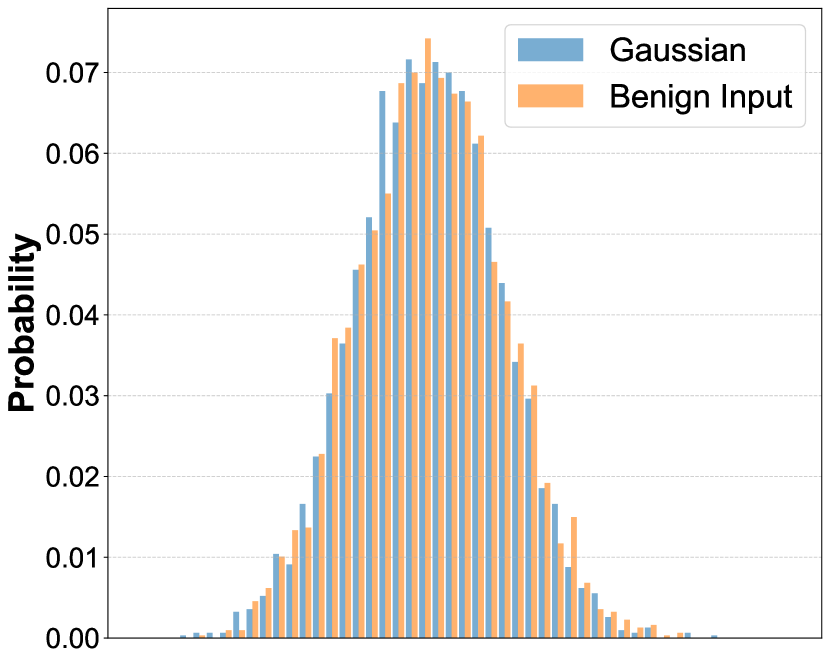
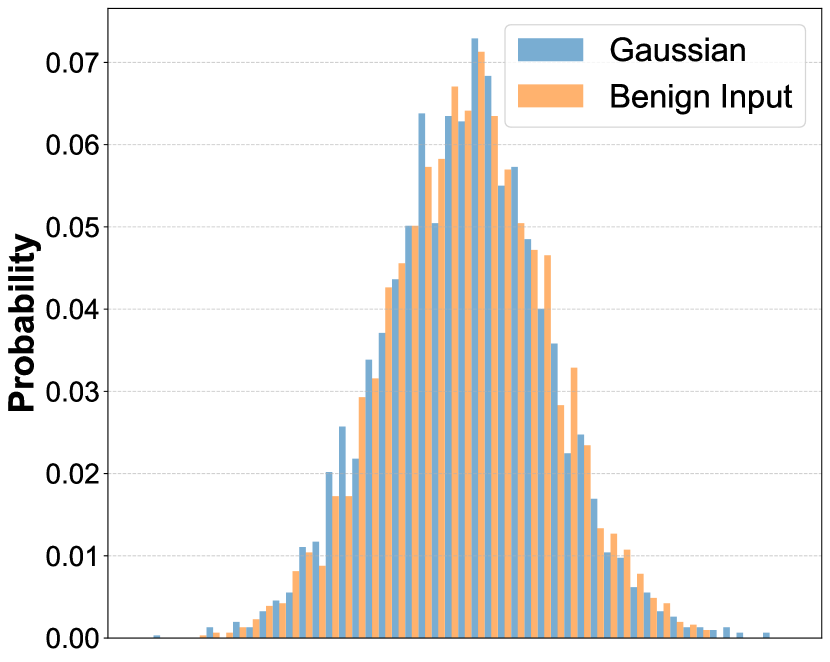
- PDD 최적화 트리거 설계는 CIFAR-10에서 PDD 점수를 0.023으로 낮춰 분포 차이를 크게 줄이고 스텔스성을 향상시킨다.
- 학습 과정 중에 트리거 값의 절대 평균이 증가하며, 이는 개선된 가우시안 유사 분포와 감소된 탐지 가능성과 관련이 있다.
- NC 손실의 포함으로 기준 대비 FID 점수를 최대 130.8점 감소시켜, 양성 및 공격 설정 모두에서 이미지 품질을 크게 향상시킨다.
- 스텔스 트리거의 탐지 통과율은 거의 100%에 도달하여, 높은 성능을 유지하면서도 탐지 회피에 효과적임을 확인한다.
- 시각화 결과는 PDD 최적화 트리거가 분포 측면에서 정상 가우시안 노이즈와 구별되지 않는 독성 입력을 생성함을 확인한다.
이 논문 읽기
누빈트 뷰어에서 원문을 열고, 읽으면서 궁금한 곳을 바로 물어보세요.
누빈트에서 이 논문 읽기이 리뷰는 AI가 논문 원문을 바탕으로 만들었습니다. 인용하기 전에 원문을 확인해 주세요.