
[논문 리뷰] Disentangling the Faraday rotation sky
이 논문은 외성간 파라데이 회절 측정값, 펄서 분산 측정값, 열 전자 추적자(Hα, 브레머스트라할루션)를 종합적으로 분석함으로써 정보장 이론을 활용해 첫 번째로 천구 전체에 걸친 선형 경로 평균화된 은하수 자기장의 지도를 제시한다. 이 방법은 $B_\parallel$와 전자 밀도 $n_{\mathrm{th}}$를 분리하여, 천구 전체 평균 자기장 강도가 1.1 μG이며, 고위도에서 기존 모델과 일치하는 세밀한 분산 측정값 지도를 도출한다. 그러나 은하수 디스크의 체계적 오차에 영향을 받는다.
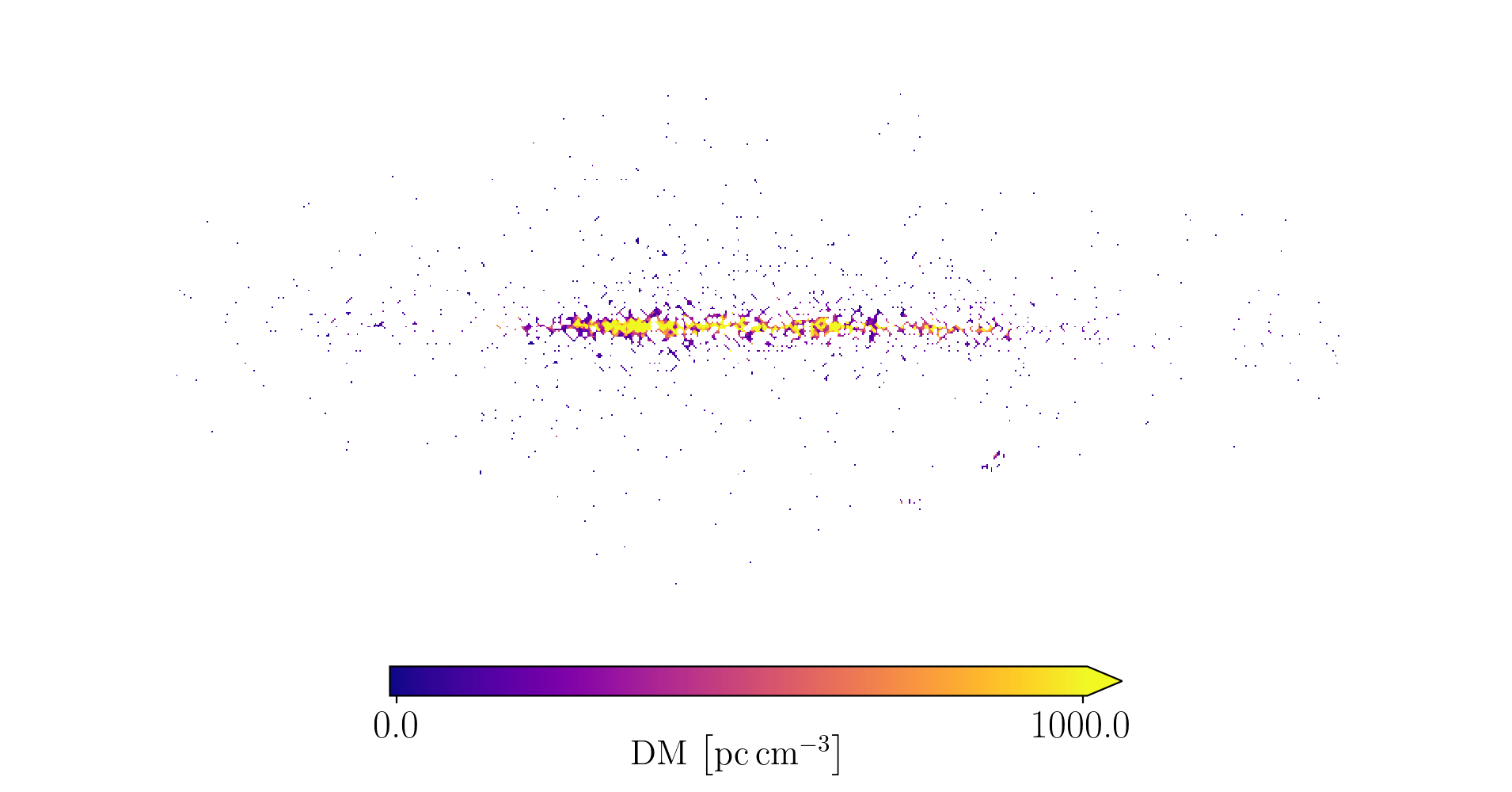
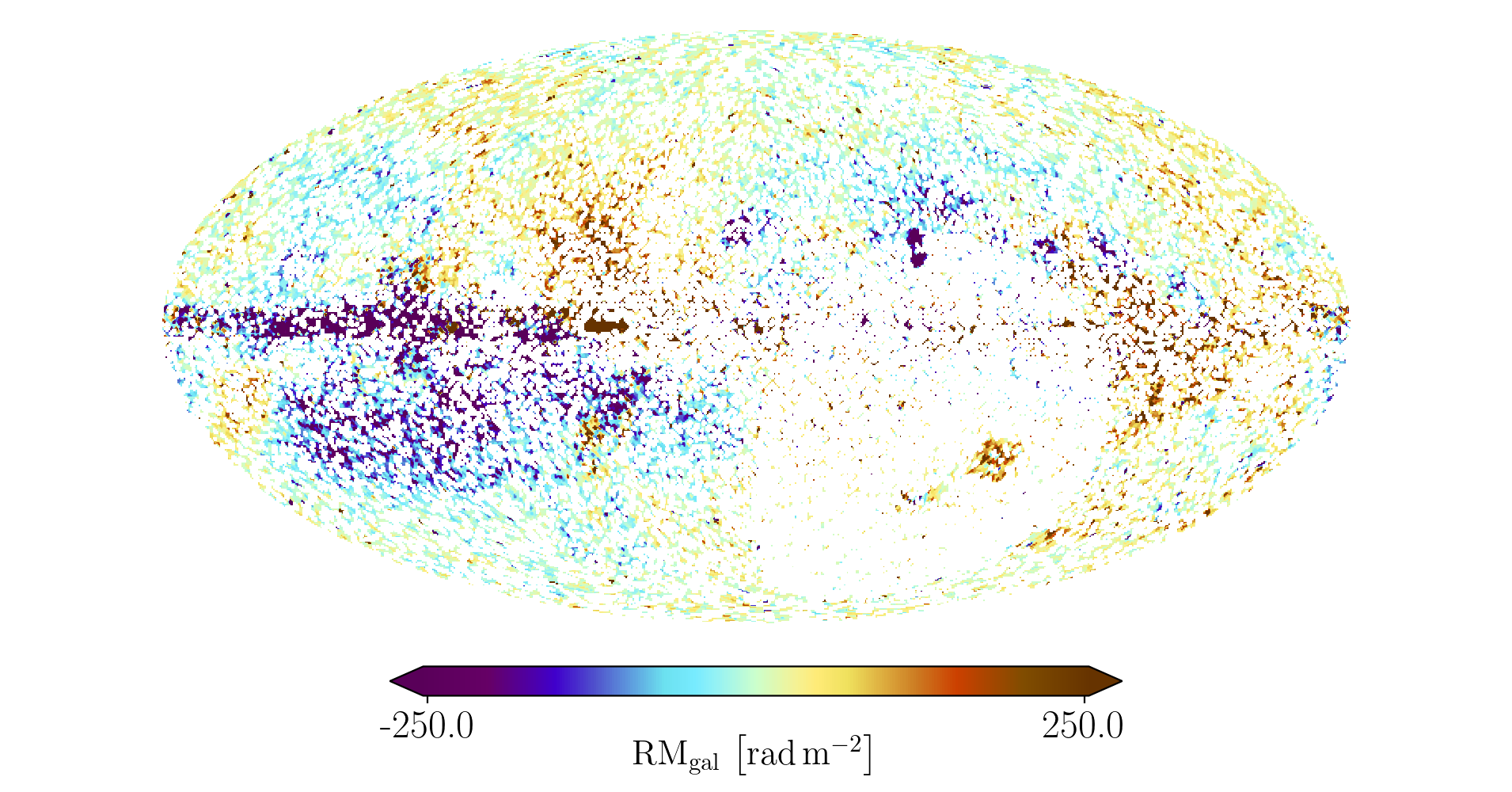
Magnetic fields permeate the diffuse interstellar medium (ISM) of the Milky Way, and are essential to explain the dynamical evolution and current shape of the Galaxy. Magnetic fields reveal themselves via their influence on the surrounding matter, and as such are notoriously hard to measure independently of other tracers. In this work, we attempt to disentangle an all sky map of the line-of-sight parallel component of the Galactic magnetic field from the Faraday effect, utilizing several tracers of the Galactic thermal electron density. Additionally, we aim to produce a Galactic electron dispersion measure map and quantify several tracers of the structure of the ionized medium of the Milky Way. We rely on compiled catalogs of extragalactic Faraday rotation measures and Galactic pulsar dispersion measures, a well as data on bremsstrahlung and the hydrogen $α$ spectral line to trace the ionized medium of the Milky Way. We present the first full sky map of the line-of-sight averaged Galactic magnetic field. Within this map, we find LoS parallel and LoS-averaged magnetic field strengths of up to 4 $μ$G, with an all-sky root-mean-square of 1.1 $μ$G, which is consistent with previous local measurements and global magnetic field models. Additionally, we produce a detailed electron dispersion measure map, which agrees with already existing parametric models at high latitudes, but suffers from systematic effects in the disk. Further analysis of our results with regard to the 3D structure of $n_{th}$ reveals that it follows a Kolmogorov-type turbulence for most of the sky. From the reconstructed dispersion measure and emission measure maps we construct several tracers of variability of $n_{th}$ along the LoS.
연구 동기 및 목표
- 다양한 천체물리적 추적자를 종합적으로 분석함으로써 파라데이 효과에 의해 얽힌 은하수 자기장을 분리해내는 것.
- 선형 경로 평균 자기장 강도 $B_\parallel$에 대한 고해상도의 천구 전체 지도를 제작하는 것.
- 세밀한 전자 분산 측정값(DM) 지도를 구축하고 기존 모델과의 일치성을 평가하는 것.
- 열 전자 밀도 $n_{\mathrm{th}}$의 3차원 구조와 난류 특성을 정량화하는 것.
- 향후 은하수 자기장과 이온화된 ISM의 3차원 재구성에 대한 로드맵을 설정하는 것.
제안 방법
- 소음이 많고, 완전하지 않으며, 고차원적인 데이터를 다루기 위해 정보장 이론, 즉 베이지안 추론 프레임워크를 활용한다.
- 외성간 파라데이 회절 측정값(RM), 펄서 분산 측정값(DM), 열 전자 추적자(Hα, 브레머스트라할루션)를 입력 데이터로 사용한다.
- 통합 통계적 추론을 적용하여 엉켜 있는 파라데이 깊이 $\phi$에서 $B_\parallel$와 $n_{\mathrm{th}}$를 분리한다.
- 각도 스펙트럼과 변환 계수 $\mathrm{L_{DM^{2}/EM}}$ 및 $\varrho_{\mathrm{EM/DM}}$를 유도하여 전자 밀도 구조를 탐색한다.
- 관측된 등급 법 행동과 체계적 오차를 해석하기 위해 $n_{\mathrm{th}}$의 몽타주 3차원 모델을 구축한다.
- 특정 영역(예: Sh 2-27, Smith 고속 구름)에 대한 세부 컷아웃을 수행하여 국지적 일관성을 검증한다.
실험 결과
연구 질문
- RQ1선형 경로 평균화된 은하수 자기장 $B_\parallel$의 진정된 천구 전체 분포는 무엇인가?
- RQ2파라데이 깊이에서 $B_\parallel$와 $n_{\mathrm{th}}$가 뒤섞여 있을 때, 이를 어떻게 분리할 수 있는가?
- RQ3은하수 내 열 전자 밀도 $n_{\mathrm{th}}$의 3차원 구조는 무엇이며, Kolmogorov 유형 난류를 따르는가?
- RQ4추론된 분산 측정값 지도와 발광 측정값 지도는 기존의 매개변수 모델과 어떻게 비교되는가?
- RQ5재구성 과정에 영향을 주는 체계적 편향은 무엇이며, 향후 데이터와 모델링을 통해 어떻게 보완할 수 있는가?
주요 결과
- 선형 경로 평균 자기장 강도에 대한 첫 번째 천구 전체 지도가 제작되었으며, 천구 전체 평균 제곱근 강도는 1.1 μG이다.
- 국소적 영역에서는 자기장 강도가 최대 4 μG에 이르며, 이는 국소 측정값과 전역 모델과 일치한다.
- 분산 측정값 지도는 고위도에서 기존의 매개변수 모델과 일치하지만, 희박한 펄서 샘플링으로 인해 은하수 디스크에서 체계적 오차를 보인다.
- DM 천체의 각도 스펙트럼은 Kolmogorov 유형 난류 행동을 보이며, '하늘의 큰 등급 법칙'과 일치한다.
- 변환 계수 $\mathrm{L_{DM^{2}/EM}}$은 DM과 EM에 기여하는 효과적 경로 길이를 나타내며, 균일한 매질 근사에서 문헌 값과 일치한다.
- 계수 $\varrho_{\mathrm{EM/DM}}$은 선형 경로를 따라 평균 열 전자 밀도를 추정하며, 은하수에 대한 기대값과 일치한다.
이 논문 읽기
누빈트 뷰어에서 원문을 열고, 읽으면서 궁금한 곳을 바로 물어보세요.
누빈트에서 이 논문 읽기이 리뷰는 AI가 논문 원문을 바탕으로 만들었습니다. 인용하기 전에 원문을 확인해 주세요.