
[논문 리뷰] Do LLMs Understand User Preferences? Evaluating LLMs On User Rating Prediction
본 논문은 즉시 사용 가능한(off-the-shelf) LLM 및 미세 조정된 LLM을 이용한 사용자 평점 예측을 평가하고, MovieLens와 Amazon-Books 데이터셋에서 제로샷, 파샷, 파인튜닝 성능을 전통적 추천 알고리즘 baselines와 비교한다.
Large Language Models (LLMs) have demonstrated exceptional capabilities in generalizing to new tasks in a zero-shot or few-shot manner. However, the extent to which LLMs can comprehend user preferences based on their previous behavior remains an emerging and still unclear research question. Traditionally, Collaborative Filtering (CF) has been the most effective method for these tasks, predominantly relying on the extensive volume of rating data. In contrast, LLMs typically demand considerably less data while maintaining an exhaustive world knowledge about each item, such as movies or products. In this paper, we conduct a thorough examination of both CF and LLMs within the classic task of user rating prediction, which involves predicting a user's rating for a candidate item based on their past ratings. We investigate various LLMs in different sizes, ranging from 250M to 540B parameters and evaluate their performance in zero-shot, few-shot, and fine-tuning scenarios. We conduct comprehensive analysis to compare between LLMs and strong CF methods, and find that zero-shot LLMs lag behind traditional recommender models that have the access to user interaction data, indicating the importance of user interaction data. However, through fine-tuning, LLMs achieve comparable or even better performance with only a small fraction of the training data, demonstrating their potential through data efficiency.
연구 동기 및 목표
- 오프 더 셀프(off-the-shelf) LLM이 태스크 특화 학습 없이도 사용자 평점을 예측할 수 있는지 평가한다.
- LLMs를 Fair한 평가 설정에서 강력한 전통적 추천 베이스라인과 비교한다.
- 모델 크기와 데이터 효율성이 LLM 기반 평점 예측에 미치는 영향을 조사한다.
- 인간 인터랙션 데이터로 LLM을 미세 조정하는 것이 성능에 미치는 영향을 평가한다.
- 추천 태스크에서 LLM의 데이터 효율적 학습 체제를 탐구한다.
제안 방법
- 사용자 히스토리와 항목 메타데이터를 바탕으로 1–5 등급 예측 문제로 사용자 평점 예측을 형식화한다.
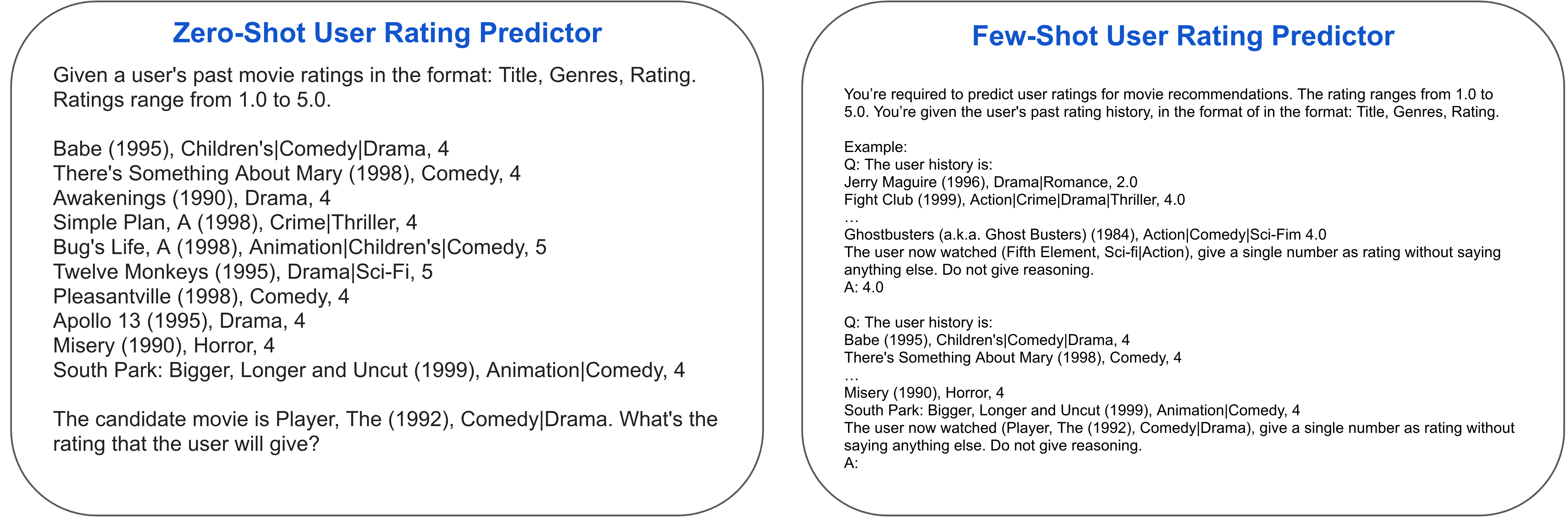
- 제로샷 및 파샷 프롬프트를 활용해 다양한 크기의 LLM에서 평점을 유도한다.
- 수치 평점 출력(예: 단일 숫자, 설명 없음)을 보장하기 위한 프롬프트 엔지니어링.
- 평점 예측을 위한 분류(5-class) 또는 회귀 목표로 Flan-T5 패밀리 모델(Base 및 XXL)을 미세 조정한다.
- 제로샷, 파샷, 미세 조정 LLM을 전통적 베이스라인(MF, MLP, Transformer-MLP) 및 단순 휴리스틱과 비교한다.
- MovieLens-1M 및 Amazon-Books(5-core) 데이터셋에서 RMSE, MAE, 및 AUC를 사용해 평가한다.
실험 결과
연구 질문
- RQ1RQ1: 오프 더 셀프 LLM이 제로샷 및 파샷 평점 예측에서 어느 정도 성능을 보이는가?
- RQ2RQ2: 공정한 설정에서 LLM과 전통적 추천 모델은 어떻게 비교되는가?
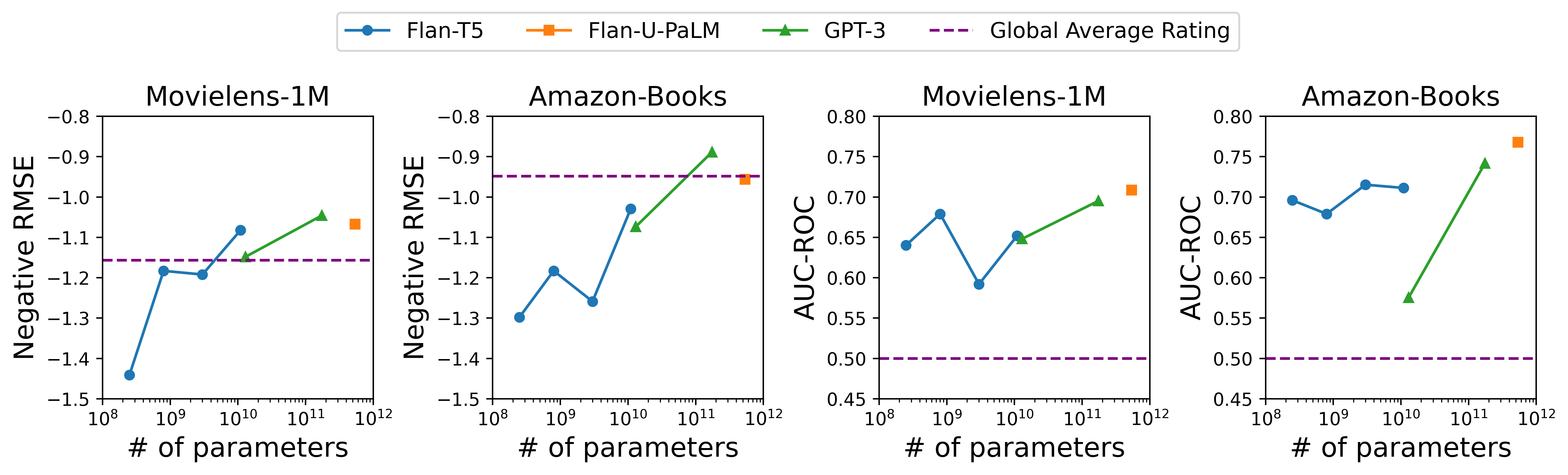
- RQ3RQ3: 모델 크기가 평점 예측에서 LLM의 성능에 어떤 영향을 미치는가?
- RQ4RQ4: LLM은 전통 모델보다 빠르게 수렴하거나 더 적은 데이터를 필요로 하는가?
주요 결과
- 제로샷 LLM은 100B 파라미터를 초과하는 크기에서 차가운 시작(cold-start) 설정에서 합리적인 추천을 제공하고 RMSE 및 AUC에서 일부 베이스라인에 필적하지만 일반적으로 상호작용 데이터 기반 방법보다 뒤따른다.
- 제로샷 및 파샷 LLM은 사용자-아이템 상호작용 데이터를 활용하는 감독 학습 추천 모델보다 성능이 미흡하다.
- 미세 조정된 LLM은 소량의 학습 데이터로도 강력한 베이스라인과 비교 가능하거나 더 나은 성능을 얻을 수 있어 데이터 효율적 가능성을 시사한다.
- Flan-T5-XXL의 미세 조정은 작은 변형 및 일부 베이스라인보다 일반적으로 더 나은 MAE 및 AUC를 얻는 경향이 있어 데이터세트 특화 학습의 이점을 강조한다.
- 데이터 효율성 분석에서 LLM은 RMSE 및 특히 AUC 측면에서 Transformer-MLP 베이스라인에 비해 더 적은 데이터로 수렴하는 경향을 나타낸다.
이 논문 읽기
누빈트 뷰어에서 원문을 열고, 읽으면서 궁금한 곳을 바로 물어보세요.
누빈트에서 이 논문 읽기이 리뷰는 AI가 논문 원문을 바탕으로 만들었습니다. 인용하기 전에 원문을 확인해 주세요.