
[논문 리뷰] Do Membership Inference Attacks Work on Large Language Models?
연구는 Pile에서 훈련된 대형 언어 모델에 대해 다수의 멤버십 추정(MIA) 공격을 체계적으로 평가하고, 도메인과 규모에 걸쳐 MIA 성능이 일반적으로 무작위에 가까움(랜덤에 근접)하다는 것을 발견하며, 데이터 중첩, 학습 역학, 분포 변동으로 인한 일부 예외가 있다.
Membership inference attacks (MIAs) attempt to predict whether a particular datapoint is a member of a target model's training data. Despite extensive research on traditional machine learning models, there has been limited work studying MIA on the pre-training data of large language models (LLMs). We perform a large-scale evaluation of MIAs over a suite of language models (LMs) trained on the Pile, ranging from 160M to 12B parameters. We find that MIAs barely outperform random guessing for most settings across varying LLM sizes and domains. Our further analyses reveal that this poor performance can be attributed to (1) the combination of a large dataset and few training iterations, and (2) an inherently fuzzy boundary between members and non-members. We identify specific settings where LLMs have been shown to be vulnerable to membership inference and show that the apparent success in such settings can be attributed to a distribution shift, such as when members and non-members are drawn from the seemingly identical domain but with different temporal ranges. We release our code and data as a unified benchmark package that includes all existing MIAs, supporting future work.
연구 동기 및 목표
- 다중 도메인과 규모에 걸친 대형 언어 모델(LLMs)의 사전 학습 데이터에 대한 기존 MIA의 효과를 평가한다.
- LLM 사전 학습에서 낮은 MIA 효과의 근본 원인을 식별하고 데이터 크기, 에폭, 도메인 중첩 등 요인을 분석한다.
- MIAs가 LLM에서 정보를 누출할 수 있는 시점과 그렇지 않은 시점을 이해하기 위한 통합 벤치마크와 분석 방법을 제시한다.
제안 방법
- Pile에서 훈련된 Pythia 및 Pythia-dedup 모델(매개변수 160M에서 12B까지)에 대해 다섯 가지 MIA(LOSS, reference-based, zlib entropy, neighborhood, min-k% probability)를 평가한다.
- 주 메트릭으로 AUC ROC를 사용하고, 보조 지표로 TPR@low-FPR를 활용하여 고신뢰도 성능을 평가한다.
- 모델 크기, 중복 제거(deduplication), 참조 모델 선택이 공격 효과성에 미치는 영향을 분석한다.
- 회원 데이터와의 비회원 데이터 중첩(n-gram 중첩)이 MIA 구분 가능성에 미치는 영향을 조사한다.
- 비회원의 시간적 변화와 회원 데이터의 수정이 MIA 결과에 어떤 영향을 미치는지 조사한다.
- LM용 공격 구현을 포함한 통합 MIA 벤치마크 패키지(Mimir)를 제공한다.
실험 결과
연구 질문
- RQ1Pile를 사전 학습한 대형 언어 모델에서 다양한 크기에 걸쳐 멤버십 추정 공격이 무작위 추정보다 유의미하게 성능을 발휘하는가?
- RQ2LLM 사전 학습 데이터에서 MIA 효과성에 영향을 주는 요인(모델 크기, 데이터 중복 제거, 학습 에폭, 참조 모델 선택)은 무엇인가?
- RQ3회원 데이터와 비회원 데이터 간의 n-gram 중첩이 MIA 성능에 어떤 영향을 미치며, 중첩 분석이 관찰된 결과를 설명할 수 있는가?
- RQ4시간적으로 변동된 비회원이나 의미적으로/음절적으로 근접한 perturbed 레코드가 MIA 결과에 의미 있게 영향을 주는가?
- RQ5생성 모델의 MIA 벤치마크를 평가하고 해석하는 데 도움이 되는 원칙적 지침은 무엇인가?
주요 결과
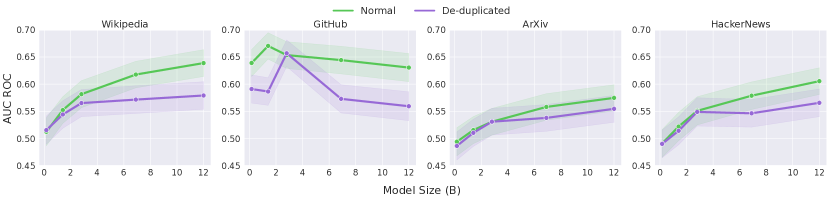
- MIAs generally perform near random (AUC ROC < 0.6) across most domains and model sizes tested (up to 12B parameters).
- Increasing model size yields marginal MIA performance gains, while deduplication tends to decrease MIA effectiveness.
- Reference-based attacks perform best among evaluated MIAs in some settings, but differences across attacks are modest overall.
- High n-gram overlap between members and non-members is common in natural-language domains, reducing MIA distinguishability; lower overlap can improve attack performance.
- Temporally shifted non-members (e.g., newer data) yield higher MIA performance, indicating distribution shifts can inflate apparent leakage.
- Modified (lexically/semantically close) member records can still be misclassified by MIAs, highlighting ambiguity in defining membership for generative models.
이 논문 읽기
누빈트 뷰어에서 원문을 열고, 읽으면서 궁금한 곳을 바로 물어보세요.
누빈트에서 이 논문 읽기이 리뷰는 AI가 논문 원문을 바탕으로 만들었습니다. 인용하기 전에 원문을 확인해 주세요.