
[논문 리뷰] Domain adaptation using optimal transport for invariant learning using histopathology datasets
이 논문은 특징 공간에서 기관 간 데이터 배치 간 분포 차이를 보상함으로써, 새로운 기관에서의 모델 일반화 능력을 향상시키는 새로운 최적 운반(Optimal Transport, OT)-기반 도메인 적응 방법을 제안한다. 기존의 개별 이미지 수준에서 작용하는 적대적 도메인 적응과는 달리, OT 손실은 전반적인 분포 이동을 포착하여, 레이블이 없거나 새로운 데이터로 재학습이 불가능한 상황에서도 희귀하거나 미대표되는 표현형에 대해 크게 향상된 성능을 보인다.
Histopathology is critical for the diagnosis of many diseases, including cancer. These protocols typically require pathologists to manually evaluate slides under a microscope, which is time-consuming and subjective, leading to interest in machine learning to automate analysis. However, computational techniques are limited by batch effects, where technical factors like differences in preparation protocol or scanners can alter the appearance of slides, causing models trained on one institution to fail when generalizing to others. Here, we propose a domain adaptation method that improves the generalization of histopathological models to data from unseen institutions, without the need for labels or retraining in these new settings. Our approach introduces an optimal transport (OT) loss, that extends adversarial methods that penalize models if images from different institutions can be distinguished in their representation space. Unlike previous methods, which operate on single samples, our loss accounts for distributional differences between batches of images. We show that on the Camelyon17 dataset, while both methods can adapt to global differences in color distribution, only our OT loss can reliably classify a cancer phenotype unseen during training. Together, our results suggest that OT improves generalization on rare but critical phenotypes that may only make up a small fraction of the total tiles and variation in a slide.
연구 동기 및 목표
- 다른 스캐너, 염색 방법, 기관에서 기인하는 배치 효과로 인한 히스토파스ولوج리 이미지의 도메인 이동 문제를 해결하기 위해.
- 새로운 데이터에 대한 레이블이나 재학습 없이도 새로운 기관으로의 모델 일반화 능력을 향상시키기 위해.
- 기존의 적대적 도메인 적응 방법은 개별 이미지 수준의 차이에 집중하나 희귀하거나 대표되지 않는 표현형에서는 실패하므로 이를 극복하기 위해.
- 지역적이고 빈번한 차이가 아닌 기관 간 데이터 배치 간의 전반적인 분포 이동을 포착하는 방법을 개발하기 위해.
- 다양하고 실제 임상 환경의 히스토파스ولوج리 데이터 소스에서의 다양한 도메인에 걸쳐 신뢰성 있는 딥 러닝 모델의 구현을 가능하게 하기 위해.
제안 방법
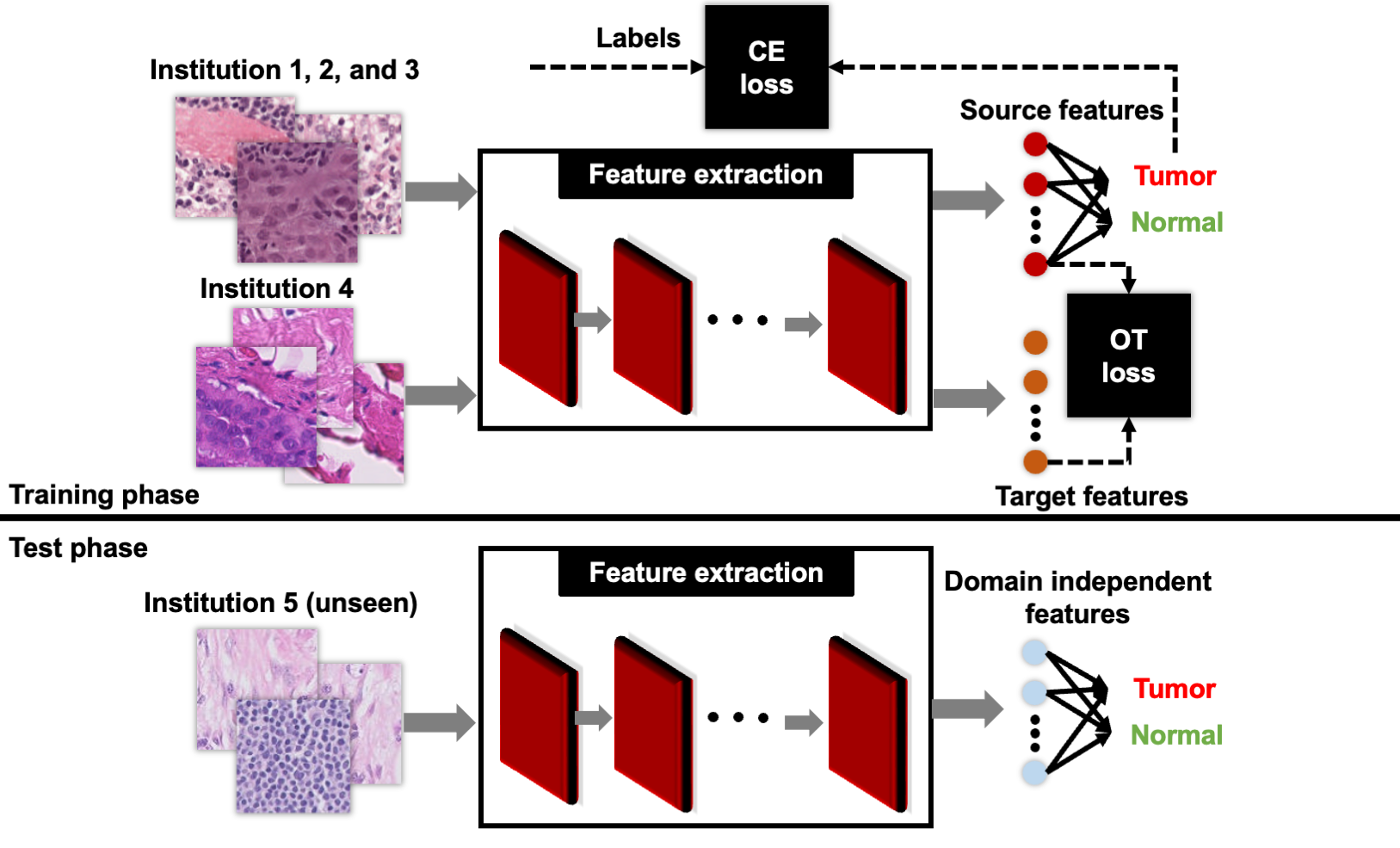
- 다른 기관의 이미지 배치에서 특징 임bedding의 전체 분포를 비교하는 새로운 최적 운반(OT) 손실을 도입한다.
- 모델 학습 중에 기관 간 데이터 분포의 표현 차이를 정량화하고 보상함으로써 표현 차이를 줄인다.
- 개별 이미지 수준의 도메인 분류를 대체하여 OT를 통해 배치 수준의 분포 일치를 실현함으로써 적대적 도메인 적응을 확장한다.
- 딥 신경망 학습 파이프라인에 OT 손실을 정규화 항으로 적용하여 도메인 불변 표현을 장려한다.
- 특징 추출을 위해 ImageNet에서 미리 훈련된 ResNet-50 백본을 사용하고, OT 기반 정규화를 위한 도메인 식별 헤드를 활용한다.
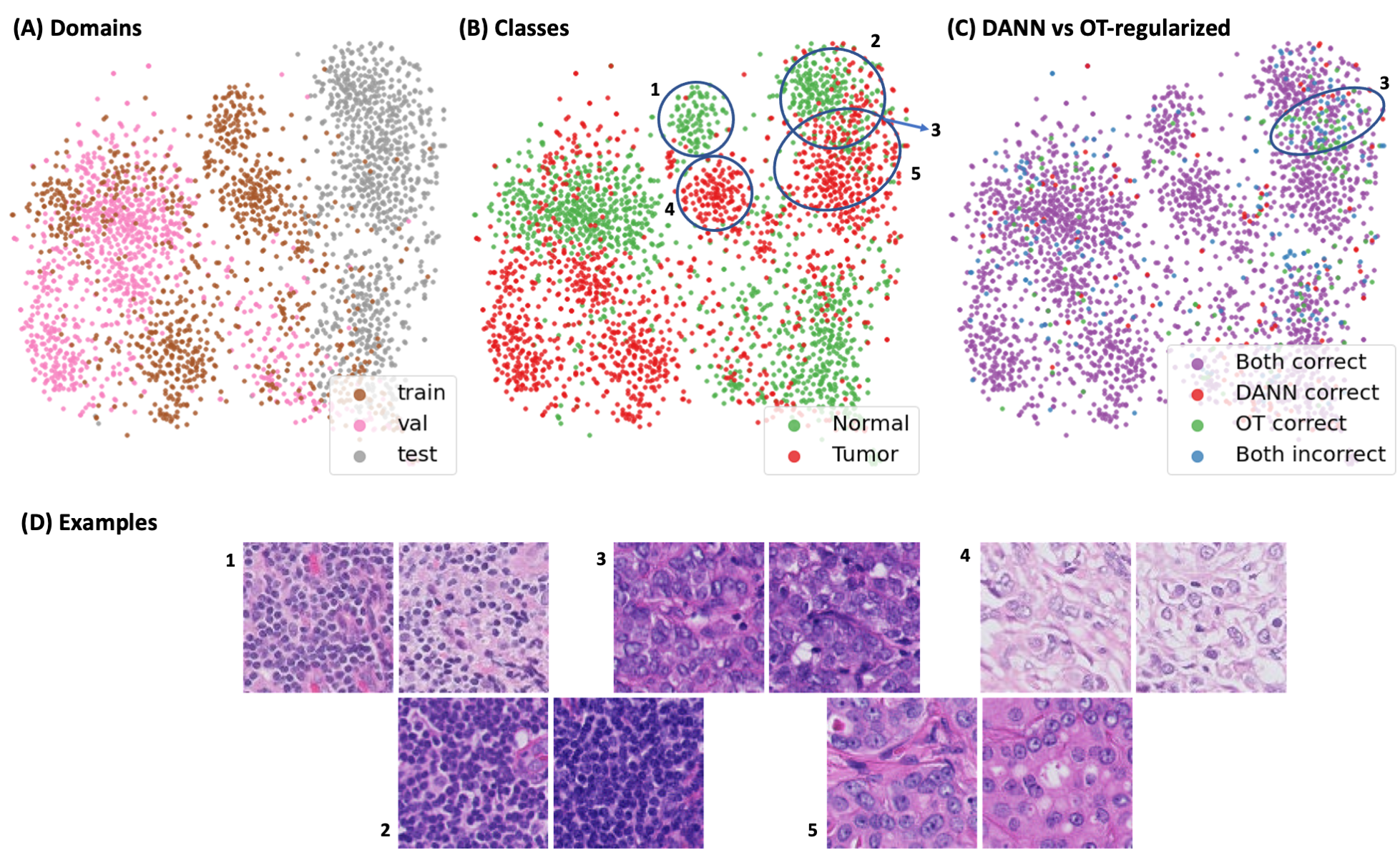
- t-SNE 시각화와 클러스터 분석을 통해 OT 기반 모델이 생물학적 및 기술적 변동에 대해 더 강력하고 일반화 능력 있는 특징 표현을 학습함을 검증한다.
실험 결과
연구 질문
- RQ1기존의 적대적 도메인 적응과 비교해 볼 때, 최적 운반 기반 도메인 적응이 새로운 기관에 대한 모델 일반화 능력을 향상시키는가?
- RQ2OT 기반 방법이 히스토파스ولوج리 이미지 타일에서 하위집단 이동과 대표되지 않는 표현형을 더 잘 다룰 수 있는가?
- RQ3Camelyon17 벤치마크에서 OT 손실은 다른 최첨단 도메인 적응 방법과 비교해 어떻게 성능을 내는가?
- RQ4새로운 기관이 검증 세트로 사용될 경우, OT 기반 방법이 도메인 이동에 대해 강건한가?
- RQ5특징 공간의 낮은 학습 데이터 커버리지 영역에서 OT 기반 정규화가 특징 분포에 어떤 영향을 미치는가?
주요 결과
- OT 정규화 모델은 테스트 세트에서 89.1%의 정확도(표준편차 0.019)를 기록하여, ERM 기반 베이스라인(70.3%)과 CORAL(59.5%), IRM(68.4%) 등 다른 베이스라인들을 크게 앞서나갔다.
- Camelyon17 데이터셋에서 OT 방법은 희귀하거나 잘 대표되지 않는 표현형에 대해 뛰어난 성능을 보였으며, 특히 DANN이 실패한 클러스터 3에서는 OT가 성공했다.
- 검증 기관과 테스트 기관의 역할을 바꿔도 OT 기반 모델은 강건하게 높은 성능을 유지하여, 어떤 기관이 새로운 기관이든 간에 일반화 능력이 뛰어나다는 것을 보여주었다.
- t-SNE 시각화 결과, OT 방법이 특징 공간에서 생물학적 및 기술적 변동의 전체 분포를 더 잘 유지함을 확인했으며, 특히 낮은 커버리지 영역에서 두드러졌다.
- 이 방법은 하위집단 이동에 대해 향상된 강건성을 보였으며, 이는 OT를 통한 배치 수준의 분포 일치가 희소하거나 불균형한 학습 데이터로 인한 실패를 완화시킨다는 것을 시사한다.
- 가장 고급 기법들(MBDG, SGD (Freeze-Embed))에 비해 뛰어난 성능을 내진 않지만, 염색 증강 및 비전 트랜스포머와 같은 기존 접근법과의 융합 잠재력이 높다는 점을 보였다.
이 논문 읽기
누빈트 뷰어에서 원문을 열고, 읽으면서 궁금한 곳을 바로 물어보세요.
누빈트에서 이 논문 읽기이 리뷰는 AI가 논문 원문을 바탕으로 만들었습니다. 인용하기 전에 원문을 확인해 주세요.