
[논문 리뷰] DreamAvatar: Text-and-Shape Guided 3D Human Avatar Generation via Diffusion Models
DreamAvatar는 텍스트 프롬프트와 SMPL 기반 형태/자세 입력에서 고품질 3D 인간 아바타를 생성하며, 이중 관찰 공간과 확산 기반 자기지도를 활용해 자세에 충실한 기하학과 텍스처를 생성합니다.
We present DreamAvatar, a text-and-shape guided framework for generating high-quality 3D human avatars with controllable poses. While encouraging results have been reported by recent methods on text-guided 3D common object generation, generating high-quality human avatars remains an open challenge due to the complexity of the human body's shape, pose, and appearance. We propose DreamAvatar to tackle this challenge, which utilizes a trainable NeRF for predicting density and color for 3D points and pretrained text-to-image diffusion models for providing 2D self-supervision. Specifically, we leverage the SMPL model to provide shape and pose guidance for the generation. We introduce a dual-observation-space design that involves the joint optimization of a canonical space and a posed space that are related by a learnable deformation field. This facilitates the generation of more complete textures and geometry faithful to the target pose. We also jointly optimize the losses computed from the full body and from the zoomed-in 3D head to alleviate the common multi-face ''Janus'' problem and improve facial details in the generated avatars. Extensive evaluations demonstrate that DreamAvatar significantly outperforms existing methods, establishing a new state-of-the-art for text-and-shape guided 3D human avatar generation.
연구 동기 및 목표
- 현실적인 형상과 자세를 보존하면서 텍스트 지침 아래 강건한 3D 인간 아바타 생성을 촉진한다.
- 확산 기반 최적화 과정에서 기하학과 자세를 안내하기 위해 SMPL을 형태 사전으로 활용한다.
- 학습 가능한 변형 필드로 연결된 이중 관찰 공간(정규 공간과 자세가 적용된 공간)을 도입하여 텍스처와 기하학의 충실성을 높인다.
- 전신과 머리 부분의 공동 최적화를 통해 다-face Janus 문제를 완화하고 얼굴 디테일을 향상시킨다.
- SMPL 매개변수를 통한 형태 변형으로 텍스트 기반 편집과 다양한 아바타 생성을 가능하게 한다.
제안 방법
- 3D 포인트의 밀도와 색상을 표현하기 위해 학습 가능한 NeRF를 사용한다.
- 사전 학습된 확산 모델과 함께 변분 점수 증류(VSD)를 적용하여 2D 자기지도 학습을 수행한다.
- SMPL 유도 밀도 필드를 활용하여 기하학(정규 공간과 자세 공간)을 초기화하고 제약한다.
- 정규 공간과 자세 공간 사이를 매핑하는 변형 필드를 도입하여 이중 관찰 공간 최적화를 가능하게 한다.
- 얼굴 디테일을 개선하고 Janus 아티팩트를 줄이기 위해 전신 및 확대 머리 손실을 공동으로 최적화한다.
- 역방향 뷰 토큰을 갖춘 ControlNet 기반의 머리 부분 감독을 활용하여 두상 특징을 안정화한다.
실험 결과
연구 질문
- RQ1텍스트-guided diffusion을 사용하여 현실적인 기하학과 텍스처를 갖춘 일관된 3D 인간 아바타를 신뢰성 있게 생성할 수 있는가?
- RQ2SMPL 형태/자세 사전 정보를 도입하면 3D 아바타 생성에서 자세 일관성과 기하학적 충실도가 향상되는가?
- RQ3이중 관찰 공간 설계가 단일 공간 접근 방식보다 더 완전한 텍스처와 자세에 충실한 기하학을 제공하는가?
- RQ4전신과 머리 영역의 공동 최적화가 얼굴 디테일 문제와 위상적 인 artefacts를 완화하는가?
- RQ5텍스트 프롬프트를 편집하여 아바타 외관을 얼마나 잘 변경할 수 있으며 형태 매개변수가 생성 결과에 어떻게 영향을 미치는가?
주요 결과
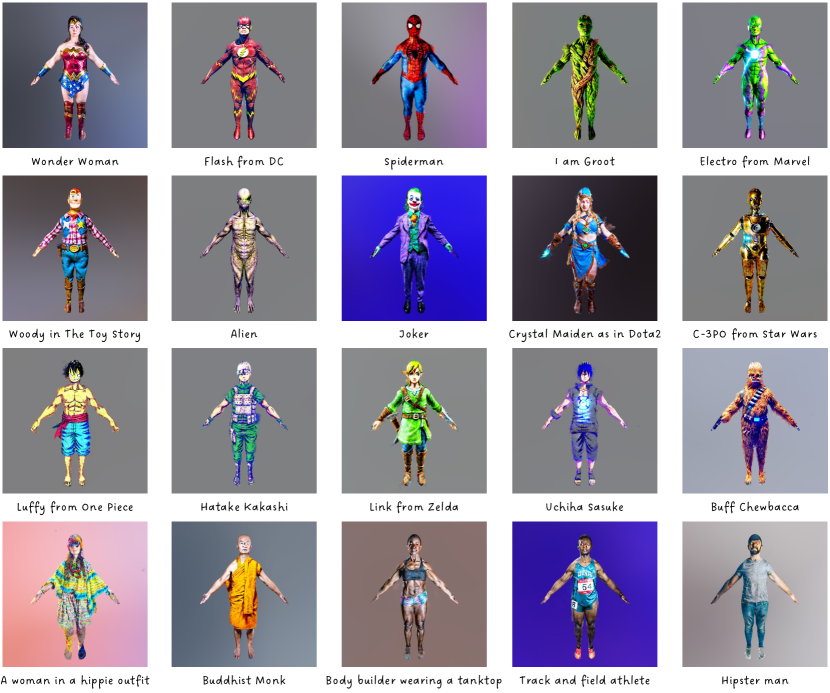
- DreamAvatar는 기하학 및 텍스처 품질 면에서 기존의 텍스트-및 형태 가이드 3D 아바타 방법들을 질적 평가 및 사용자 연구에서 능가한다.
- 이중 관찰 공간 설계로 텍스처가 더 완전해지고 기하학이 목표 자세에 더 충실해진다.
- SMPL-유도 밀도 필드를 통합하면 기하학이 안정되고 비현실적인 형태를 방지한다.
- 머리와 전신의 공동 최적화는 얼굴 디테일을 향상시키고 Janus 문제를 줄인다.
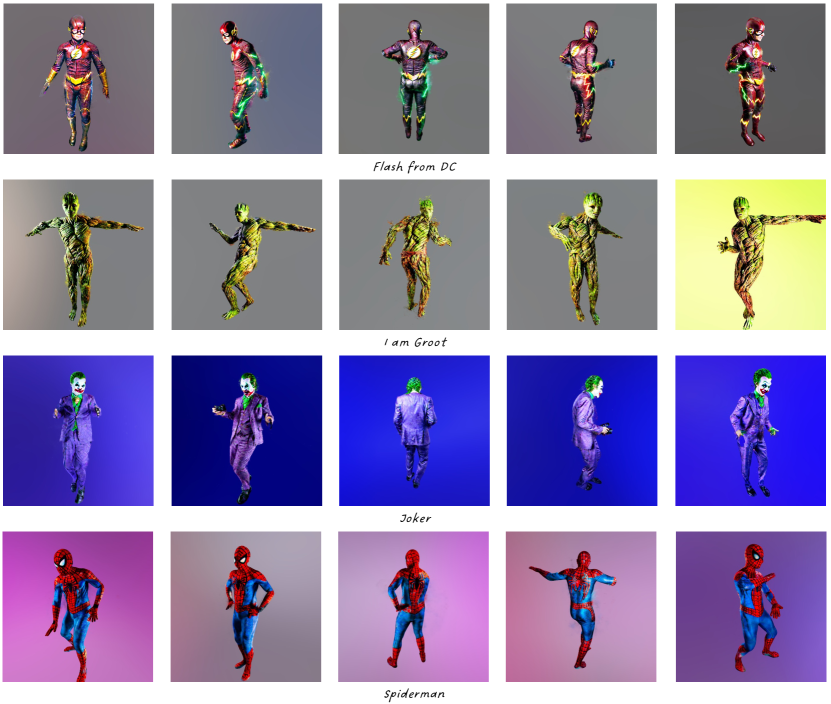
- 텍스트 조작 및 SMPL 기반 형태 편집으로 스타일과 자세에 따라 제어 가능하고 다양한 아바타 생성을 가능하게 한다.
이 논문 읽기
누빈트 뷰어에서 원문을 열고, 읽으면서 궁금한 곳을 바로 물어보세요.
누빈트에서 이 논문 읽기이 리뷰는 AI가 논문 원문을 바탕으로 만들었습니다. 인용하기 전에 원문을 확인해 주세요.