
[논문 리뷰] Edge Directionality Improves Learning on Heterophilic Graphs
Dir-GNN은 방향 그래프에 대해 들어오는 간선/나가는 간선 집계를 분리하여 임의의 MPNN을 확장하고, 이종친화 그래프에서 성능을 향상시키는 동시에 동질친화 그래프에서의 결과를 보존합니다. Directed Weisfeiler-Lehman 표현력을 맞추고 여러 방향성 이질 친화 벤치마크에서 최첨단 성능을 달성합니다.
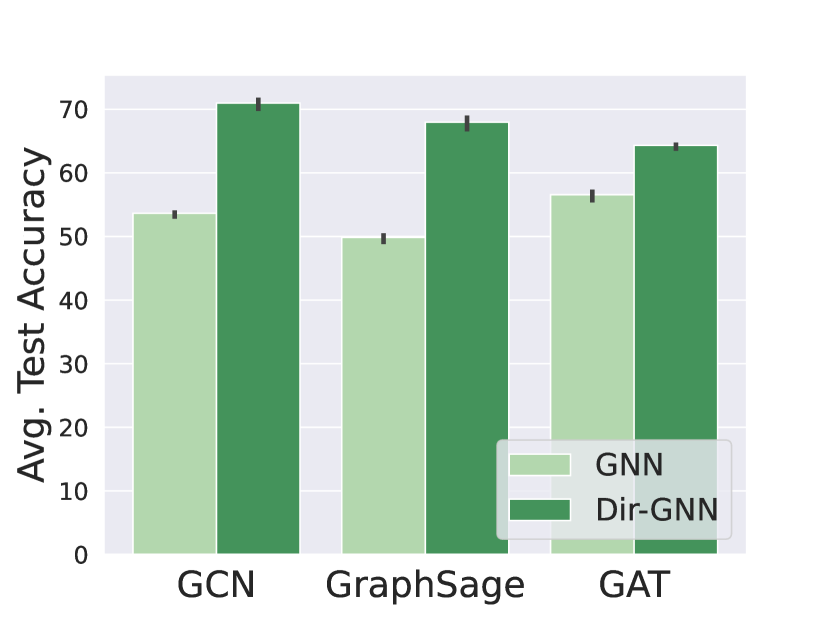
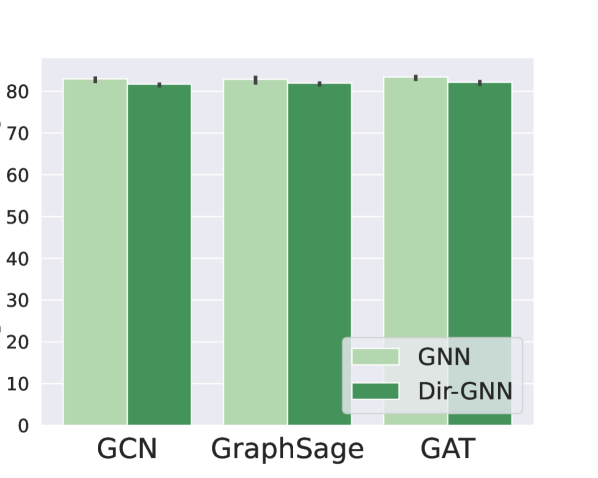
Graph Neural Networks (GNNs) have become the de-facto standard tool for modeling relational data. However, while many real-world graphs are directed, the majority of today's GNN models discard this information altogether by simply making the graph undirected. The reasons for this are historical: 1) many early variants of spectral GNNs explicitly required undirected graphs, and 2) the first benchmarks on homophilic graphs did not find significant gain from using direction. In this paper, we show that in heterophilic settings, treating the graph as directed increases the effective homophily of the graph, suggesting a potential gain from the correct use of directionality information. To this end, we introduce Directed Graph Neural Network (Dir-GNN), a novel general framework for deep learning on directed graphs. Dir-GNN can be used to extend any Message Passing Neural Network (MPNN) to account for edge directionality information by performing separate aggregations of the incoming and outgoing edges. We prove that Dir-GNN matches the expressivity of the Directed Weisfeiler-Lehman test, exceeding that of conventional MPNNs. In extensive experiments, we validate that while our framework leaves performance unchanged on homophilic datasets, it leads to large gains over base models such as GCN, GAT and GraphSage on heterophilic benchmarks, outperforming much more complex methods and achieving new state-of-the-art results.
연구 동기 및 목표
- 그래프에서 간선 방향성 활용의 필요성을 특히 이질 친화 설정에서 동기 부여한다.
- 듀얼 인- 및 아웃 집계로 임의의 MPNN을 방향 그래프로 확장하는 일반 프레임워크로 Dir-GNN을 소개한다.
- Dir-GNN의 표현력을 이론적으로 분석하고 이를 Directed WL 테스트와 비교한다.
- 이질 친화 및 동질 친화 데이터셋에서 Dir-GNN을 실험적으로 검증하여 이질 친화 벤치마크의 향상과 동질 친화 데이터에서의 안정성을 보인다.
제안 방법
- 독립적인 매개변수를 가질 수 있는 경우를 포함하여, 인접 이웃과 아웃 이웃에 대해 별도의 집계를 수행함으로써 MPNN을 방향 그래프로 확장한다.
- 두 개의 메시지-패싱 행렬 S_→ 및 S_←를 사용하고 정규화는 S_→ = D_→^{-1/2} A D_←^{-1/2}이고 S_← = S_→^T이다.
- 두 방향의 기여를 가중치로 조정하기 위한 학습 가능한 α를 도입한다.
- Dir-GNN이 도입 조건에서 Directed WL 테스트만큼 표현력이 있으며, MPNN-U 또는 MPNN-D보다 엄밀히 더 표현력이 있음을 보인다.
- Dir-GCN, Dir-SAGE, Dir-GAT가 방향별 가중치 분리로 매개변수 수가 증가하는 동안 레이어당 복잡도는 비슷하게 유지됨을 보여준다.
실험 결과
연구 질문
- RQ1그래프에서 간선 방향성이 특히 이질 친화 설정에서 그래프의 실질적 동질성을 증가시키는가?
- RQ2일반적인 Dir-GNN 프레임워크가 어떤 MPNN이든지 방향 그래프로 확장하여 성능을 향상시킬 수 있는가?
- RQ3Dir-GNN이 방향 WL 테스트만큼 표현력이 있는가, 그리고 전통적인 MPNN보다 더 표현력이 있는가?
- RQ4Dir-GNN 확장이 이질 친화 벤치마크에서 정확도를 향상시키고 동질 친화 벤치마크에 악영향을 주지 않는가?
주요 결과
- 방향 그래프를 사용하는 것은 이질 친화 그래프에서 실질적 동질성을 증가시키며 동질 그래프에서는 영향이 거의 없다.
- Dir-GNN은 이중 인- 및 아웃 집계를 통해 MPNN을 확장하여 실제로 더 많은 동질적 집계를 만든다.
- Dir-GNN은 다섯 개의 방향성 이질 친화 벤치마크(Chameleon, Squirrel, Arxiv-Year, Snap-Patents, Roman-Empire)에서 최첨단 결과를 달성한다.
- Dir-GNN은 방향성 이질 친화 데이터세트에서 더 복잡한 이질 친화성 특화 방법보다 우수하고 동질 친화 데이터세트에서도 성능을 유지한다.
- 프레임워크는 이론적으로 Directed Weisfeiler-Lehman 테스트만큼 표현력이 있으며 표준 MPNN보다 엄밀히 더 표현력이 있다.
이 논문 읽기
누빈트 뷰어에서 원문을 열고, 읽으면서 궁금한 곳을 바로 물어보세요.
누빈트에서 이 논문 읽기이 리뷰는 AI가 논문 원문을 바탕으로 만들었습니다. 인용하기 전에 원문을 확인해 주세요.