
[논문 리뷰] Evaluating Large Language Models on a Highly-specialized Topic, Radiation Oncology Physics
본 연구는 100문항의 방사선 종양학 물리학 평가에서 네 가지 대형 언어 모델을 평가하고 이를 의료 물리학자 및 비전문가와 비교하며, 프롬프트 전략, 설명-먼저 프롬프팅, 및 연역 추론 테스트를 탐구한다.
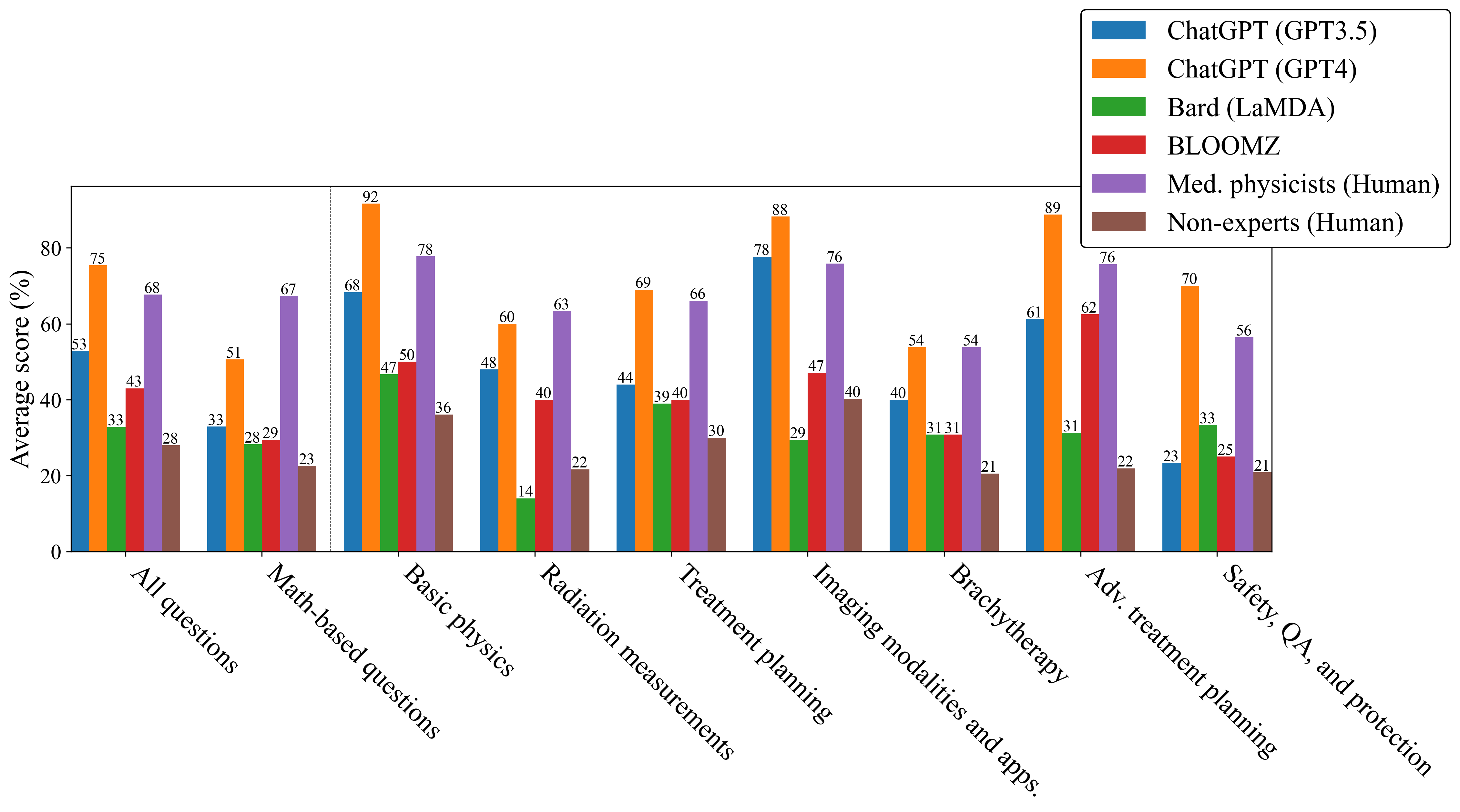
We present the first study to investigate Large Language Models (LLMs) in answering radiation oncology physics questions. Because popular exams like AP Physics, LSAT, and GRE have large test-taker populations and ample test preparation resources in circulation, they may not allow for accurately assessing the true potential of LLMs. This paper proposes evaluating LLMs on a highly-specialized topic, radiation oncology physics, which may be more pertinent to scientific and medical communities in addition to being a valuable benchmark of LLMs. We developed an exam consisting of 100 radiation oncology physics questions based on our expertise at Mayo Clinic. Four LLMs, ChatGPT (GPT-3.5), ChatGPT (GPT-4), Bard (LaMDA), and BLOOMZ, were evaluated against medical physicists and non-experts. ChatGPT (GPT-4) outperformed all other LLMs as well as medical physicists, on average. The performance of ChatGPT (GPT-4) was further improved when prompted to explain first, then answer. ChatGPT (GPT-3.5 and GPT-4) showed a high level of consistency in its answer choices across a number of trials, whether correct or incorrect, a characteristic that was not observed in the human test groups. In evaluating ChatGPTs (GPT-4) deductive reasoning ability using a novel approach (substituting the correct answer with "None of the above choices is the correct answer."), ChatGPT (GPT-4) demonstrated surprising accuracy, suggesting the potential presence of an emergent ability. Finally, although ChatGPT (GPT-4) performed well overall, its intrinsic properties did not allow for further improvement when scoring based on a majority vote across trials. In contrast, a team of medical physicists were able to greatly outperform ChatGPT (GPT-4) using a majority vote. This study suggests a great potential for LLMs to work alongside radiation oncology experts as highly knowledgeable assistants.
연구 동기 및 목표
- 데이터가 풍부한 시험 편향을 피하기 위해 매우 전문화된 주제에서 LLM 평가를 자극한다.
- 거주 의과 레지던트 교육과정을 반영한 100문항의 방사선 종양학 물리학 시험을 개발한다.
- 여러 LLM을 의료 물리학자 및 비전문가와 비교한다.
- 프롬프트, 설명-그다음 대답 전략, 그리고 연역 추론 능력을 조사한다.
제안 방법
- 기본 물리학, 측정, 치료 계획, 이미징, brachytherapy, 고급 계획 및 QA/안전을 다루는 100문항의 객관식 시험을 설계한다.
- 네 가지 LLM(ChatGPT GPT-3.5, ChatGPT GPT-4, Bard LaMDA, BLOOMZ)을 다섯 차례에 걸쳐 평가한다( BLOOMZ는 한 차례).
- 응답 형식을 제어하기 위해 초기화 및 지시 프롬프트를 사용하고 가능하면 20개 문제씩 배치로 질문을 실행한다.
- 평균 점수, 표준 편차, 평균 실험 상관관계를 사용하여 LLM 점수를 두 인간 그룹(의료 물리학자 및 비전문가)와 비교한다.
- LLM과 인간 간의 일관성을 평가하고 다수결 집계를 적용하여 그룹 성능을 평가한다.
- 설명 먼저를 요청한 뒤에 답을 제시하여 GPT-4 정확도 향상을 검토하고, 정답을 None of the above 변환으로 대체하여 연역 추론을 테스트한다.
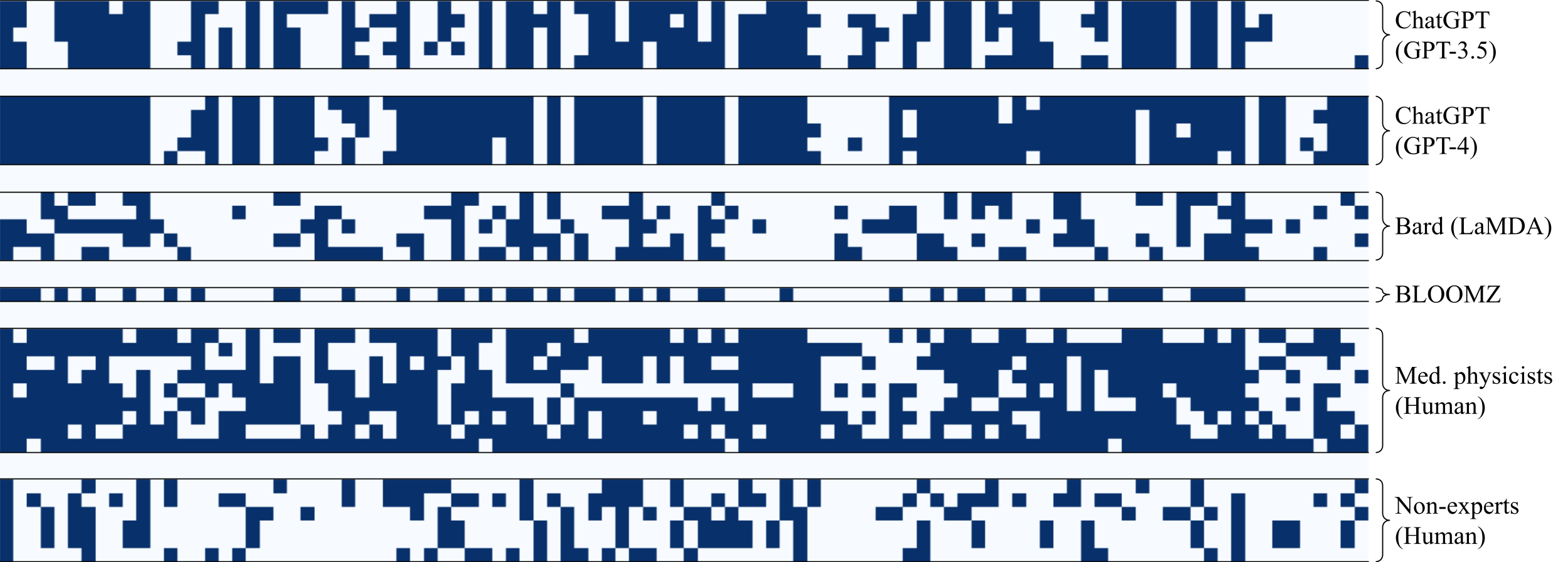
실험 결과
연구 질문
- RQ1LLMs가 의료 물리학자 및 비전문가와 비교하여 매우 전문화된 방사선 종양학 물리학 시험에 정확히 답할 수 있는가?
- RQ2프롬프트 설계 및 설명-먼저 프롬프팅이 전문화된 의학 물리학 콘텐츠에서 GPT-4의 정확도를 향상시키는가?
- RQ3LLMs가 맥락 축소된 질문에 직면했을 때 연역 추론 능력을 보이는가?
- RQ4다수결 협업이 인간 또는 LLM 간에 정확도 향상에 유익한가?
- RQ5매우 전문화된 도메인에서 LLM의 연역 추론에 나타나는 새롭게 emergent properties는 무엇인가?
주요 결과
- GPT-4가 100문항 시험에서 평균적으로 다른 모든 LLM과 의료 물리학자보다 우수했다.
- 설명 먼저를 통해 먼저 설명하고 그다음 대답하도록 프롬프트를 설정하면 전반적인 정확도가 약 5퍼센트 포인트 증가했다.
- 정답을 None of the above로 대체한 테스트에서 설명-먼저-대응 프롬프트를 사용한 GPT-4는 55%의 전반적 정확도를 보이며 주목할만한 연역 추론을 보였다.
- 다수결 투표를 이용한 인간의 경우 개별 LLM보다 상당히 높은 성과를 보였으며, 의료 물리학자들은 23%의 상승을 얻었다.
- LLMs는 여러 차례의 시험에서 높은 일관성을 보였고 비전문가들은 무작위 추측에 가까웠으며, 의료 물리학자들은 그룹의 합의로 이점을 얻었다.
이 논문 읽기
누빈트 뷰어에서 원문을 열고, 읽으면서 궁금한 곳을 바로 물어보세요.
누빈트에서 이 논문 읽기이 리뷰는 AI가 논문 원문을 바탕으로 만들었습니다. 인용하기 전에 원문을 확인해 주세요.