
[논문 리뷰] Evaluating LLMs at Detecting Errors in LLM Responses
이 논문은 추론 정확성, 지시 이행, 맥락 충실도, 파rameterized 지식의 네 가지 범주에 걸쳐 객관적이고 현실적이며 다양한 오류를 포함하는 LLM 응답의 오류 탐지 평가를 위한 첫 번째 벤치마크인 ReaLMistake을 소개한다. GPT-4와 Llama 2 70B에서 유래한 900개의 전문가가 검토한 인스턴스를 대상으로 평가한 결과, GPT-4와 Claude 3과 같은 최고 수준의 LLM들조차도 오류 탐지의 재현율이 매우 낮게 나타나며, LLM 기반 탐지기는 인간보다 유의미하게 열등하고, 설명은 신뢰성이 없으며, 프롬프트 변형에 대해 매우 취약한 것으로 드러났다.
With Large Language Models (LLMs) being widely used across various tasks, detecting errors in their responses is increasingly crucial. However, little research has been conducted on error detection of LLM responses. Collecting error annotations on LLM responses is challenging due to the subjective nature of many NLP tasks, and thus previous research focuses on tasks of little practical value (e.g., word sorting) or limited error types (e.g., faithfulness in summarization). This work introduces ReaLMistake, the first error detection benchmark consisting of objective, realistic, and diverse errors made by LLMs. ReaLMistake contains three challenging and meaningful tasks that introduce objectively assessable errors in four categories (reasoning correctness, instruction-following, context-faithfulness, and parameterized knowledge), eliciting naturally observed and diverse errors in responses of GPT-4 and Llama 2 70B annotated by experts. We use ReaLMistake to evaluate error detectors based on 12 LLMs. Our findings show: 1) Top LLMs like GPT-4 and Claude 3 detect errors made by LLMs at very low recall, and all LLM-based error detectors perform much worse than humans. 2) Explanations by LLM-based error detectors lack reliability. 3) LLMs-based error detection is sensitive to small changes in prompts but remains challenging to improve. 4) Popular approaches to improving LLMs, including self-consistency and majority vote, do not improve the error detection performance. Our benchmark and code are provided at https://github.com/psunlpgroup/ReaLMistake.
연구 동기 및 목표
- 이진 오류 탐지 평가를 위한 벤치마크 부족 문제를 해결하기 위해, 특히 객관적이고 현실적이며 다양한 오류를 포함하는 LLM 응답에 초점을 맞춘다.
- 이전의 벤치마크가 주관적이거나 단순한 작업(예: 단어 정렬)이나 제한된 오류 유형(예: 요약 시 충실도)에 의존하는 데서 비롯하는 한계를 극복한다.
- GPT-4와 Llama 2 70B와 같은 강력한 LLM에서 자연스럽게 발생하는, 객관적으로 평가 가능한 오류를 유도할 수 있는 작업을 설계한다.
- 실제로 전문가가 검토한 벤치마크를 기반으로 12개의 LLM 기반 오류 탐지기의 성능을 평가한다.
- LLM 기반 오류 탐지 방법의 신뢰성, 내구성 및 한계를 조사한다.
제안 방법
- 수학적 단어 문제 생성, 세밀한 사실 검증, 답변 가능성 분류의 세 가지 NLG 작업을 설계하여 추론 정확성, 지시 이행, 맥락 충실도, 파rameterized 지식의 네 가지 오류 범주에서 오류를 체계적으로 유도한다.
- GPT-4-0613과 Llama 2 70B의 LLM 응답에서 유래한 900개의 전문가가 검토한 인스턴스를 수집하며, 각 인스턴스는 이진 오류 레이블, 오류 범주, 상세한 설명을 포함한다.
- ReaLMistake 벤치마크를 사용하여 표준화된 프롬프트 템플릿을 적용해 12개의 LLM 기반 오류 탐지기의 성능을 평가하며, 내구성 테스트를 위해 프롬프트 변형도 포함한다.
- 자기 일관성 및 다수결 투표와 같은 표준 LLM 개선 기법을 적용하여 오류 탐지 성능에 미치는 영향을 평가한다.
- 탐지기 출력의 수작업 분석을 통해 설명의 신뢰성과 이진 레이블의 정확성을 평가한다.
- 모호하거나 주관적인 평가 기준을 피하고, 검증 가능한 사실적 및 논리적 일관성 결여에 초점을 맞춰 객관성을 확보한다.
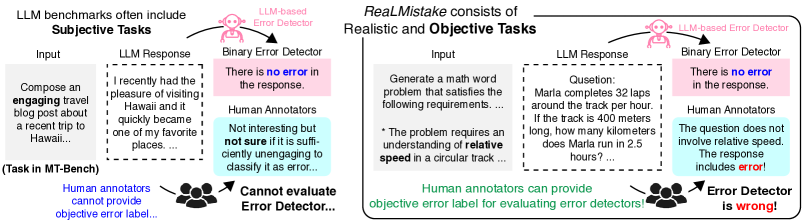
실험 결과
연구 질문
- RQ1LLM 기반 오류 탐지기는 특히 객관적으로 평가 가능한 오류를 신뢰성 있게 탐지할 수 있는가?
- RQ2LLM 기반 오류 탐지자의 성능은 LLM 출력의 오류를 탐지하는 데 있어 인간 수준의 정확성과 비교해 어떻게 되는가?
- RQ3LLM 기반 오류 탐지기가 제공하는 설명은 오류에 대한 정확한 추론을 반영하는가?
- RQ4LLM 기반 오류 탐지기는 소규모 프롬프트 변형에 얼마나 민감한가? 이러한 민감성은 완화될 수 있는가?
- RQ5자기 일관성 및 다수결 투표와 같은 기존의 LLM 개선 전략은 LLM 기반 오류 탐지기의 성능을 향상시키는가?
주요 결과
- GPT-4와 Claude 3과 같은 최고 수준의 LLM들은 이진 오류 탐지 작업에서 매우 낮은 재현율을 보이며, 이는 이 작업에서의 성능이 열악하다는 것을 시사한다.
- 평가된 모든 LLM 기반 오류 탐지기는 LLM 응답의 오류를 식별하는 데 있어 전문가 수준의 인간보다 유의미하게 열등하다.
- LLM 기반 오류 탐지기가 제공하는 설명은 종종 신뢰성이 없으며, 이진 레이블이 올바를지라도 잘못된 추론을 포함하고 있다.
- LLM 기반 오류 탐지는 소규모 프롬프트 변형에 매우 민감하며, 자기 일관성이나 다수결 투표와 같은 표준 LLM 최적화 기법으로도 성능 향상이 이루어지지 않는다.
- 벤치마크 ReaLMistake는 LLM 응답에서 네 가지 핵심 범주에 걸쳐 다양한, 현실적이며 객관적으로 평가 가능한 오류를 성공적으로 포착하였다.
- 이 연구는 현재 LLM 기반 오류 탐지의 심각한 격차를 드러내며, LLM 출력 품질을 보장하기 위한 더 강력하고 신뢰할 수 있는 방법의 필요성을 강조한다.

이 논문 읽기
누빈트 뷰어에서 원문을 열고, 읽으면서 궁금한 곳을 바로 물어보세요.
누빈트에서 이 논문 읽기이 리뷰는 AI가 논문 원문을 바탕으로 만들었습니다. 인용하기 전에 원문을 확인해 주세요.