
[논문 리뷰] Evaluating tree-based imputation methods as an alternative to MICE PMM for drawing inference in empirical studies
본 논문은 현실적인 NEPS 기반 시뮬레이션에서 트리 기반 보간 방법(MICE RF, missRanger, MIXGBoost)을 MICE PMM과 비교하고, 계수 추정, 제1종 오류 및 검정력 면에서 RF 기반 보간이 높은 누락률에서 caveats가 있더라도 종종 최적의 성능을 발휘한다는 것을 보여준다.
Dealing with missing data is an important problem in statistical analysis that is often addressed with imputation procedures. The performance and validity of such methods are of great importance for their application in empirical studies. While the prevailing method of Multiple Imputation by Chained Equations (MICE) with Predictive Mean Matching (PMM) is considered standard in the social science literature, the increase in complex datasets may require more advanced approaches based on machine learning. In particular, tree-based imputation methods have emerged as very competitive approaches. However, the performance and validity are not completely understood, particularly compared to the standard MICE PMM. This is especially true for inference in linear models. In this study, we investigate the impact of various imputation methods on coefficient estimation, Type I error, and power, to gain insights that can help empirical researchers deal with missingness more effectively. We explore MICE PMM alongside different tree-based methods, such as MICE with Random Forest (RF), Chained Random Forests with and without PMM (missRanger), and Extreme Gradient Boosting (MIXGBoost), conducting a realistic simulation study using the German National Educational Panel Study (NEPS) as the original data source. Our results reveal that Random Forest-based imputations, especially MICE RF and missRanger with PMM, consistently perform better in most scenarios. Standard MICE PMM shows partially increased bias and overly conservative test decisions, particularly with non-true zero coefficients. Our results thus underscore the potential advantages of tree-based imputation methods, albeit with a caveat that all methods perform worse with an increased missingness, particularly missRanger.
연구 동기 및 목표
- 결측数据가 있는 선형 모델에서 보간 방법이 계수 추정에 미치는 영향을 평가한다.
- 다음 방법들 간의 편향, 제1종 오류 및 검정력 비교: MICE PMM, MICE RF, missRanger, MIXGBoost.
- 다양한 결측률과 현실적인 NEPS 기반 시뮬레이션 데이터셋에서의 성능을 평가한다.
제안 방법
- 수입을 결과로 하는 5개 시점으로 구성된 12,410개의 완전 관찰치를 가진 NEPS 기반 종단 데이터를 시뮬레이션한다.
- MICE PMM, MICE RF, missRanger(PMM 포함/비포함), 그리고 MIXGBoost를 사용하여 결측치를 보간한다.
- OLS 회귀 계수, 제1종 오류 및 검정력을 평가한다.
- 데이터 유형이 숫자형 및 범주형인 경우를 요약하기 위해 IPM(Imputation Performance Metric)을 사용한다.
- 시뮬레이션을 1200회 반복하고 성공적인 재현 1000회를 분석한다.
- 결측 수준 및 데이터 패턴 간의 성능 차이를 부각한다.
실험 결과
연구 질문
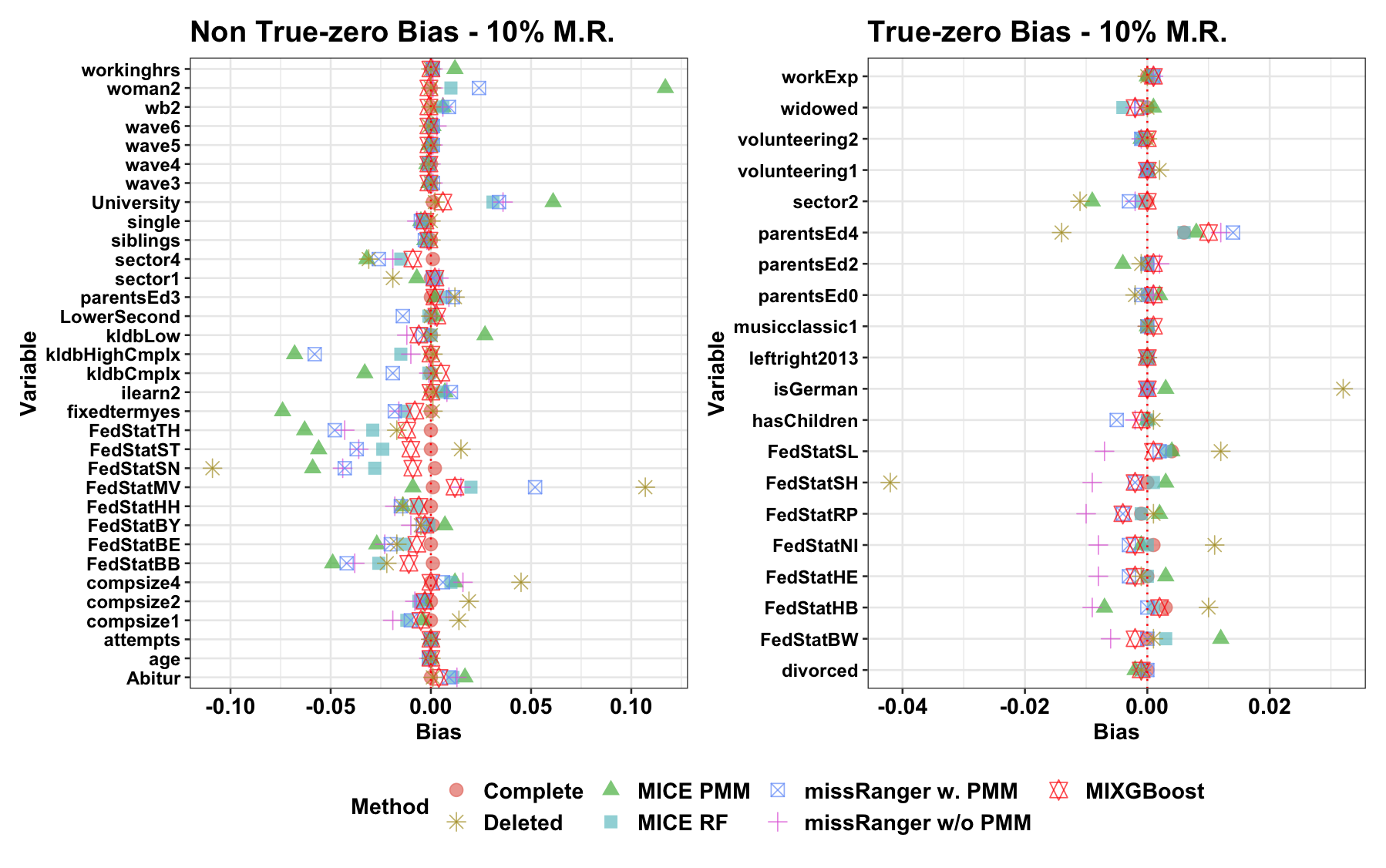
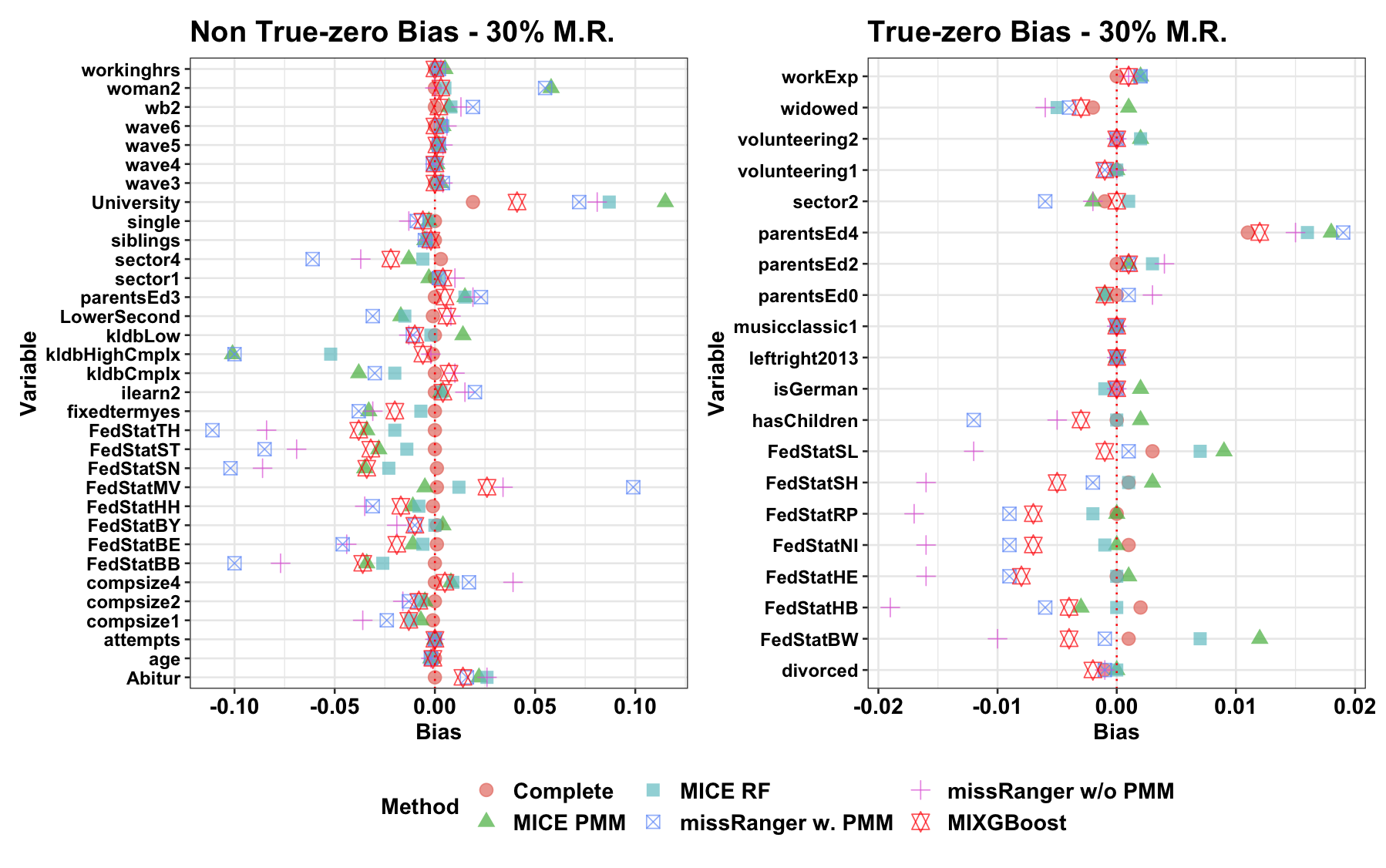
- RQ1트리 기반 보간 방법이 선형 모델의 계수 편향 측면에서 MICE PMM과 비교하여 어떤 차이가 있는가?
- RQ2결측 보간 방법이 시나리오별로 제1종 오류 및 통계적 검정력에 어떤 영향을 미치는가?
- RQ3MAR 누락에서 RF 기반 트리 보간 방법(MICE RF, missRanger)이 지속적으로 MICE PMM보다 우수한가?
- RQ4결측 증가가 각 보간 접근법의 성능에 어떤 영향을 미치는가?
주요 결과
- 랜덤 포레스트 기반 보간은, 특히 MICE RF와 PMM을 함께 사용한 missRanger가 대부분의 시나리오에서 일관되게 더 나은 성능을 보인다.
- 표준 MICE PMM은 편향이 부분적으로 증가하고 검정 결정이 보수적으로 변하는 경향이 있으며, 특히 참 제로가 아닌 계수의 경우 그렇다.
- MissRanger의 성능은 결측치 증가 수준에서 저하된다.
- 결측치가 증가함에 따라 모든 방법의 성능이 저하되며, 특히 missRanger가 가장 큰 영향을 받는다.
- 트리 기반 방법은 많은 상황에서 MICE PMM보다 혼합 데이터 유형과 복잡한 상호작용을 더 잘 처리할 수 있다.
이 논문 읽기
누빈트 뷰어에서 원문을 열고, 읽으면서 궁금한 곳을 바로 물어보세요.
누빈트에서 이 논문 읽기이 리뷰는 AI가 논문 원문을 바탕으로 만들었습니다. 인용하기 전에 원문을 확인해 주세요.