
[논문 리뷰] Explicit Correspondence Matching for Generalizable Neural Radiance Fields
MatchNeRF는 Transformer에서 추출된 특징에 대한 그룹별 코사인 유사도를 통해 명시적 뷰 간 대응 매칭을 제공하고, 일반화 가능한 NeRF를 위한 기하학적 사전(prior)을 제공하며, 두 개의 뷰만으로도 최첨단 성능을 달성합니다.
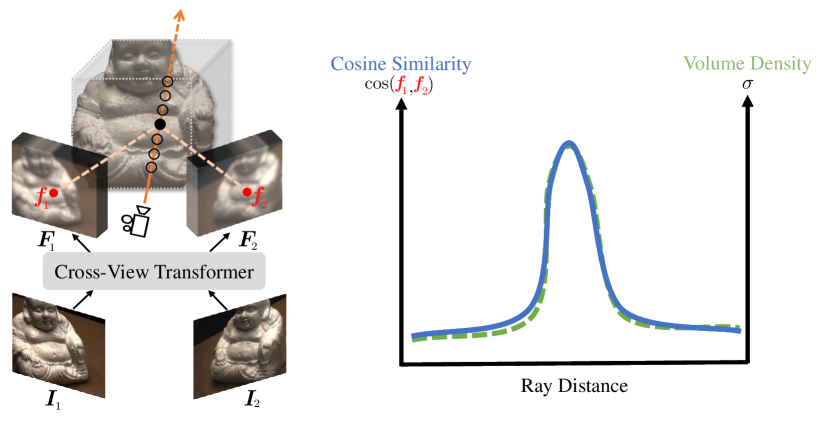
We present a new generalizable NeRF method that is able to directly generalize to new unseen scenarios and perform novel view synthesis with as few as two source views. The key to our approach lies in the explicitly modeled correspondence matching information, so as to provide the geometry prior to the prediction of NeRF color and density for volume rendering. The explicit correspondence matching is quantified with the cosine similarity between image features sampled at the 2D projections of a 3D point on different views, which is able to provide reliable cues about the surface geometry. Unlike previous methods where image features are extracted independently for each view, we consider modeling the cross-view interactions via Transformer cross-attention, which greatly improves the feature matching quality. Our method achieves state-of-the-art results on different evaluation settings, with the experiments showing a strong correlation between our learned cosine feature similarity and volume density, demonstrating the effectiveness and superiority of our proposed method. The code and model are on our project page: https://donydchen.github.io/matchnerf
연구 동기 및 목표
- 적은 입력 뷰(최소 두 뷰)로 보지 못한 장면의 새 뷰를 합성할 수 있는 일반화 가능한 NeRF를 개발한다.
- Explicit cross-view correspondence 정보를 활용하여 NeRF 밀도 예측에 기하학적 사전을 제공한다.
- 3D 코스트 볼륨에 의존하지 않고 대응 기반 사전을 사용하여 일반화 능력을 향상시킨다.
- 3-view 및 2-view 설정에서 DTU, Real Forward-Facing, Blender 같은 표준 벤치마크에서 최첨단 성능을 보여준다.
제안 방법
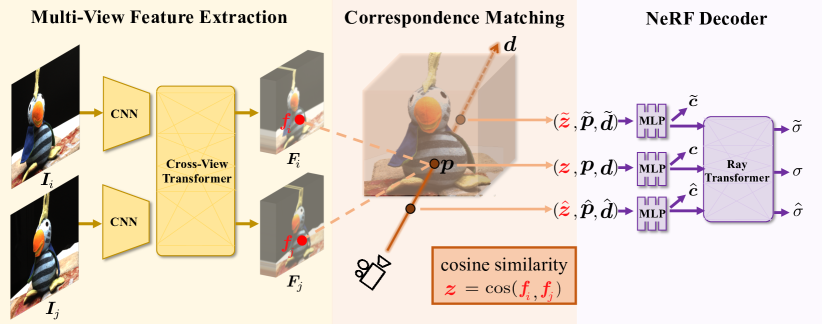
- 다뷰 이미지 특징을 교차 뷰 상호 작용을 모델링하는 트랜스포머로 추출한다.
- 각 뷰에 3D 포인트를 투영하여 Transformer 특징을 샘플링하고, 쌍별 그룹별 코사인 유사도를 기하학적 사전 z로 계산한다.
- 모든 뷰 쌍에 걸친 코사인 유사도를 모아 뷰에 구애받지 않는 z를 얻어 NeRF 디코더를 조건화한다.
- 레이에서의 교차 포인트 상호 작용을 위한 레이 트랜스포머를 활용한 NeRF 디코더로 색상과 밀도를 예측한다.
- Ground-truth 기하학 없이 photometric 손실로 엔드투엔드 학습한다.
실험 결과
연구 질문
- RQ1명시적 뷰 간 특징 대응이 3D 코스트 볼륨 없이도 일반화 가능한 NeRF를 위한 신뢰할 수 있는 기하학적 사전을 제공할 수 있는가?
- RQ2뷰 간 특징의 그룹별 코사인 유사성이 단순한 유사성 학습이나 암시적 유사 학습보다 밀도 예측 및 렌더링 품질을 향상시키는가?
- RQ3표준 벤치마크에서 입력 뷰의 수(2대 vs 3대)에 따라 방법의 성능이 어떻게 달라지는가?
- RQ4참조 뷰 선택에 대한 로버스트성 및 보지 못한 장면으로의 일반화 능력이 있는가?
주요 결과
- MatchNeRF는 3-view 및 2-view 설정에서 DTU, Real Forward-Facing, Blender에서 최첨단 성능을 달성한다.
- 쌍별 Transformer 특징 간의 명시적 그룹별 코사인 유사성은 체적 밀도와 강한 상관관계를 보여 기하학적 예측에 도움이 된다.
- 1/8 및 1/4 해상도 특징과 레이 트랜스포머를 모두 사용하고 인코더의 교차 주의(attention)로부터 큰 이점을 얻는다.
- 방법은 뷰에 구애받지 않는 특성을 가지며 비용 볼륨 기반 방법(MVSNeRF)보다 참조 뷰에 덜 민감하다.
- MatchNeRF는 GPNR 설정의 5–10뷰 등 더 많은 입력 뷰를 사용하는 비용 볼륨 기준선보다 성능이 우수하다.
이 논문 읽기
누빈트 뷰어에서 원문을 열고, 읽으면서 궁금한 곳을 바로 물어보세요.
누빈트에서 이 논문 읽기이 리뷰는 AI가 논문 원문을 바탕으로 만들었습니다. 인용하기 전에 원문을 확인해 주세요.