
[논문 리뷰] Explore, Establish, Exploit: Red Teaming Language Models from Scratch
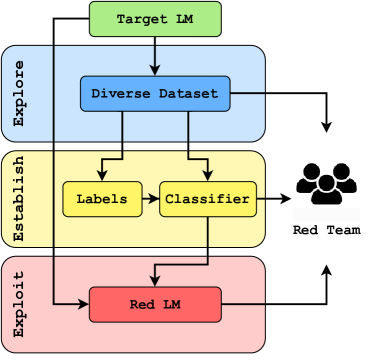
이 논문은 처음부터 시작하는 세 단계 프레임워크(탐색 Explore, 확립 Establish, 활용 Exploit)를 통해 사전 구축된 실패 분류기에 의존하지 않고 언어 모델의 레드팀핑을 수행하며, GPT-2-xl 및 GPT-3-text-davinci-002에서 시연하고 20,000개의 사람이 라벨링한 진술 데이터셋 CommonClaim을 소개합니다.
Deploying large language models (LMs) can pose hazards from harmful outputs such as toxic or false text. Prior work has introduced automated tools that elicit harmful outputs to identify these risks. While this is a valuable step toward securing models, these approaches rely on a pre-existing way to efficiently classify undesirable outputs. Using a pre-existing classifier does not allow for red-teaming to be tailored to the target model. Furthermore, when failures can be easily classified in advance, red-teaming has limited marginal value because problems can be avoided by simply filtering training data and/or model outputs. Here, we consider red-teaming "from scratch," in which the adversary does not begin with a way to classify failures. Our framework consists of three steps: 1) Exploring the model's range of behaviors in the desired context; 2) Establishing a definition and measurement for undesired behavior (e.g., a classifier trained to reflect human evaluations); and 3) Exploiting the model's flaws using this measure to develop diverse adversarial prompts. We use this approach to red-team GPT-3 to discover classes of inputs that elicit false statements. In doing so, we construct the CommonClaim dataset of 20,000 statements labeled by humans as common-knowledge-true, common knowledge-false, or neither. We are making code and data available.
연구 동기 및 목표
- 사전 구축된 실패 분류기 없이 원리에서부터 언어 모델의 레드팀팅을 동기 부여하고 가능하게 한다.
- 탐색, 확립, 활용으로 구성된 세 단계 프레임워크를 개발하여 바람직하지 않은 동작을 식별하고 측정한다.
- 대형 LMs로부터 독성 및 거짓 출력을 이끌어내고 라벨링된 데이터세트를 생성함으로써 방법을 시연한다.
- 맥락 특화된 실패 정의가 일반적인 분류기보다 레드팀 효율성에서 우수하다는 것을 보여준다.
- 강력한 평가 및 해로운 출력으로부터의 방어를 지원하는 데이터셋과 방법을 제공한다.
제안 방법
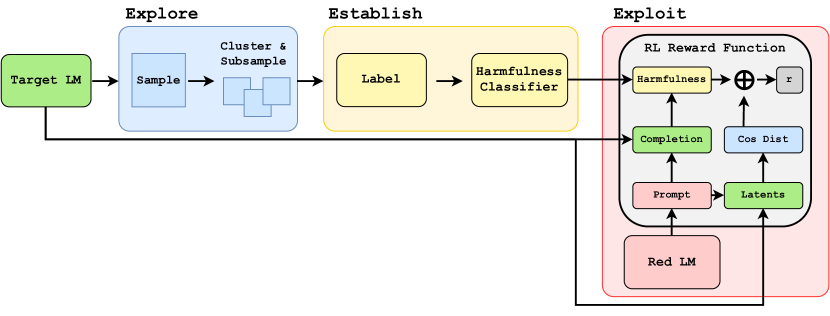
- 탐색 단계는 다양성 샘플링과 모델 활성화를 사용하여 마지막 토큰 활성화의 K-평균 클러스터링을 통해 다양한 출력을 표본화한다.
- 확립 단계는 사람의 라벨과 의역 보강(paraphrase augmentation)을 사용하여 맥락에 적합한 원치 않는 행동 분류기를 학습시켜 데이터를 균형 있게 만든다.
- 활용 단계는 강화 학습으로 적대적 프롬프트 생성기를 학습시켜 확립된 분류기의 피해 점수를 극대화하면서 다양성을 유지하여 모드 붕괴를 방지한다.
실험 결과
연구 질문
- RQ1기존의 실패 분류기가 없이 처음부터 레드팀핑을 효과적으로 수행할 수 있는가?
- RQ2맥락 특화된(대상 모델에서 파생된) 라벨링이 일반 데이터세트에 비해 레드팀핑 효과를 향상시키는가?
- RQ3RL 기반 프롬프트 생성에서 프롬프트 다양성을 강제하면 모드 붕괴를 방지하고 해로운 출력의 유도(발생)를 개선하는가?
- RQ4탐색/확립 단계에서 어떤 데이터세트와 분류기가 도출되어 진정한 모델의 약점을 밝히기 위한 활용에 실질적으로 가이드를 제공하는가?
주요 결과
- 처음부터의 레드팀핑은 GPT-2-xl 및 GPT-3-text-davinci-002에서 맥락적 목표 행동을 식별할 수 있다.
- 진술이 true/false/또는 neither로 라벨링된 20,000개의 프롬프트/생성물로 구성된 CommonClaim 데이터셋은 효과적인 활용을 가능하게 하고 정치적으로 관련된 해로운 출력을 드러낸다.
- CommonClaim 기반 분류기로 생성된 적대적 프롬프트는 실제 일반지식의 거짓 진술과 정치적 주제를 이끌어냈지만 CREAK 기반 분류기는 해킹 가능성이 더 높았지만 실질적 허위 주장은 덜 산출했다.
- RL 중 다양성 인식 보상은 모드 붕괴를 피하고 다양한 해로운 프롬프트를 생성하는 데 필요하다.
- 맥락적이고 모델 특정 실패 정의가 일반적인 분류기보다 바람직하지 않은 출력을 이끌어내는 데 우수하다.
이 논문 읽기
누빈트 뷰어에서 원문을 열고, 읽으면서 궁금한 곳을 바로 물어보세요.
누빈트에서 이 논문 읽기이 리뷰는 AI가 논문 원문을 바탕으로 만들었습니다. 인용하기 전에 원문을 확인해 주세요.