
[논문 리뷰] Fed and Trump -- The Dirty Game
본 논문은 이중으로 자유진동하는 Plutinos를 분석하여 이심률–궤도경사 공간에서 g librators의 군집을 식별하고 이를 제3종 주기 궤도와 연결한다; Plutinos 중 약 16%가 g librators임을 추정한다.
Named for orbital kinship with Pluto, the Plutinos are a prominent group of Kuiper Belt objects whose orbital periods are in libration about the 3/2 ratio with Neptune's. We investigate the long term orbital dynamics of known Plutinos, with attention to the additional libration (or lack thereof) of their argument of perihelion, $g$, a well-known characteristic of Pluto's orbit. We show that the $g$ librators amongst the Plutinos cluster around an arc in the eccentricity--inclination parameter plane. This previously unreported dynamical structure is owed to a family of periodic orbits of the third kind in the restricted problem of three bodies, identified by Poincaré at the end of the 19th century. Approximately sixteen percent of the currently known Plutinos exhibit $g$ librations, a far greater fraction than the ratios of the associated libration frequencies. These results may offer new constraints for theoretical models of the dynamical history of the Plutinos and of the orbital migration history of the giant planets.
연구 동기 및 목표
- Known Plutinos의 장기 역학을 평가하되 g libration에 무게를 둔다.
- 어떤 Plutinos가 지속적인 g libration을 보이는지 식별하고 그 분포를 특성화한다.
- g libration 군집을 고전적 삼체 문제의 제3종 궤도 가족과 연결한다.
- Plutinos 중 g librator의 비율에 대한 업데이트 추정치를 제공하고 Neptune–행성 이동 모델에 대한 시사점을 논의한다.
제안 방법
- Volk & Van Laerhoven (2024)의 Plutino 목록을 수집하고 JPL Horizons에서 궤도 데이터를 확보한다.
- Plutinos를 시험 입자(test particle)로 간주하여 100 Myr 동안 SWIFT_RMVS3로 궤도를 전파한다.
- 100 Myr 동안 최대(sigma)-최소(sigma) < 358도라는 기준으로 장기적으로 안정한 Plutinos를 식별한다.
- g libration 중심(0, 90, 180, 270도)과 g의 범위가 179도 미만인 경우를 탐색한다.
- 시간 평균 이심률 및 궤도경사도 계산; 시간 평균 e–i 평면에서의 군집화를 분석한다.
- CR6BP 및 CR3BP에서의 제3종 궤도에 대한 주파수 함수를 비교하여 Plutinos의 궤도 평균 방해함수의 극값을 계산하고 관측된 구조를 해석한다.

실험 결과
연구 질문
- RQ1네프튠의 외부 3:2 공전에서 지속적인 g libration(g librators)을 보이는 Plutinos의 비율은 얼마인가?
- RQ2시간 평균 이심률–궤도경사 평면에서 g librators는 어떻게 분포하며, 이 분포를 설명하는 동역학적 구조는 무엇인가?
- RQ3관측된 g-libration 위치가 축약된 삼체 문제에서 제3종 궤도 가족과 어떤 관련이 있는가?
- RQ4CR3BP와 CR6BP 모델을 비교할 때 내부 거대 행성의 영향이 g-리브레이션 위치에 어떤 영향을 주는가?
주요 결과
- 장기적으로 안정한 441개의 Plutinos 중 69개가 g libration을 보이며 약 16%이다.
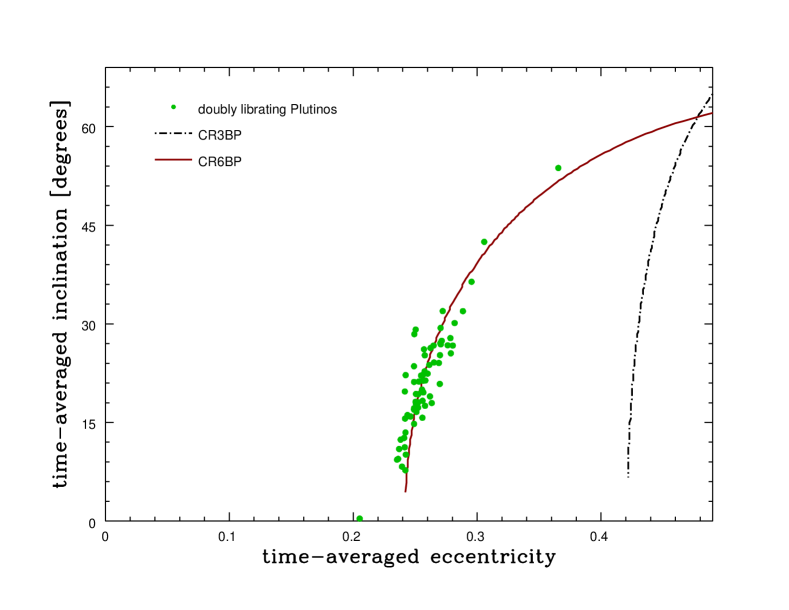
- g librators는 시간 평균 이심률–궤도경사 평면에서 대략 쌍곡선 모양의 호를 따라 군집한다.
- 궤도 평균 방해함수의 로컬 최소값은 g = ±90°의 최소값과 정렬되며, 이는 제3종 궤도 가족과 일치한다; 내부 거대 행성은 이 위치를 순수 CR3BP의 경우보다 더 낮은 이심률로 이동시킨다.
- 군집은 g libration 중심이 0° 또는 180°인 경우에 대해 관찰되지 않으며, g librators는 대략 90°와 270° 중심 간에 균등하게 분포한다.
- 예외 객체인 2015 VR164는 주된 군집에서 벗어나 매우 낮은 e와 i를 가지며, 이는 공전역 역학이 아니라 운동학적 효과 때문일 가능성이 있다.
- 관찰된 g-librator 비율은 간단한 위상공간 부피 추정치를 초과하며, 행성의 이동 도중의 역학적 안정성과 포획 이력으로 인한 과밀도 가능성을 시사한다.
이 논문 읽기
누빈트 뷰어에서 원문을 열고, 읽으면서 궁금한 곳을 바로 물어보세요.
누빈트에서 이 논문 읽기이 리뷰는 AI가 논문 원문을 바탕으로 만들었습니다. 인용하기 전에 원문을 확인해 주세요.