
[논문 리뷰] FedSpeed: Larger Local Interval, Less Communication Round, and Higher Generalization Accuracy
FedSpeed는 로컬 편향 및 과적합을 줄이기 위해 prox-corrected prox-term 및 그래디언트 섭동을 도입하여 연합학습에서 더 큰 로컬 간격과 더 빠른 수렴을 가능하게 하고 일반화가 향상됩니다.
Federated learning is an emerging distributed machine learning framework which jointly trains a global model via a large number of local devices with data privacy protections. Its performance suffers from the non-vanishing biases introduced by the local inconsistent optimal and the rugged client-drifts by the local over-fitting. In this paper, we propose a novel and practical method, FedSpeed, to alleviate the negative impacts posed by these problems. Concretely, FedSpeed applies the prox-correction term on the current local updates to efficiently reduce the biases introduced by the prox-term, a necessary regularizer to maintain the strong local consistency. Furthermore, FedSpeed merges the vanilla stochastic gradient with a perturbation computed from an extra gradient ascent step in the neighborhood, thereby alleviating the issue of local over-fitting. Our theoretical analysis indicates that the convergence rate is related to both the communication rounds $T$ and local intervals $K$ with a upper bound $\small \mathcal{O}(1/T)$ if setting a proper local interval. Moreover, we conduct extensive experiments on the real-world dataset to demonstrate the efficiency of our proposed FedSpeed, which performs significantly faster and achieves the state-of-the-art (SOTA) performance on the general FL experimental settings than several baselines. Our code is available at \url{https://github.com/woodenchild95/FL-Simulator.git}.
연구 동기 및 목표
- 낮은 이질성 데이터로 인한 연합학습에서의 로컬 불일치와 클라이언트 드리프트를 해결합니다.
- prox-correction과 gradient perturbation으로 로컬 편향과 과적합을 줄이기 위한 FedSpeed를 제안합니다.
- 대규모 로컬 간격에서 비볼록 매끄러운 설정하에서 O(1/T) 수렴 보장을 확립합니다.
- IID 및 non-IID 분포 전반에서 CIFAR-10/100 및 TinyImagenet의 SOTA 성능을 입증합니다.
제안 방법
- 로컬 업데이트 중 prox-term에서 생기는 편향을 상쇄하기 위한 prox-correction 항을 적용합니다.
- 로컬 과적합을 완화하기 위해 일반적 확률적 경사와 추가 그래디언트 상승 단계의 섭동을 결합합니다.
- 세 단계 로컬 업데이트를 사용합니다: 그래디언트를 계산하고 상승 단계를 수행한 다음 두 번째 그래디언트를 계산하고 이를 Descent용 준 그래디언트로 합칩니다.
- 로컬 오프셋 모멘텀을 포착하고 라운드 간 바이어스를 줄이기 위해 hat{g}^t를 업데이트합니다.
- 각 라운드에서 K개의 로컬 스텝 후 수정된 로컬 모델을 평균화하여 글로벌 집계를 수행합니다.
- 적절한 로컬 간격 K, 섭동 및 학습률의 선택 하에서 O(1/T) 수렴 속도를 보이는 수렴 분석을 제공합니다.
실험 결과
연구 질문
- RQ1 prox-correction과 gradient perturbation이 연합학습에서의 로컬 불일치와 클라이언트 드리프트에 어떤 영향을 미치는가?
- RQ2FedSpeed가 기존 기준선과 비교해 더 큰 로컬 간격으로 더 빠른 수렴과 더 나은 일반화를 달성할 수 있는가?
- RQ3비볼록 매끄러운 목적함수와 이질적인 데이터 하에서 FedSpeed의 이론적 수렴 보장은 무엇인가?
- RQ4IID 및 non-IID 설정에서 다양한 참여도 하에서 표준 데이터셋에 대한 FedSpeed의 실험적 성능은 어떠한가?
주요 결과
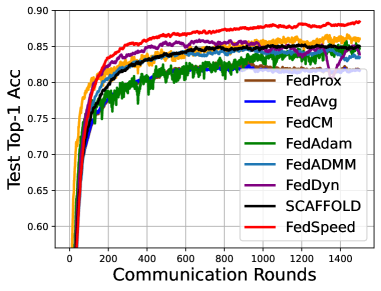
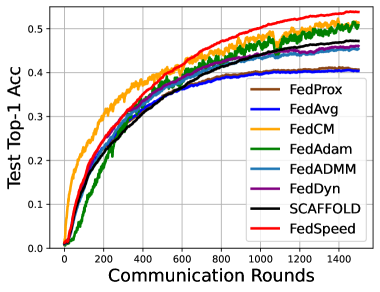
- FedSpeed는 실험에서 FedAvg, FedProx, FedCM, FedPD, SCAFFOLD, FedDyn, FedADMM에 비해 더 빠른 수렴과 향상된 일반화를 달성합니다.
- 더 큰 로컬 간격에서도 FedSpeed는 안정성을 유지하고 CIFAR-10/100 및 TinyImagenet에서 테스트 정확도를 향상시킵니다.
- 참여도 2%에서 500개 클라이언트의 경우, FedSpeed는 CIFAR-10/100 및 TinyImagenet의 IID 및 Dirichlet(0.6) non-IID 설정에서 최고의 테스트 정확도를 달성했습니다(강력한 기준선 대비 상대 이득 최대 약 3% 포인트).
- 이론적 결과는 로컬 간격 K가 적절히 크게 설정되고 학습률이 조정될 때 빠른 O(1/T) 수렴 속도를 보임을 나타냅니다.
이 논문 읽기
누빈트 뷰어에서 원문을 열고, 읽으면서 궁금한 곳을 바로 물어보세요.
누빈트에서 이 논문 읽기이 리뷰는 AI가 논문 원문을 바탕으로 만들었습니다. 인용하기 전에 원문을 확인해 주세요.