
[논문 리뷰] Few-shot Classification via Ensemble Learning with Multi-Order Statistics
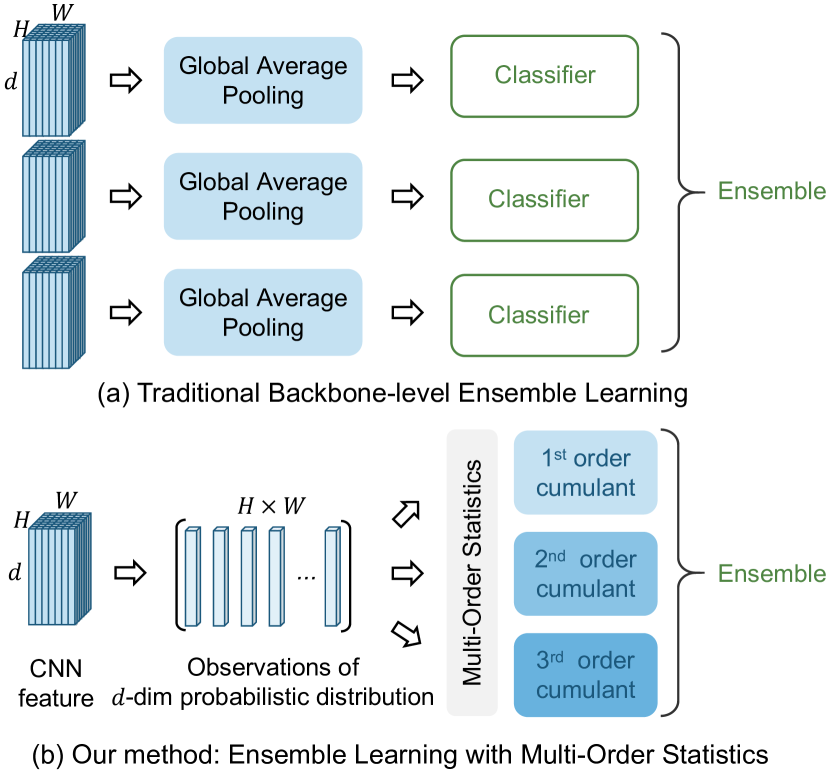
이 논문은 공유 백본에서 추출한 특징에 대해 일차, 이차, 삼차 통계 풀링을 적용하여 다양한 파rameter가 없는 학습자들을 생성하고, 앙상블 학습을 통해 신규 클래스에 대한 일반화 성능을 향상시키는 ELMOS라는 새로운 소수의 분류 방법을 제안한다. 공유 백본에서 추출한 특징에 일차, 이차, 삼차 통계 풀링을 적용함으로써 ELMOS는 서로 다른 특징 분포의 측면을 포괄하는 다각도의 파rameter가 없는 학습자들을 생성하고, 이를 공동으로 훈련함으로써 기존의 앙상블 방법보다 낮은 저장 및 계산 비용으로 miniImageNet, CIFAR-FS, CUB에서 최신 기술 수준(SOTA)의 성능을 달성한다.
Transfer learning has been widely adopted for few-shot classification. Recent studies reveal that obtaining good generalization representation of images on novel classes is the key to improving the few-shot classification accuracy. To address this need, we prove theoretically that leveraging ensemble learning on the base classes can correspondingly reduce the true error in the novel classes. Following this principle, a novel method named Ensemble Learning with Multi-Order Statistics (ELMOS) is proposed in this paper. In this method, after the backbone network, we use multiple branches to create the individual learners in the ensemble learning, with the goal to reduce the storage cost. We then introduce different order statistics pooling in each branch to increase the diversity of the individual learners. The learners are optimized with supervised losses during the pre-training phase. After pre-training, features from different branches are concatenated for classifier evaluation. Extensive experiments demonstrate that each branch can complement the others and our method can produce a state-of-the-art performance on multiple few-shot classification benchmark datasets.
연구 동기 및 목표
- 기본 클래스에서의 앙상블 학습이 소수의 분류에서 새로운 클래스에 대한 일반화 오차를 이론적으로 어떻게 감소시키는지 설명하는 것.
- 기존의 앙상블 방법이 소수의 분류에서 높은 계산 및 저장 비용을 유발하는 문제를 해결하는 것.
- 딥 테처의 다중 순서 통계를 활용하여 다양성과 성능을 향상시키는 파rameter가 없는 앙상블 메커니즘을 설계하는 것.
- 다양한 순서의 통계가 소수의 분류를 향상시키기 위해 보완적인 학습자들을 생성하는 데 효과적인지 검증하는 것.
제안 방법
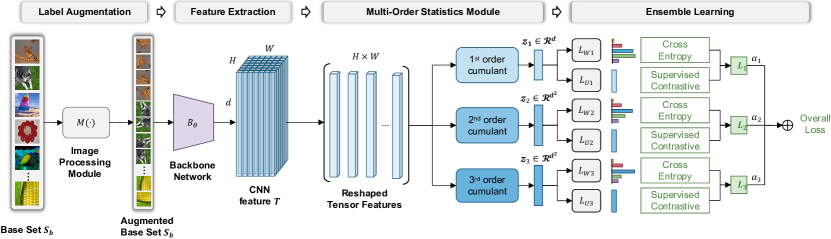
- 이 방법은 공유 백본 네트워크를 기반으로 하며, 이를 따라 다중 평행 브랜치를 구현하며, 각 브랜치는 특징 맵에 대해 다른 순서의 통계 풀링(1차, 2차, 3차)을 적용한다.
- 각 브랜치는 앙상블 내의 개별 학습자로 기능하며, 추가 파rameter가 없어 효율적인 공동 훈련이 가능하다.
- 특징의 분류 능력과 일반화 성능 향상을 위해 분류 기반(CB) 및 유사도 기반(SB) 손실의 조합을 사용하여 앙상블을 훈련시킨다.
- 사전 훈련 후, 모든 브랜치의 특징를 연결하여 분류기로 전달하여 새로운 클래스에서 평가한다.
- 다양한 순서의 통계를 사용함으로써 특징 분포의 서로 다른 측면을 포착함으로써 학습자 간의 다양성이 보장된다.
- 이 방법은 전이 학습을 위해 설계되었으며, 에피소드 기반 샘플링 없이 전체 기본 데이터셋을 활용함으로써 메타학습에서 발생하는 정보 손실을 방지한다.
실험 결과
연구 질문
- RQ1기본 클래스에서의 앙상블 학습이 소수의 분류에서 진짜 오차를 이론적으로 감소시킬 수 있는가?
- RQ2다양한 순서의 통계 풀링이 특징의 다양성과 분류 성능에 어떻게 기여하는가?
- RQ3공유 백본을 사용하는 파rameter가 없는 앙상블이 기존의 앙상블 방법보다 소수의 분류에서 더 낮은 계산 비용으로 성능을 뛰어넘을 수 있는가?
- RQ4제안된 프레임워크에서 분류 기반 및 유사도 기반 손실의 상대적 기여도는 어떠한가?
주요 결과
- ELMOS는 1-shot 5-way miniImageNet에서 78.18% ± 0.41의 정확도를 기록하여 이전의 최신 기술 수준(SOTA) 방법을 초월한다.
- 5-shot 5-way CIFAR-FS에서 ELMOS는 89.87% ± 0.31의 정확도를 달성하여 두 번째로 좋은 방법보다 0.31% 높다.
- CUB에서 ELMOS는 5-shot에서 95.02% ± 0.16의 정확도를 기록하며, 두 번째로 좋은 모델을 1.0% 초월한다.
- 절단 실험 결과, 일차, 이차, 삼차 통계를 모두 조합할 경우 단일 순서의 통계보다 더 높은 정확도를 달성함을 확인하여, 이들의 보완적 성격을 입증한다.
- CB와 SB 손실을 병합한 결과, 각각의 손실을 별도로 사용할 경우보다 더 뛰어난 성능을 보이며, 이는 두 가지 감독 신호의 중요성을 검증한다.
- ELMOS는 가장 유사한 방법인 EASY보다 전반적인 벤치마크에서 더 낮은 사전 훈련 시간과 더 높은 정확도를 기록하여 뚜렷한 승리를 거두었다.
이 논문 읽기
누빈트 뷰어에서 원문을 열고, 읽으면서 궁금한 곳을 바로 물어보세요.
누빈트에서 이 논문 읽기이 리뷰는 AI가 논문 원문을 바탕으로 만들었습니다. 인용하기 전에 원문을 확인해 주세요.