
[논문 리뷰] Flatten: Video Action Recognition is an Image Classification task
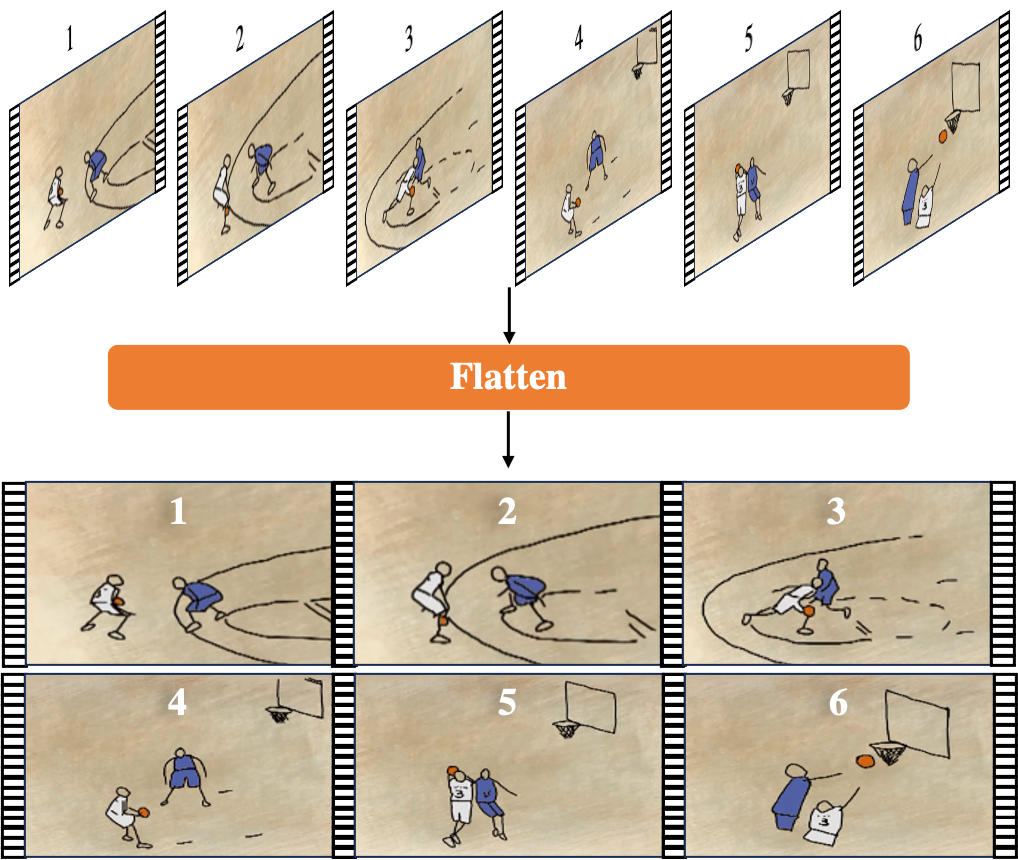
이 논문은 3D 비디오 클립을 행 우선 평탄화를 통해 2D 공간 표현으로 변환하는 플러그 앤 플레이 모듈인 Flatten을 제안한다. 이를 통해 표준 이미지 분류 모델이 비디오 동작을 효과적으로 인식할 수 있도록 한다. 시간적 시퀀스를 공간 레이아웃으로 변환함으로써, Flatten은 ResNet, SwinV2, Uniformer 백본을 사용할 때 Kinetics-400, Something-Want-2, HMDB-51에서 최신 기술 수준의 성능을 달성하며, 원래의 3D 대비 유의하게 뛰어난 성능을 보인다.
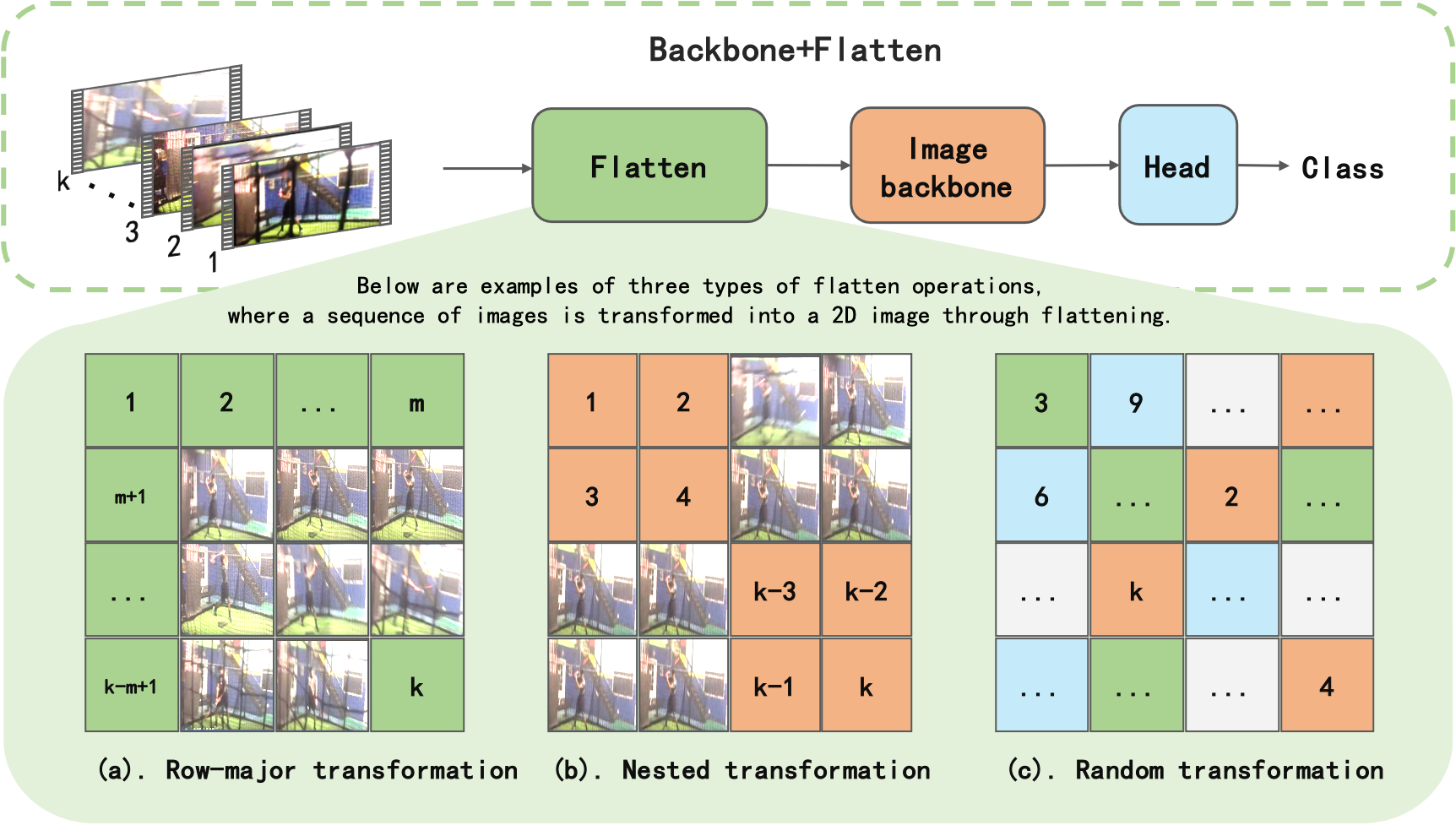
In recent years, video action recognition, as a fundamental task in the field of video understanding, has been deeply explored by numerous researchers.Most traditional video action recognition methods typically involve converting videos into three-dimensional data that encapsulates both spatial and temporal information, subsequently leveraging prevalent image understanding models to model and analyze these data. However,these methods have significant drawbacks. Firstly, when delving into video action recognition tasks, image understanding models often need to be adapted accordingly in terms of model architecture and preprocessing for these spatiotemporal tasks; Secondly, dealing with high-dimensional data often poses greater challenges and incurs higher time costs compared to its lower-dimensional counterparts.To bridge the gap between image-understanding and video-understanding tasks while simplifying the complexity of video comprehension, we introduce a novel video representation architecture, Flatten, which serves as a plug-and-play module that can be seamlessly integrated into any image-understanding network for efficient and effective 3D temporal data modeling.Specifically, by applying specific flattening operations (e.g., row-major transform), 3D spatiotemporal data is transformed into 2D spatial information, and then ordinary image understanding models are used to capture temporal dynamic and spatial semantic information, which in turn accomplishes effective and efficient video action recognition. Extensive experiments on commonly used datasets (Kinetics-400, Something-Something v2, and HMDB-51) and three classical image classification models (Uniformer, SwinV2, and ResNet), have demonstrated that embedding Flatten provides a significant performance improvements over original model.
연구 동기 및 목표
- 특수 3D 아키텍처가 필요 없도록 비디오 동작 인식을 단순화하기 위해.
- 2D 이미지 모델이 시간적 동역학을 모델링할 수 있도록 이미지와 비디오 이해 간 격차를 메우기 위해.
- 3D 공간-시간 모델링과 관련된 계산 복잡도와 학습 오버헤드를 줄이기 위해.
- 비디오 동작 인식이 최소한의 수정으로 표준 이미지 분류 프레임워크를 사용해 효과적으로 해결될 수 있음을 보여주기 위해.
- 3D 비디오 데이터를 2D 형태로 평탄화하는 것이 시간적 관계를 유지하고 활용하는 데 효과적인지 검증하기 위해.
제안 방법
- Flatten 모듈은 비디오 프레임 시퀀스를 단일 2D 이미지 텐서로 변환하기 위해 행 우선 평탄화 연산을 적용한다.
- 형태 (T, C, H, W)인 입력 비디오 클립은 T = n×m일 때 (C, H×n, W×m)로 재형성되며, 공간적 및 시간적 구조를 유지한다.
- 모델은 아키텍처 수정 없이 표준 이미지 분류 모델(예: ResNet, SwinV2, Uniformer)을 사용한다.
- 평탄화 연산은 2D 레이아웃에서의 공간적 위치 인코딩을 통해 시간적 의존성을 학습할 수 있도록 한다.
- 이 방법은 플러그 앤 플레이 방식이다: 백본 재학습이 필요 없으며 추론 전에 단일 전처리 단계만 필요하다.
- 이 방법은 다수의 평탄화 유형(예: 행 우선, 열 우선)을 지원하며, 시퀀스 길이에 따라 최적의 n과 m를 동적으로 선택한다.
실험 결과
연구 질문
- RQ13D 비디오 데이터를 2D 공간 형태로 변환한 후, 표준 2D 이미지 분류 모델을 사용해 비디오 동작 인식을 효과적으로 수행할 수 있는가?
- RQ2시간적 시퀀스를 공간 레이아웃으로 평탄화하는 것이 정확한 동작 인식을 위해 충분한 시간적 동역학을 유지하는가?
- RQ3평탄화된 비디오 표현의 성능는 전통적인 3D 컨볼루션 또는 트랜스포머 기반 비디오 모델과 비교해 어떻게 되는가?
- RQ4ResNet101+Flatten은 Kinetics-400에서 83.7%의 top-1 정확도를 기록하며 깊이 있는 아키텍처에서의 일관된 성능 향상을 보여준다.
- RQ5Flatten을 적용한 모델의 특징 맵 분석 결과, 더 깊은 층에서 점점 더 글로벌한 시간적 표현을 포착하는 것으로 확인되어 장거리 모델링이 효과적으로 이루어지는 것으로 나타났다.
주요 결과
- Flatten은 평가된 모든 데이터셋인 Kinetics-400, Something-Something v2, HMDB-51에서 동작 인식 정확도를 유의미하게 향상시켰다.
- Kinetics-400에서 Uniformer-S+Flatten은 85.1%의 top-1 정확도를 기록하여 원래의 3D Uniformer-S 모델을 초월했다.
- SwinV2-T+Flatten는 Kinetics-400에서 84.3%의 top-1 정확도를 기록하여 원래의 SwinV2-T 모델을 뛰어넘었다.
- ResNet101+Flatten는 Kinetics-400에서 83.7%의 top-1 정확도를 기록하며 깊이 있는 아키텍처에서의 일관된 성능 향상을 보였다.
- 시각화 결과, Uniformer-S+Flatten가 3D 버전 대비 더 집중적으로 운동 패턴을 인식하는 주의 메커니즘을 학습하는 것으로 나타났다.
- 특징 맵 분석을 통해, Flatten를 적용한 모델의 더 깊은 층에서 점점 더 글로벌한 시간적 표현을 포착하는 것으로 확인되어 효과적인 장거리 모델링이 이루어지는 것으로 나타났다.
이 논문 읽기
누빈트 뷰어에서 원문을 열고, 읽으면서 궁금한 곳을 바로 물어보세요.
누빈트에서 이 논문 읽기이 리뷰는 AI가 논문 원문을 바탕으로 만들었습니다. 인용하기 전에 원문을 확인해 주세요.