
[논문 리뷰] Forecasting Workload in Cloud Computing: Towards Uncertainty-Aware Predictions and Transfer Learning
이 논문은 클라우드 컴퓨팅 환경에서 불확실성 인식 워크로드 예측을 위한 단변량 및 이변량 베이지안 딥러닝 모델인 HBNN 및 LSTMD를 제안한다. 복잡한 불확실성과 경험적 불확실성을 모두 모델링함으로써, 신뢰도 기반 자원 할당을 통해 서비스 수준 메트릭을 향상시킨다. 전이 학습은 원천 도메인이 크고 목표 도메인과 유사할 경우에만 성공을 보였다.
Predicting future resource demand in Cloud Computing is essential for optimizing the trade-off between serving customers' requests efficiently and minimizing the provisioning cost. Modelling prediction uncertainty is also desirable to better inform the resource decision-making process, but research in this field is under-investigated. In this paper, we propose univariate and bivariate Bayesian deep learning models that provide predictions of future workload demand and its uncertainty. We run extensive experiments on Google and Alibaba clusters, where we first train our models with datasets from different cloud providers and compare them with LSTM-based baselines. Results show that modelling the uncertainty of predictions has a positive impact on performance, especially on service level metrics, because uncertainty quantification can be tailored to desired target service levels that are critical in cloud applications. Moreover, we investigate whether our models benefit transfer learning capabilities across different domains, i.e. dataset distributions. Experiments on the same workload datasets reveal that acceptable transfer learning performance can be achieved within the same provider (because distributions are more similar). Also, domain knowledge does not transfer when the source and target domains are very different (e.g. from different providers), but this performance degradation can be mitigated by increasing the training set size of the source domain.
연구 동기 및 목표
- 클라우드 리소스 수요 예측에서 복잡한 불확실성과 경험적 불확실성을 모두 포착하는 불확실성 인식 워크로드 예측 모델을 개발하는 것.
- 실제 구글 및 알리바바 클라우드 데이터셋에서 단변량 및 이변량 베이지안 신경망(HBNN)과 확률적 LSTMs(LSTMD)의 성능을 평가하는 것.
- 다른 클라우드 제공업체의 데이터셋 간에 불확실성 인식 모델의 전이 학습 능력을 조사하는 것, 특히 저자료 또는 분포 외 시나리오에서의 성능을 중심으로 한다.
- 불확실성 정량화가 신뢰도에 맞춘 자원 할당 전략을 가능하게 하여 클라우드 서비스 수준 메트릭을 향상시키는지 평가하는 것.
- 워크로드 예측에서 전이 학습이 성공하거나 실패하는 조건, 특히 도메인 유사성과 원천 데이터셋 크기 측면에서 조건을 규명하는 것.
제안 방법
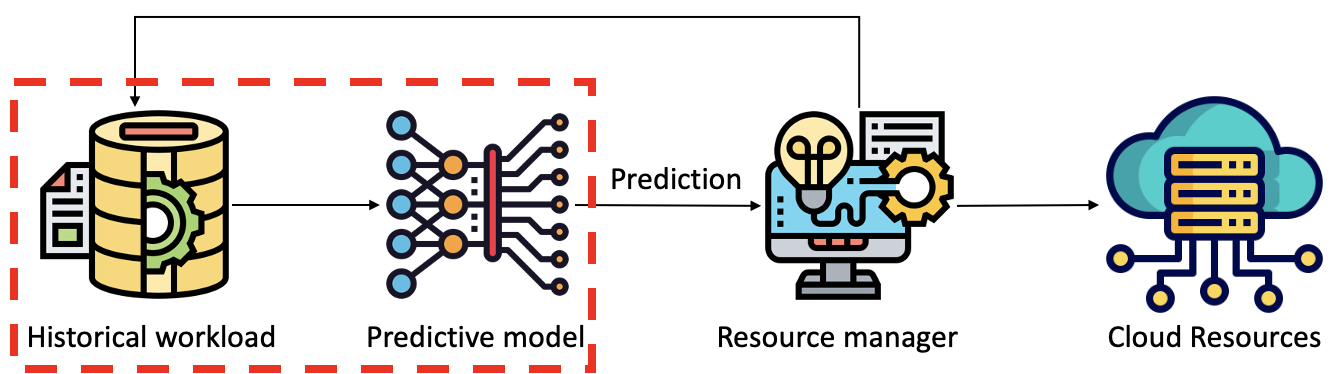
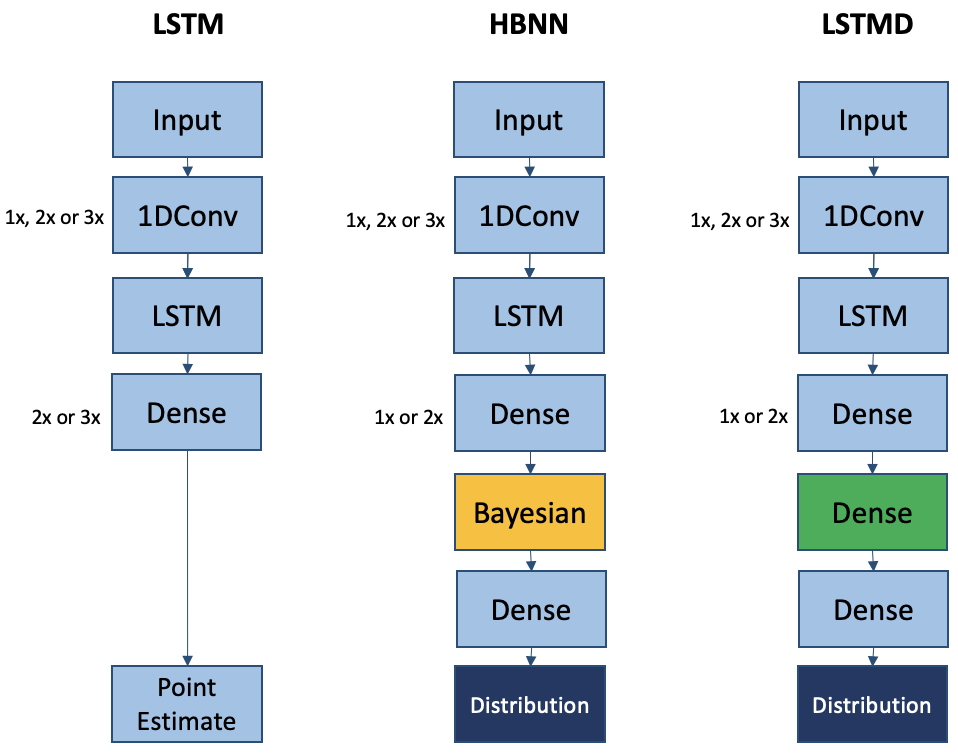
- CPU/GPU 및 메모리 사용량의 연합 분포를 예측할 수 있도록 베이지안 신경망(HBNN) 및 확률적 LSTMs(LSTMD) 아키텍처를 수정하여 불확실성 추정 기능을 구현한다.
- 더 큰 이변량 학습 데이터에서 표현 학습을 향상시키기 위해 레이어를 추가하여 모델의 표현 능력을 강화함으로써 일반화 능력을 향상시킨다.
- 다양한 제공업체의 데이터셋(Google 및 Alibaba)을 사용하여 전이 학습 성능을 평가하기 위해 모델을 훈련시켰다. 이는 제로샷 및 파인튜닝 시나리오를 포함한다.
- 원하는 서비스 수준에 맞게 조정된 신뢰도 기반 예측 구간을 사용하여 성능을 평가하였으며, 점 추정 정확도가 아닌 서비스 수준 메트릭을 기준으로 평가하였다.
- 원천 도메인(Google 등)에서 학습하고 목표 도메인(Alibaba 등)에서 테스트함으로써 전이 학습 성능을 평가하였으며, 도메인 간 분리가 증가함에 따라 성능 저하를 측정하였다.
- 비대칭 손실 함수와 사후 근사 기법을 도입하여 불확실성 추정의 정확도를 향상시켰다.
실험 결과
연구 질문
- RQ1불확실성 인식 딥러닝 모델이 점 추정을 초월하여 클라우드 워크로드 예측 성능을 향상시킬 수 있는가, 특히 서비스 수준 메트릭 측면에서?
- RQ2복잡한 불확실성과 경험적 불확실성을 동시에 모델링할 경우 클라우드 환경에서 예측 신뢰도와 자원 할당 결정에 어떤 영향을 미치는가?
- RQ3다른 클라우드 제공업체나 데이터 분포 간에 워크로드 예측 지식을 전이할 때 전이 학습이 성공하는 조건은 무엇인가?
- RQ4원천 도메인의 크기를 증가시키면 매우 다른 목표 도메인으로 전이할 경우 성능 저하를 완화할 수 있는가?
- RQ5실제 클라우드 시스템에 효과적으로 구현 가능한가? 특히 추론 지연 시간과 확장성 측면에서 수용 가능한 성능을 보이는가?
주요 결과
- 점 추정 정확도 지표에서 명확한 이점이 없더라도, 불확실성 모델링은 신뢰도 기반 자원 할당을 통해 서비스 수준 메트릭을 크게 향상시킨다.
- 다양한 데이터셋에서 훈련된 이변량 HBNN(M-B-HBNN)가 성능과 구현 복잡도 사이의 최적의 균형을 달성한다.
- 원천 도메인과 목표 도메인이 다른 클라우드 제공업체에서 오는 경우, 특히 원천 데이터셋이 작을 경우 전이 학습 성능이 크게 저하된다.
- 파인튜닝이 항상 전이 성능을 향상시키는 것은 아니며, 원천 도메인과 목표 도메인이 너무 다를 경우 지식 전이가 실패한다.
- 원천 도메인이 크고 목표 도메인의 다양성을 충분히 반영할 수 있을 때에만 수용 가능한 전이 학습 성능를 달성할 수 있다.
- 모든 모델의 런타임은 실시간 프로덕션 클라우드 환경에서의 구현을 지원하기에 충분히 효율적이다.
이 논문 읽기
누빈트 뷰어에서 원문을 열고, 읽으면서 궁금한 곳을 바로 물어보세요.
누빈트에서 이 논문 읽기이 리뷰는 AI가 논문 원문을 바탕으로 만들었습니다. 인용하기 전에 원문을 확인해 주세요.