
[논문 리뷰] Foundation Models for Decision Making: Problems, Methods, and Opportunities
본 논문은 기초모델이 의사결정에 어떻게 적응될 수 있는지 설문하고, 생성 모델링, 표현 학습, 인터랙티브 에이전트 패러다임을 개괄하며, 기초모델과 순차 의사결정의 교차점에서 남은 도전과 기회에 대해 논의한다.
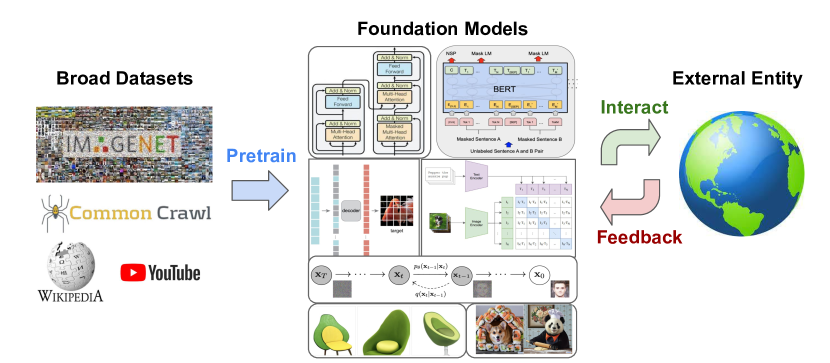
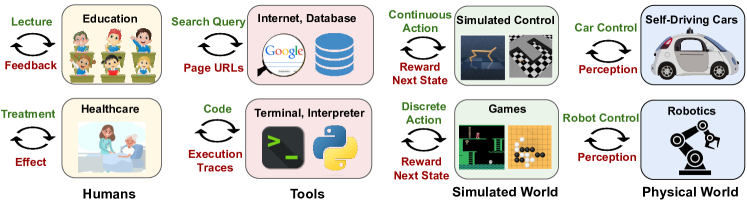
Foundation models pretrained on diverse data at scale have demonstrated extraordinary capabilities in a wide range of vision and language tasks. When such models are deployed in real world environments, they inevitably interface with other entities and agents. For example, language models are often used to interact with human beings through dialogue, and visual perception models are used to autonomously navigate neighborhood streets. In response to these developments, new paradigms are emerging for training foundation models to interact with other agents and perform long-term reasoning. These paradigms leverage the existence of ever-larger datasets curated for multimodal, multitask, and generalist interaction. Research at the intersection of foundation models and decision making holds tremendous promise for creating powerful new systems that can interact effectively across a diverse range of applications such as dialogue, autonomous driving, healthcare, education, and robotics. In this manuscript, we examine the scope of foundation models for decision making, and provide conceptual tools and technical background for understanding the problem space and exploring new research directions. We review recent approaches that ground foundation models in practical decision making applications through a variety of methods such as prompting, conditional generative modeling, planning, optimal control, and reinforcement learning, and discuss common challenges and open problems in the field.
연구 동기 및 목표
- 기초모델을 순차적 의사결정과 통합하는 범위와 동기를 설명한다.
- 행동과 세계의 생성모델로서 기초모델이 작동하는 방식을 이해하기 위한 기술적 프레임워크와 도구를 제공한다.
- 의사결정 구성요소에 대한 표현 학습기로서 기초모델이 어떻게 작동할 수 있는지 탐구한다.
- 언어모델이 인터랙티브 작업에서 에이전트와 환경으로 작동하는 방법을 논의한다.
- 이 교차점에서 향후 연구를 안내할 수 있는 공개된 문제와 기회를 식별한다.
제안 방법
- MDP, RL, 모방학습, 계획, 최적 제어를 포함한 순차적 의사결정의 기초를 검토한다.
- 생성모형 가족(잠재변수, 자기회귀, 확산, 에너지 기반)을 설명하고 이것들의 의사결정과의 관련성을 다룬다.
- 기초모델이 행동 사전 정보와 환경 모델로 어떻게 사용될 수 있는지 설명한다.
- 플러그-앤-플레이 표현과 언어 보강된 작업 명세화를 통한 순차 의사결정을 논의한다.
- 대형 언어모델이 인터랙티브한 환경에서 에이전트, 환경 또는 도구로 작동하는 접근법을 개요한다.
실험 결과
연구 질문
- RQ1기초모델이 의사결정 과제에서 외부 엔터티와 상호작용하도록 어떻게 접지되고 적응될 수 있는가?
- RQ2연속 의사결정을 위한 행동과 세계 역학을 표현하도록 기초모델을 가능하게 하는 핵심 생성 모델링 접근법은 무엇인가?
- RQ3MDP에서 상태, 행동, 보상, 전이의 표현 학습기로서 기초모델은 어떻게 작용할 수 있는가?
- RQ4인터랙티브 과제에서 에이전트, 환경 및 도구 사용자로서 언어모델을 사용하는 데 있어 도전과 기회는 무엇인가?
주요 결과
- 기초모델은 다양한 행동 및 목표의 시퀀스를 모델링하여 행동 사전 정보와 일반화된 정책을 제공한다.
- 세계 역학의 생성모형화는 모델 기반 계획과 장기 추론을 의사결정 과제에서 가능하게 한다.
- 대규모 행동 데이터와 온라인 상호작용은 일반화된 에이전트를 특정 과제 정책을 넘어서 확장시킬 수 있다.
- 기초모델을 이용한 표현 학습은 플러그-앤-플레이 적응과 다중모달 작업 명세화를 지원한다.
- 언어모델은 인간과 도구와 상호작용하여 순차 의사결정 문제에서 에이전트와 환경으로 작동할 수 있다.
이 논문 읽기
누빈트 뷰어에서 원문을 열고, 읽으면서 궁금한 곳을 바로 물어보세요.
누빈트에서 이 논문 읽기이 리뷰는 AI가 논문 원문을 바탕으로 만들었습니다. 인용하기 전에 원문을 확인해 주세요.