
[논문 리뷰] Full Event Particle-Level Unfolding with Variable-Length Latent Variational Diffusion
가변 길이 잠재 확산 모델(Particle VLD)을 도입하여 detector-level 데이터에 조건화된 전체 이벤트, 입자 수준 언패킹을 수행. LHC의 semi-leptonic tt̄ 생산에서 시연.
The measurements performed by particle physics experiments must account for the imperfect response of the detectors used to observe the interactions. One approach, unfolding, statistically adjusts the experimental data for detector effects. Recently, generative machine learning models have shown promise for performing unbinned unfolding in a high number of dimensions. However, all current generative approaches are limited to unfolding a fixed set of observables, making them unable to perform full-event unfolding in the variable dimensional environment of collider data. A novel modification to the variational latent diffusion model (VLD) approach to generative unfolding is presented, which allows for unfolding of high- and variable-dimensional feature spaces. The performance of this method is evaluated in the context of semi-leptonic top quark pair production at the Large Hadron Collider.
연구 동기 및 목표
- 비싼 시뮬레이션에 의존하지 않고 검출기 효과를 언패킹하려는 동기를 부여한다.
- 가변 차원의 충돌 데이터에서 전체 이벤트 언패킹을 가능하게 한다(객체 수가 달라짐).
- 가변 관측량과 다중성을 다루도록 variational latent diffusion (VLD)를 확장한다.
- SM 및 BSM 주입과 함께 현실적인 LHC 유사 semi-leptonic t t̄ 이벤트에서 성능을 평가한다.
제안 방법
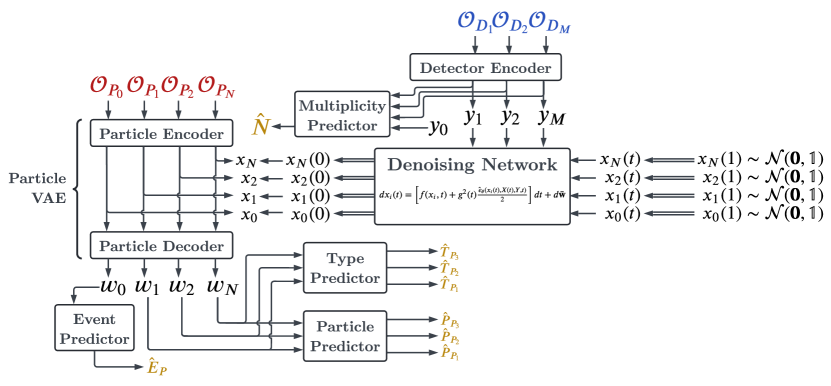
- 입자 수준 객체의 수에 대한 다중성 예측기를 도입하여 가변 길이 출력에 Variational Latent Diffusion (VLD)를 적응시킨다.
- 가변 길이 입자 객체를 잠재 공간으로 매핑하기 위해 transformer 기반 인코더/디코더를 갖는 Particle VAE를 사용한다.
- X|Y 생성용 조정 잠재 공간으로 detector-level 관측치를 매핑하기 위해 detector encoder를 사용한다.
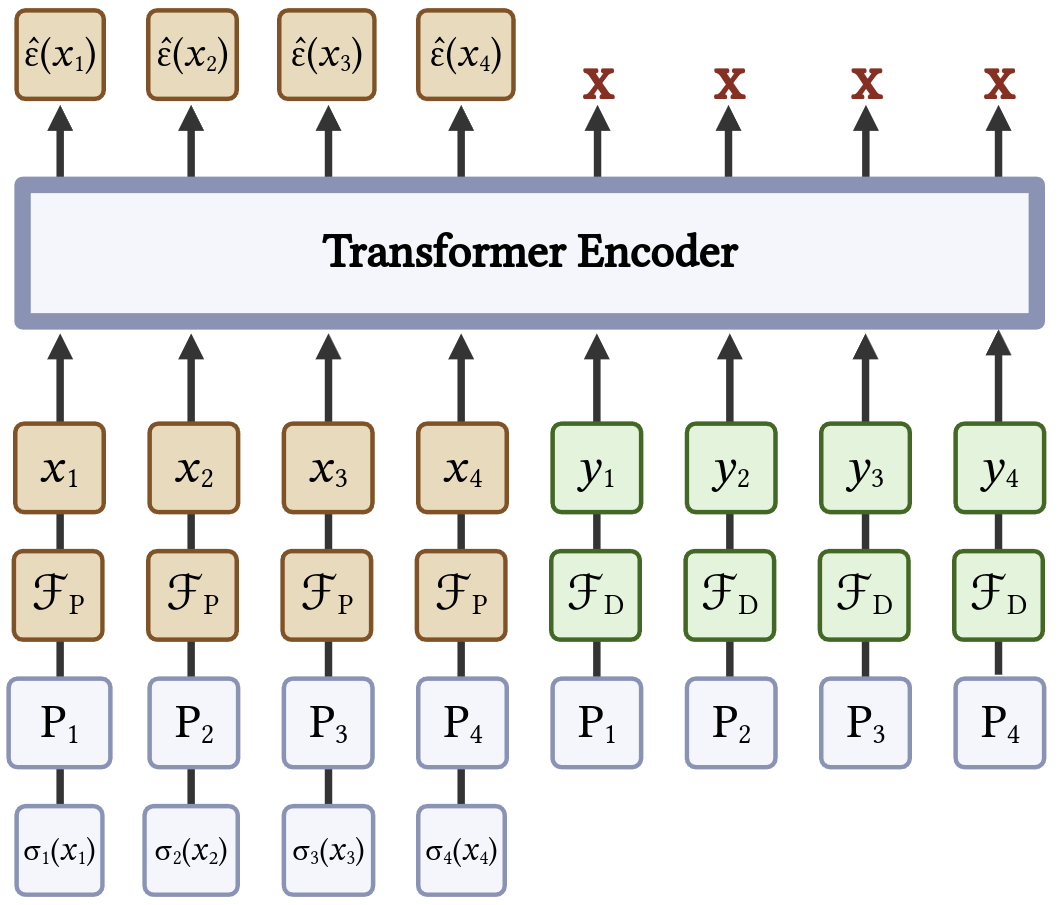
- 개별 객체별 노이즈 스케줄과 집합 조건화 디노이징 네트워크를 갖는 원소별, 객체별 확산 프로세스를 구현한다.
- 언패킹 중 가변 이벤트 크기를 다루기 위해 감마 분포 다중성 샘플을 도입한다.
실험 결과
연구 질문
- RQ1최종 상태 객체의 수가 가변일 때 전체 이벤트 입자 수준 언패킹이 달성될 수 있는가?
- RQ2검출기 수준 관찰에 조건화가 가변 차원에서 입자 수준의 운동학을 정확하게 재구성하는 데 도움이 되는가?
- RQ3SM 데이터 세트에서 방법의 성능은 어떠하며 참 분포가 섞이거나(BSM 주입) 변화했을 때는 어떤가?
- RQ4사전 선택의 영향이 언패킹 분포에 어떤 영향을 주며 반복적 사전 재가중 접근법으로 이를 완화할 수 있는가?
주요 결과
- 이 방법은 가변 다중성을 가진 입자 수준 관측치로의 언패킹을 가능하게 하며, semi-leptonic t t̄ 이벤트에서 시연되었다.
- 언패킹된 렌슨 및 제트 운동학 분포는 실제 입자 수준 분포와 탁월한 일치를 보이며, 일부 경계 영역에서 차이가 있다.
- 표 기반 지표(Wasserstein, Energy, KL)는 대부분의 관측값에 대해 언패킹 분포가 검출기 분포보다 진실에 더 가깝게 나타난다.
- 이 방법은 prior 분포 변화에 대한 강건성을 테스트하기 위해 물리 주입(BSM)을 지원한다.
- 확산 모델은 개별 객체의 노이즈 스케줄과 입자 수준 X와 검출기 수준 Y의 정보를 활용하는 컨텍스트 인식 디노이징 네트워크를 사용한다.
이 논문 읽기
누빈트 뷰어에서 원문을 열고, 읽으면서 궁금한 곳을 바로 물어보세요.
누빈트에서 이 논문 읽기이 리뷰는 AI가 논문 원문을 바탕으로 만들었습니다. 인용하기 전에 원문을 확인해 주세요.