
[논문 리뷰] Game-theoretic LLM: Agent Workflow for Negotiation Games
이 논문은 전략적 협상 환경에서 대규모 언어 모델(Large Language Models, LLMs)의 이성성을 향상시키기 위해 게임 이론 기반 에이전트 워크플로우를 제안한다. 고전적 게임 이론 원리—예를 들어 지배 전략 탐색과 역행 귀납법—을 LLM의 추론에 통합함으로써, 완전 정보 및 부분 정보 게임에서의 의사결정 능력이 크게 향상되며, 특히 Deal-or-No-Deal와 같은 복잡한 시나리오에서 near-optimal 결과를 도출하고 협상에서의 착취를 줄이는 데 기여한다.
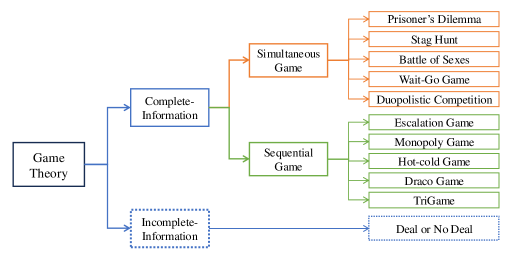
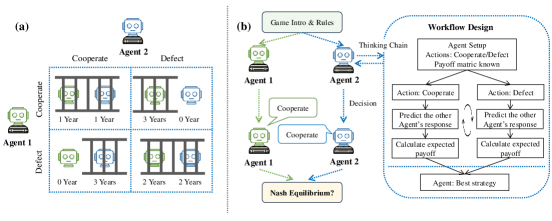
This paper investigates the rationality of large language models (LLMs) in strategic decision-making contexts, specifically within the framework of game theory. We evaluate several state-of-the-art LLMs across a spectrum of complete-information and incomplete-information games. Our findings reveal that LLMs frequently deviate from rational strategies, particularly as the complexity of the game increases with larger payoff matrices or deeper sequential trees. To address these limitations, we design multiple game-theoretic workflows that guide the reasoning and decision-making processes of LLMs. These workflows aim to enhance the models' ability to compute Nash Equilibria and make rational choices, even under conditions of uncertainty and incomplete information. Experimental results demonstrate that the adoption of these workflows significantly improves the rationality and robustness of LLMs in game-theoretic tasks. Specifically, with the workflow, LLMs exhibit marked improvements in identifying optimal strategies, achieving near-optimal allocations in negotiation scenarios, and reducing susceptibility to exploitation during negotiations. Furthermore, we explore the meta-strategic considerations of whether it is rational for agents to adopt such workflows, recognizing that the decision to use or forgo the workflow constitutes a game-theoretic issue in itself. Our research contributes to a deeper understanding of LLMs' decision-making capabilities in strategic contexts and provides insights into enhancing their rationality through structured workflows. The findings have implications for the development of more robust and strategically sound AI agents capable of navigating complex interactive environments. Code and data supporting this study are available at \url{https://github.com/Wenyueh/game_theory}.
연구 동기 및 목표
- 게임 복잡도가 증가함에 따라 최신 LLM의 전략적 게임 이론적 맥락에서의 이성성 평가
- 특히 부분 정보 및 순차적 게임에서 LLM의 협상 및 게임 플레이 과제 수행 시 관찰되는 이성적 행동에서의 이탈 현상 해결
- Nash 균형을 계산하고 최적의 결정을 내리도록 LLM 추론을 이끄는 게임 이론 기반 워크플로우 설계 및 검증
- 이러한 워크플로우를 협상 게임에서의 에이전트가 채택하는 것이 본질적으로 이성적인 메타전략적 선택인지 탐구
- 프롬프트 설계, 협상 순서, 에이전트 성격이 LLM의 이성성과 결과 효율성에 미치는 영향 탐색
제안 방법
- 지배 전략 탐색 기반 게임 이론 워크플로우 설계를 통해 상대방의 행동과 무관하게 수익을 극대화하는 전략을 식별
- 순차적 게임에서 역행 귀납법을 구현하여 종단 노드에서부터 루트까지 의사결정 트리를 분석해 최적 경로 도출
- 부분 정보 게임(예: Deal-or-No-Deal)을 위한 베이지안 업데이트 기반 워크플로우 개발로 파레토 최적 및 선호 없음 할당 가능
- 구조화된 추론 프롬프트 통합으로 LLM이 단계별 게임 이론 분석을 수행하도록 유도해 히وري스틱 또는 직관적 반응에 대한 의존도 감소
- 자기 일관성 있는 추론 체인을 활용해 LLM의 결정을 평가 및 개선하여 게임 이론 균형과의 일치 확보
- 다양한 게임 유형에서 제어 실험을 실시해 워크플로우의 유효성 평가하며, 워크플로우 유무에 따른 LLM 성능 비교
실험 결과
연구 질문
- RQ1수익 행렬 크기와 게임 깊이가 증가함에 따라 LLM이 완전 정보 게임에서 이성적 전략에서 얼마나 벗어나는가?
- RQ2게임 이론 기반 워크플로우가 LLM의 Nash 균형 식별 능력과 전략적 게임에서 최적의 결과 도달 능력을 현저히 향상시킬 수 있는가?
- RQ3Deal-or-No-Deal와 같은 부분 정보 협상 게임에서 워크플로우는 파레토 효율적 및 선호 없음 할당 달성에 어떻게 영향을 미치는가?
- RQ4LLM 에이전트가 협상 워크플로우를 채택하는 것이 이성적인가? 이러한 메타전략적 결정은 총 수익과 결과의 공정성에 어떻게 영향을 미치는가?
- RQ5프롬프트 어조, 협상 순서, 에이전트 성격 등의 요소가 협상 과제에서 LLM의 이성성과 일관성에 어떻게 영향을 미치는가?
주요 결과
- LLM은 특히 수익 행렬이 크거나 순차적 트리가 깊어지는 복잡한 게임에서 이성적 전략에서 벗어나는 경향을 보이며, 불확실성 하에서 복원력이 떨어진다.
- 게임 이론 기반 워크플로우 도입으로 LLM의 최적 전략 식별 능력이 크게 향상되었으며, 사슴 사냥 게임과 성별 갈등 게임과 같은 게임에서 협업 능력과 결과 효율성이 뚜렷이 향상되었다.
- Deal-or-No-Deal 협상 게임에서 베이지안 기반 워크플로우가 근접한 파레토 최적 및 선호 없음 할당을 가능하게 하여 비워크플로우 전략을 압도적으로 뛰어넘었다.
- 양측 모두 워크플로우를 사용할 경우 비협력적 또는 비체계적 협상 대비 집단 수익이 크게 증가하여 협업 능력과 상호 이득이 향상됨을 보여주었다.
- 잘 설계된 프롬프트로 협상이 LLM의 이성성에 미치는 영향은 완화되었지만, 협상 라운드가 많아질수록 이 효과가 약화되어 지속적인 추론 구조의 필요성을 시사했다.
- LLM은 인간과 다른 비이성적 패턴을 보이며, 단순한 성능 격차가 아니라 고유한 인지 편향을 지니고 있음을 시사하여 맞춤형 이성성 향상 기법의 필요성을 강조한다.
이 논문 읽기
누빈트 뷰어에서 원문을 열고, 읽으면서 궁금한 곳을 바로 물어보세요.
누빈트에서 이 논문 읽기이 리뷰는 AI가 논문 원문을 바탕으로 만들었습니다. 인용하기 전에 원문을 확인해 주세요.