
[논문 리뷰] Generative Retrieval via Term Set Generation
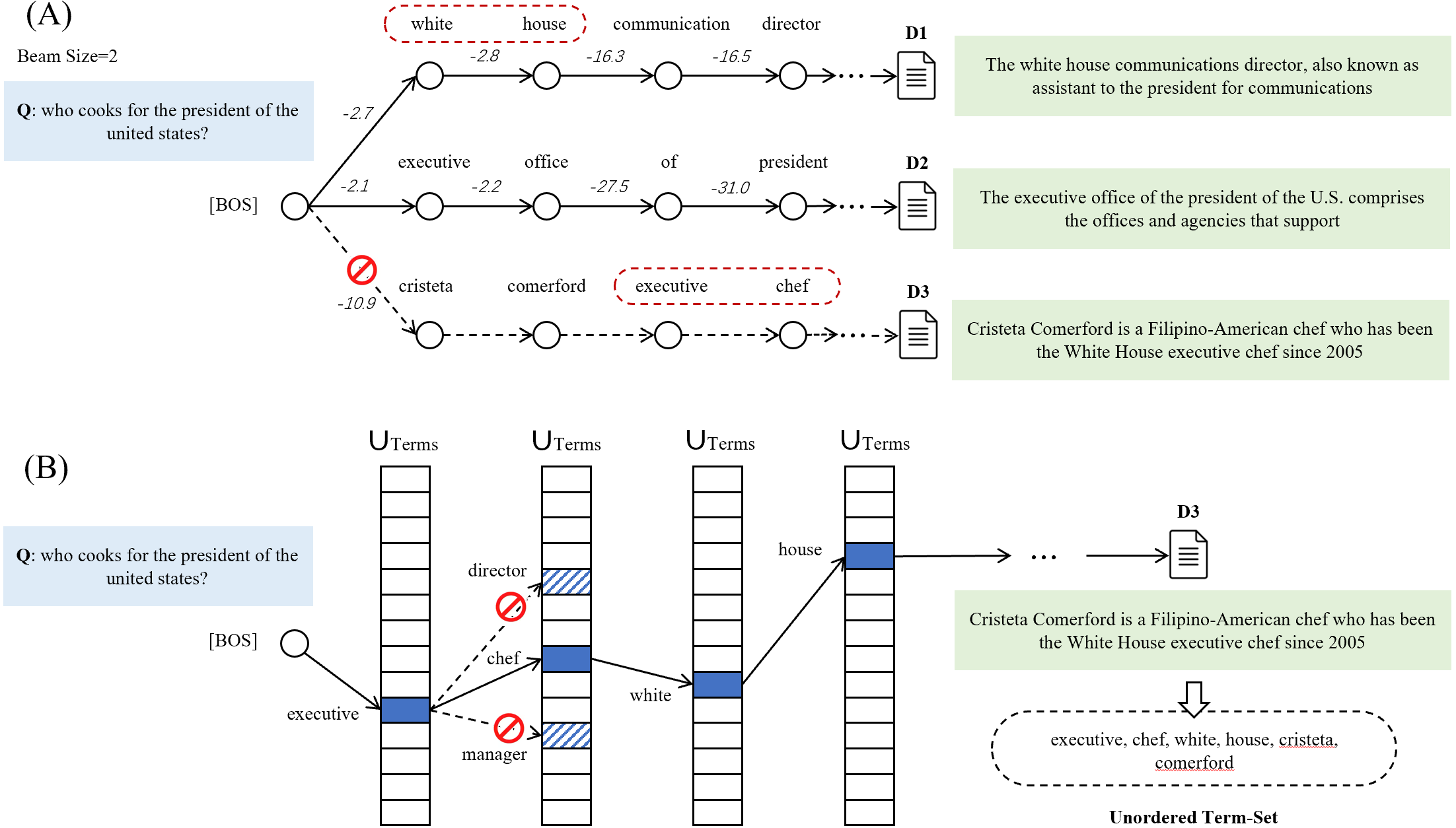
이 논문은 순서 없는 용어 집합을 문서 식별자로 사용하고, 정확한 순서 생성의 엄격한 요구를 완화하기 위해 집합 기반 생성을 허용하는 새로운 순차적 생성 기반 검색 프레임워크인 AutoTSG를 제안한다. 용어 집합의 어떤 순열이라도 올바른 문서를 검색할 수 있도록 함으로써 AutoTSG는 잘못된 가지치기(false pruning)를 크게 줄이고, Natural Questions 및 MS MARCO에서 최신 기술 수준의 성능을 달성하며, 기존 순차적 생성 모델보다 뚜렷한 성능 향상을 이룬다.
Recently, generative retrieval emerges as a promising alternative to traditional retrieval paradigms. It assigns each document a unique identifier, known as DocID, and employs a generative model to directly generate the relevant DocID for the input query. A common choice for DocID is one or several natural language sequences, e.g. the title or n-grams, so that the pre-trained knowledge of the generative model can be utilized. However, a sequence is generated token by token, where only the most likely candidates are kept and the rest are pruned at each decoding step, thus, retrieval fails if any token within the relevant DocID is falsely pruned. What's worse, during decoding, the model can only perceive preceding tokens in DocID while being blind to subsequent ones, hence is prone to make such errors. To address this problem, we present a novel framework for generative retrieval, dubbed Term-Set Generation (TSGen). Instead of sequences, we use a set of terms as DocID, which are automatically selected to concisely summarize the document's semantics and distinguish it from others. On top of the term-set DocID, we propose a permutation-invariant decoding algorithm, with which the term set can be generated in any permutation yet will always lead to the corresponding document. Remarkably, TSGen perceives all valid terms rather than only the preceding ones at each decoding step. Given the constant decoding space, it can make more reliable decisions due to the broader perspective. TSGen is also resilient to errors: the relevant DocID will not be pruned as long as the decoded term belongs to it. Lastly, we design an iterative optimization procedure to incentivize the model to generate the relevant term set in its favorable permutation. We conduct extensive experiments on popular benchmarks, which validate the effectiveness, the generalizability, the scalability, and the efficiency of TSGen.
연구 동기 및 목표
- 문서의 순차적 식별자를 잘못 생성할 경우 검색 실패가 발생하는 순차적 생성 검색 엔진에서의 잘못된 가지치기 문제를 해결한다.
- 고정된 순차적 문서 식별자에 대한 엄격함을 극복하기 위해, 어떤 순열이라도 올바른 문서를 검색할 수 있도록 순서 없는 용어 집합을 식별자로 도입한다.
- 생성 과정에서 문서 식별자의 최적 순열을 탐색할 수 있도록 해, 검색 품질을 향상시킨다.
- 유의미한 순열에 맞게 생성 과정을 적응시키는 학습 프레임워크를 설계하여, 다양한 쿼리에 대한 일반화 능력을 향상시킨다.
- 용어 집합 기반 식별자와 집합 기반 생성이 효율성에 거의 영향을 주지 않으면서도 검색 성능을 뛰어나게 한다는 것을 입증한다.
제안 방법
- 문서 제목과 첫 번째 문단에서 추출한 매칭 중심의 용어 선택 전략을 사용해 기존의 순차적 문서 식별자를 순서 없는 용어 집합으로 대체한다.
- 문서 식별자를 집합으로 간주하여, 용어의 어떤 순열이라도 올바른 문서를 검색할 수 있도록 하는 집합 기반 생성 파이프라인을 도입한다.
- 추론 중에 쿼리 기반의 가능도 점수를 기반으로 최적의 용어 집합 순열을 생성하기 위해 제약 조건이 있는 탐욕적 검색을 사용한다.
- 동적으로 목표 순열을 조정하여 가장 유력한 생성 경로와 일치시키는, 가능도 적응형 Seq2Seq 학습 목표를 설계한다.
- 용어의 중요도 기반 초기화를 사용하여, 쿼리에 대한 추정 관련도 순서로 용어를 정렬함으로써 학습 안정성과 수렴성을 향상시킨다.
- 데이터 증강을 위해 표준 모델(예: DocT5)을 사용해 쿼리 생성을 통합하여, 핵심 프레임워크를 변경하지 않고도 모델의 일반화 능력을 향상시킨다.
실험 결과
연구 질문
- RQ1순서 없는 용어 집합이 순차적 생성 검색 엔진에서 강력하고 구별 가능한 문서 식별자로 기능할 수 있는가?
- RQ2문서 식별자의 순열을 자유롭게 허용하면 잘못된 가지치기가 감소하고 검색 정확도가 향상되는가?
- RQ3가능도 적응형 학습이 추론 중 최적의 용어 집합 순열 생성에 어떻게 기여하는가?
- RQ4초기화 전략(랜덤, 가능도 기반, 중요도 기반)이 모델 성능과 수렴성에 어떤 영향을 미치는가?
- RQ5AutoTSG는 기존의 순차적 생성 검색 방법보다 뛰어난 성능을 내면서도 얼마나 효율성을 유지하는가?
주요 결과
- AutoTSG는 Natural Questions 및 MS MARCO 벤치마크에서 최신 기술 수준의 성능을 달성하였으며, NQ320k에서 recall@10이 0.766, recall@100이 0.938이다.
- 가능도 적응형 학습 방법은 학습 중에 유력한 순열 경로와 일치하도록 목표를 동적으로 조정함으로써 검색 품질을 크게 향상시킨다.
- 중요도 기반 초기화는 랜덤 또는 가능도 기반 초기화보다 우수한 성능을 내며, 이는 쿼리-문서 관련도와의 더 나은 일치 때문일 것이다.
- DocT5를 통한 쿼리 생성은 검색 성능을 크게 향상시키지만, AutoTSG는 데이터 증강 없이도 여전히 우위를 유지한다.
- 백본 T5 모델을 대규모로 확장하면 성능이 더욱 향상되며, 다양한 모델 크기에서 AutoTSG는 베이스라인 대비 상대적인 성능 향상을 유지한다.
- 효율성 분석 결과 AutoTSG는 최소한의 오버헤드를 유발하며, 메모리 사용량 35MB, 지연 시간 0.06초(빔 크기 10)를 기록하여 다른 방법과 유사하고, SEAL과 같이 메모리 소비가 큰 대안보다는 훨씬 낮다.
이 논문 읽기
누빈트 뷰어에서 원문을 열고, 읽으면서 궁금한 곳을 바로 물어보세요.
누빈트에서 이 논문 읽기이 리뷰는 AI가 논문 원문을 바탕으로 만들었습니다. 인용하기 전에 원문을 확인해 주세요.