
[논문 리뷰] GMS-3DQA: Projection-based Grid Mini-patch Sampling for 3D Model Quality Assessment
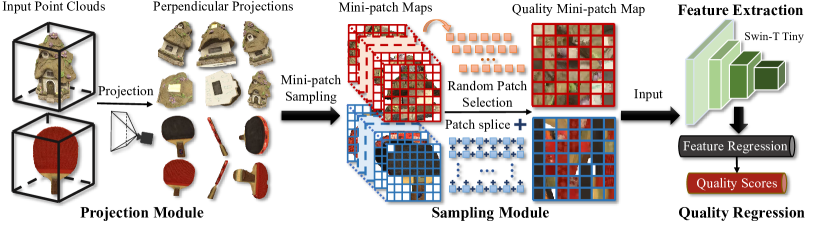
이 논문은 다중 투영 그리드 미니패치 샘플링을 사용하여 계산 비용을 줄이면서도 높은 정확도를 유지하는 비참조 3D 품질 평가 방법인 GMS-3DQA를 제안한다. 여섯 개인 투영도를 렌더링하고, 이를 통해 미니패치를 추출하며, 이를 하나의 품질 미니패치 맵(QMM)으로 융합함으로써 효율적인 Swin-Transformer 기반 특징 추출을 가능하게 하여, 이전 방법들보다 3.28배 빠른 추론 속도와 더 적은 파라미터를 달성함으로써 최신 기술 수준의 성능을 달성한다.
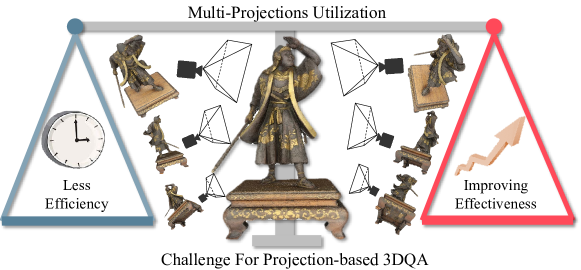
Nowadays, most 3D model quality assessment (3DQA) methods have been aimed at improving performance. However, little attention has been paid to the computational cost and inference time required for practical applications. Model-based 3DQA methods extract features directly from the 3D models, which are characterized by their high degree of complexity. As a result, many researchers are inclined towards utilizing projection-based 3DQA methods. Nevertheless, previous projection-based 3DQA methods directly extract features from multi-projections to ensure quality prediction accuracy, which calls for more resource consumption and inevitably leads to inefficiency. Thus in this paper, we address this challenge by proposing a no-reference (NR) projection-based extit{\underline{G}rid \underline{M}ini-patch \underline{S}ampling \underline{3D} Model \underline{Q}uality \underline{A}ssessment (GMS-3DQA)} method. The projection images are rendered from six perpendicular viewpoints of the 3D model to cover sufficient quality information. To reduce redundancy and inference resources, we propose a multi-projection grid mini-patch sampling strategy (MP-GMS), which samples grid mini-patches from the multi-projections and forms the sampled grid mini-patches into one quality mini-patch map (QMM). The Swin-Transformer tiny backbone is then used to extract quality-aware features from the QMMs. The experimental results show that the proposed GMS-3DQA outperforms existing state-of-the-art NR-3DQA methods on the point cloud quality assessment databases. The efficiency analysis reveals that the proposed GMS-3DQA requires far less computational resources and inference time than other 3DQA competitors. The code will be available at https://github.com/zzc-1998/GMS-3DQA.
연구 동기 및 목표
- 기존의 투영 기반 3D 품질 평가(3DQA) 방법의 높은 계산 비용과 긴 추론 시간 문제를 해결하기 위해.
- 다중 투영 특징 추출에서의 중복을 줄이면서도 정확한 평가를 위해 충분한 품질 정보를 유지하기 위해.
- 다양한 3D 모델 유형과 왜곡에 걸쳐 높은 성능을 유지하는 효율적인 비참조 3DQA 프레임워크를 개발하기 위해.
- 목표 도메인에서 최소한의 레이블 데이터로 효과적인 도메인 간 일반화를 가능하게 하기 위해.
제안 방법
- 기하학적 및 시각적 품질 정보를 포괄적으로 반영하기 위해 3D 모델에서 여섯 개의 수직 투영도를 렌더링하기 위해.
- 각 투영도에서 겹치지 않는 미니패치를 추출하기 위해 다중 투영 그리드 미니패치 샘플링 전략(MP-GMS)을 적용하기 위해.
- 모든 여섯 각도에서 추출된 미니패치를 하나의 품질 미니패치 맵(QMM)으로 융합하여 다중 시점 품질 패턴을 통합하기 위해.
- QMM에서 계층적이고 품질 인식 특징을 추출하기 위해 Swin-Transformer의 타이니 백본을 사용하여 최종 품질 예측을 수행하기 위해.
- 감각적으로 일치하는 품질 표현을 학습하기 위해 대규모 3DQA 데이터베이스에서 모델을 엔드 투 엔드로 훈련하기 위해.
- 전체 투영도를 처리하는 것과 비교해 입력 토큰 수와 계산 연산 수를 줄임으로써 효율성 최적화를 위해.
실험 결과
연구 질문
- RQ1투영 기반 3DQA 방법이 계산 비용과 추론 시간을 크게 줄이면서도 높은 정확도를 달성할 수 있는가?
- RQ2제안된 그리드 미니패치 샘플링 전략이 다중 투영 입력 간의 중복을 얼마나 효과적으로 줄이는가?
- RQ3품질 미니패치 맵(QMM)이 개별 투영도를 처리하는 것과 비교해 성능 향상과 강건성 향상에 어느 정도 기여하는가?
- RQ4제안된 방법이 포인트 클라우드와 메쉬와 같은 다양한 3D 데이터 형식 간에 제한된 레이블 데이터로도 잘 일반화되는가?
- RQ5정확도와 효율성 측면에서 제안된 방법이 비참조 및 전참조 3DQA 기준 모델과 비교해 어떻게 성능을 내는가?
주요 결과
- GMS-3DQA는 포인트 클라우드 및 메쉬 품질 평가 데이터베이스에서 모두 최신 기술 수준의 성능을 달성하였으며, 교차 도메인 평가에서 SJTU 데이터셋에서는 SRCC 0.75, WPC 데이터셋에서는 0.60을 기록하였다.
- CPU에서 가장 빠른 경쟁 3DQA 방법보다 3.28배 더 빠르며, 파라미터 수와 FLOPs가 크게 줄어들었다.
- SJTU-PCQA 및 WPC 데이터베이스에서, GMS-3DQA는 각각 14개 및 15개의 비참조 지표보다 통계적으로 유의미하게 뛰어난 성능을 보였다.
- TMQ 데이터베이스에서 훈련된 GMS-3DQA는 최고의 내부 도메인 모델과 비교해 경쟁적인 성능(SJTU에서 SRCC: 0.75, WPC에서 SRCC: 0.60)을 달성하여 강력한 도메인 일반화 능력을 보였다.
- PCQA 데이터베이스에서 GMS-3DQA는 전참조 방법과 통계적으로 구분되지 않아, 높은 감각 정확도를 확인하였다.
- QMM 기반 접근법은 다중 시점에서의 품질 패턴을 통합함으로써 중복을 줄이고 강건성을 향상시켰다.
이 논문 읽기
누빈트 뷰어에서 원문을 열고, 읽으면서 궁금한 곳을 바로 물어보세요.
누빈트에서 이 논문 읽기이 리뷰는 AI가 논문 원문을 바탕으로 만들었습니다. 인용하기 전에 원문을 확인해 주세요.