
[논문 리뷰] How to build the best medical image segmentation algorithm using foundation models: a comprehensive empirical study with Segment Anything Model
이 논문은 17개의 의료 영상 데이터셋에서 SAM의 18개 파인튜닝 전략을 경험적으로 비교하고, 의료 영상 분할을 위한 효과적인 PEFT 기반 접근법과 데이터셋 가용성 시나리오를 식별한다.
Automated segmentation is a fundamental medical image analysis task, which enjoys significant advances due to the advent of deep learning. While foundation models have been useful in natural language processing and some vision tasks for some time, the foundation model developed with image segmentation in mind - Segment Anything Model (SAM) - has been developed only recently and has shown similar promise. However, there are still no systematic analyses or "best-practice" guidelines for optimal fine-tuning of SAM for medical image segmentation. This work summarizes existing fine-tuning strategies with various backbone architectures, model components, and fine-tuning algorithms across 18 combinations, and evaluates them on 17 datasets covering all common radiology modalities. Our study reveals that (1) fine-tuning SAM leads to slightly better performance than previous segmentation methods, (2) fine-tuning strategies that use parameter-efficient learning in both the encoder and decoder are superior to other strategies, (3) network architecture has a small impact on final performance, (4) further training SAM with self-supervised learning can improve final model performance. We also demonstrate the ineffectiveness of some methods popular in the literature and further expand our experiments into few-shot and prompt-based settings. Lastly, we released our code and MRI-specific fine-tuned weights, which consistently obtained superior performance over the original SAM, at https://github.com/mazurowski-lab/finetune-SAM.
연구 동기 및 목표
- 어떤 SAM 파인튜닝 전략이 의학 영상 분할 성능이 가장 좋게 나오는지 조사한다.
- 다양한 의료 영상 모달리티에 걸쳐 SAM 기반 접근법을 전통적인 UNet 기반 방법과 비교한다.
- 데이터셋 가용성 시나리오가 파인튜닝 전략 선택에 미치는 영향을 평가한다.
- 의학 영상에서 사전 학습 전략(과제 확장 프롬프트 및 자기지도 학습)과 소샷/인터랙티브 분할 설정을 탐구한다.
제안 방법
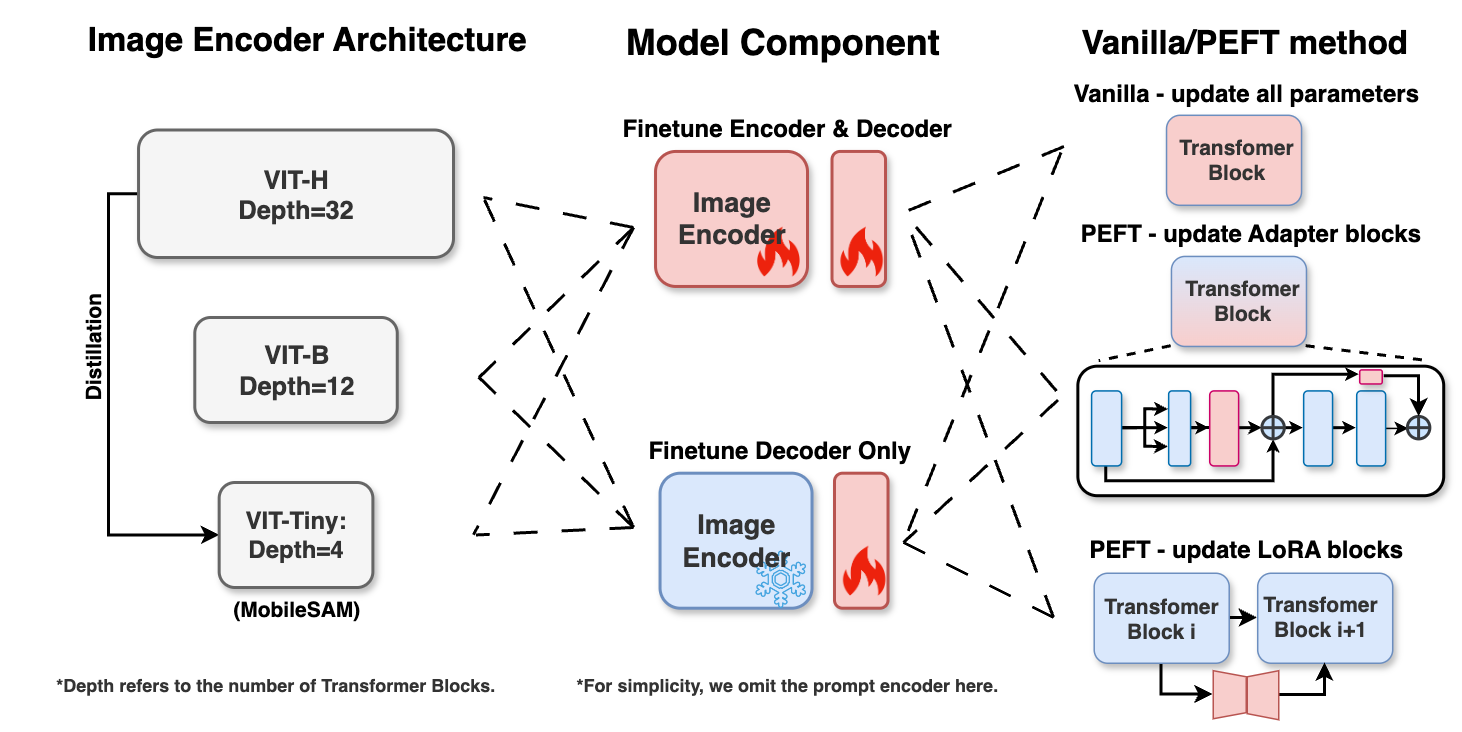
- 의료 데이터셋에서 SAM을 파인튜닝하여 18개 아키텍처–구성요소–방법 조합을 평가한다.
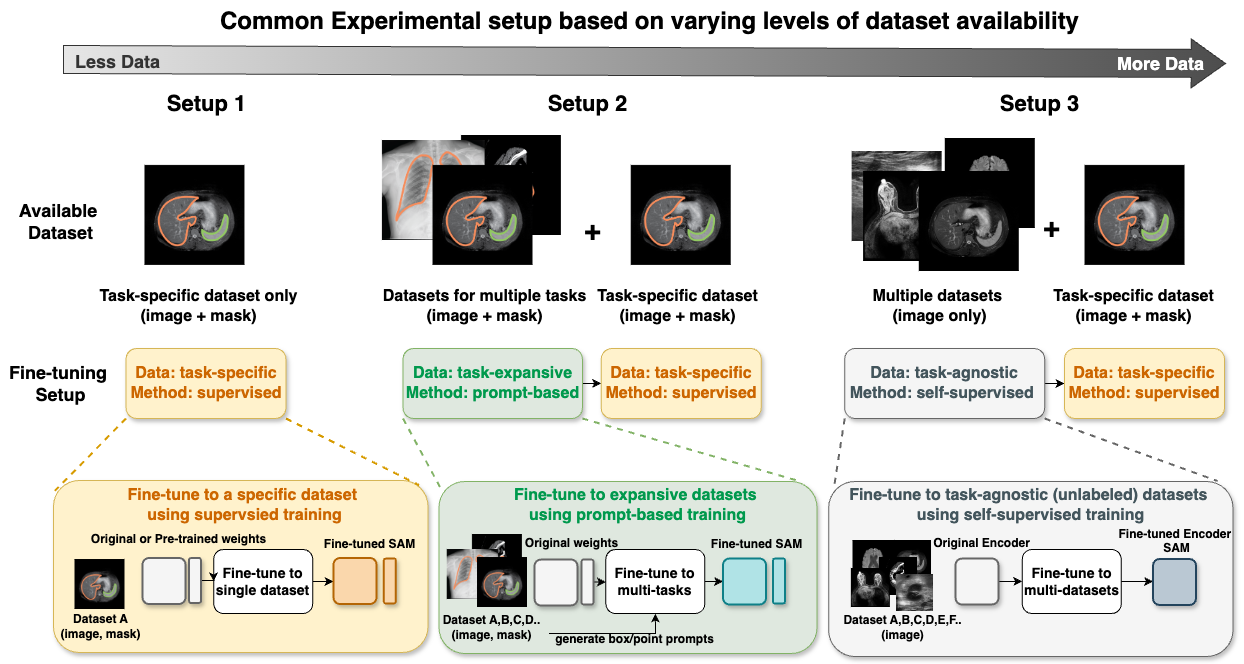
- 단일 표기된 데이터셋, 다중 표기 데이터셋, 그리고 다중 표기 + 비표기 데이터셋의 세 가지 데이터 가용성 시나리오를 고려한다.
- 디코더/인코더/바닐라 및 PEFT 변형(Adapter 및 LoRA)과 함께 ViT-H, ViT-B, ViT-T 백본을 사용한다.
- 데이터 가용성에 따라 순서대로 과제별 감독 학습, 과제 확장 프롬프트 기반 학습, 과제 비의존적 자기지도 학습(MAE)을 적용한다.
- 17개 데이터셋에서 SAM 파인튜닝을 UNet, nnUNet, SwinUNet 기초치와 비교하고 Dice Similarity Coefficient (DSC)을 보고한다.
- 재현을 위한 MRI-전용 사전학습 가중치와 코드를 제공한다.
실험 결과
연구 질문
- RQ1다양한 데이터 가용성 시나리오에서 의학 영상 분할을 위한 최적의 SAM 파인튜닝 전략은 무엇인가?
- RQ2PEFT 방법(Adapter/LoRA)이 의학 영상에서 SAM의 바닐라 파인튜닝보다 더 성능이 우수한가?
- RQ3추가적인 사전학습(과제 확장 프롬프트 또는 자기지도 MAE)이 의학 데이터셋에서 SAM 성능을 향상시킬 수 있는가?
- RQ4다양한 방사선학 모달리티와 장기에 대해 SAM은 전통적인 UNet 기반 방법과 어떻게 비교되는가?
주요 결과
- 인코더와 디코더를 모두 파인튜닝하고 PEFT(Adapter 또는 LoRA)를 사용하는 것이 디코더만 업데이트하는 것보다 일반적으로 DSC를 더 좋게 만든다.
- PEFT를 사용할 때 인코더 선택의 영향이 더 작다; 데이터 크기와 학습 안정성으로 인해 의료 작업에서 더 작은 백본(ViT-B 또는 ViT-T)이 ViT-H를 능가할 수 있다.
- 일부 설정에서 자기지도 사전학습(MAE)과 과제 확장 프롬프트 기반 학습이 최종 성능을 더 향상시킬 수 있다.
- SAM 기반 방법은 복잡한 대상에서 일부 UNet 변형보다 우수할 수 있지만, 특정 데이터셋에서 간단한 대상에 대해서는 UNet 변형(nnUNet)이 뛰어나다.
- 큰 SAM(ViT-H, 인코더/디코더, Vanilla)을 직접 파인튜닝하면 일부 데이터셋에서 모델 붕괴로 이어질 수 있어 의료 환경에서 PEFT의 이점을 강조한다.
- 본 연구는 MRI 중심의 사전 학습과 재현을 위한 공개 가능한 코드베이스 및 미리 학습된 가중치를 제공한다.
이 논문 읽기
누빈트 뷰어에서 원문을 열고, 읽으면서 궁금한 곳을 바로 물어보세요.
누빈트에서 이 논문 읽기이 리뷰는 AI가 논문 원문을 바탕으로 만들었습니다. 인용하기 전에 원문을 확인해 주세요.