
[논문 리뷰] HSIDMamba: Exploring Bidirectional State-Space Models for Hyperspectral Denoising
HSIDMamba(HSDM)을 도입하는 양방향 상태-공간 모델로서, 고해상도 스펙트럼(HSI) 디노이징에 대해 선형(거의 선형)에 가까운 복잡도와 최근 트랜스포머 대비 더 빠른 추론 속도로 최첨단 성능을 달성한다.
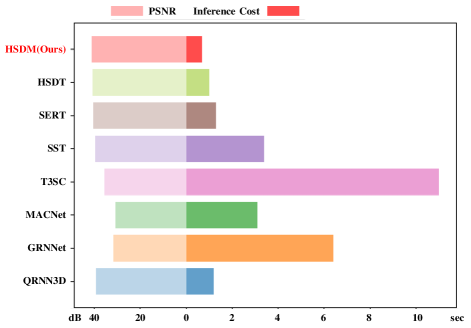
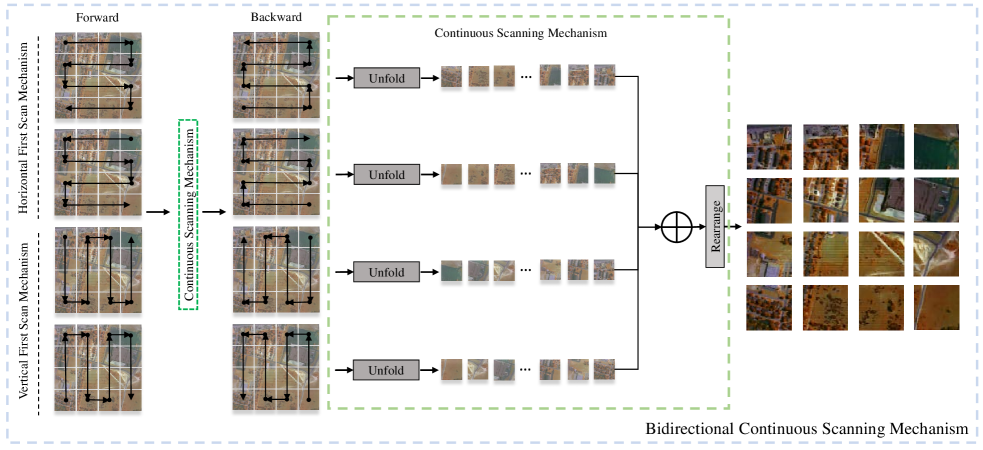
Effectively modeling global context information in hyperspectral image (HSI) denoising is crucial, but prevailing methods using convolution or transformers still face localized or computational efficiency limitations. Inspired by the emerging Selective State Space Model (Mamba) with nearly linear computational complexity and efficient long-term modeling, we present a novel HSI denoising network named HSIDMamba (HSDM). HSDM is tailored to exploit the capture of potential spatial-spectral dependencies effectively and efficiently for HSI denoising. In particular, HSDM comprises multiple Hyperspectral Continuous Scan Blocks (HCSB) to strengthen spatial-spectral interactions. HCSB links forward and backward scans and enhances information from eight directions through the State Space Model (SSM), strengthening the context representation learning of HSDM and improving denoising performance more effectively. In addition, to enhance the utilization of spectral information and mitigate the degradation problem caused by long-range scanning, spectral attention mechanism. Extensive evaluations against HSI denoising benchmarks validate the superior performance of HSDM, achieving state-of-the-art performance and surpassing the efficiency of the transformer method SERT by 31%.
연구 동기 및 목표
- 고해상도 스펙트럼 디노이징에서 효율적인 장거리 공간-스펙트럴 모델링의 필요성을 동기 부여한다.
- HSIDMamba(HSDM), HSI 디노이징에 맞추어 설계된 양방향 연속 상태 공간 아키텍처를 제안한다.
- 장거리 의존성을 포착하기 위해 양방향 연속 스캐닝, 스케일 잔차, 스펙트럴 어텐션을 도입한다.
- 트랜스포머 기반 방법에 비해 최첨단 디노이징 성능과 우수한 효율성을 입증한다.
제안 방법
- 길이가 긴 1D 스펙트럴 시퀀스를 처리하기 위해 Selective State Space Models(Mamba)를 양방향 연속 스캐닝으로 채택한다.
- 2D 공간 스캐닝과 채널 어텐션을 결합하는 Hyperspectral Continuous Scan Blocks(HCSB)을 도입한다.
- 8방향에 걸쳐 순방향 및 역방향 스캔을 연결하는 Bidirectional Continuous Scanning Mechanism(BCSM)을 사용한다.
- 레이어 정규화, Conv1D 처리 및 스펙트럴 어텐션을 적용하여 공간-스펙트럴 모델링을 강화한다.
- 혼합 노이즈 합성 데이터로 학습하고 PSNR, SSIM, SAM을 사용하여 디노이징 기반선과 비교 평가한다.
실험 결과
연구 질문
- RQ1양방향 선형 복잡도 상태 공간 모델이 CNN이나 Transformers에 비해 하이퍼스펙트럴 디노이징에서 장거리 공간-스펙트럴 의존성을 더 효율적으로 포착할 수 있는가?
- RQ2제안된 BCSM 및 HCSL 설계가 다양한 노이즈 조건에서 합성 및 실제 HSI 데이터 세트의 디노이징 품질(PSNR/SSIM/SAM)을 향상시키는가?
- RQ3HSIDMamba가 최근 트랜스포머 기반 디노이징 방법보다 더 빠르고 파라미터 효율적이면서 정확도를 유지하거나 향상시키는가?
- RQ4스캐닝 전략(양방향 대 단방향, sweep 대 cross) 및 hidden-dim 선택이 성능에 미치는 영향은 무엇인가?
주요 결과
- HSIDM은 Gaussian 및 혼합 노이즈 하에서 합성 ICVL/CAVE 데이터셋에 대해 최첨단 디노이징 성능을 달성한다.
- HSIDM은 SST, SERT, HSDT 등의 트랜스포머 기반 방법을 포함한 다수의 베이스라인에 비해 PSNR/SSIM/SAM 지표에서 우수한 성능을 보인다.
- 양방향 인접 스캐닝 메커니즘(BCSM)은 공간-스펙트럴 의존성 포착에서 다른 스캐닝 전략보다 우수하다.
- HSIDM은 선형 시간 복잡도로 실행되며 최신 트랜스포머 방법에 비해 추론이 더 빠르고(약 30% 빠름) 파라미터 효율이 우수하다.
- 에플레이트 연구는 Conv1D 처리, 채널 어텐션 및 최적의 블록/숨김 차원 설정이 최상의 성능에 중요함을 확인한다.
- 효율성 분석은 HSIDM이 스케일링 시 GPU 메모리와 FPS를 유지하면서 CAVE/WDC/Urban 데이터셋에서 베이스라인 대비 속도에서 우위를 보인다.
이 논문 읽기
누빈트 뷰어에서 원문을 열고, 읽으면서 궁금한 곳을 바로 물어보세요.
누빈트에서 이 논문 읽기이 리뷰는 AI가 논문 원문을 바탕으로 만들었습니다. 인용하기 전에 원문을 확인해 주세요.