
[논문 리뷰] Humanoid Locomotion as Next Token Prediction
원인적 트랜스포머가 휴머노이드 보행을 위한 토큰화된 감각-운동 궤적을 자기회귀적으로 예측하도록 학습되어 불완전한 모달리티를 포함한 다양한 데이터 소스를 활용해 현실 세계 제로샷 보행을 가능하게 한다.
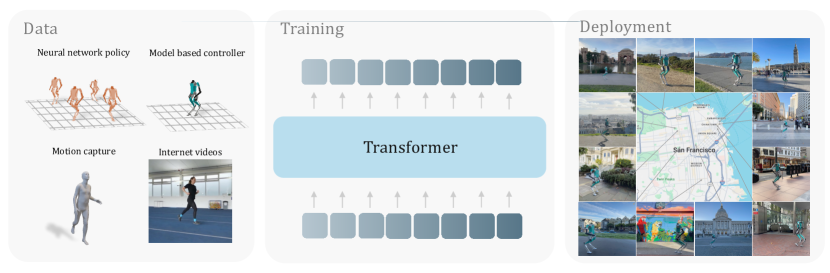
We cast real-world humanoid control as a next token prediction problem, akin to predicting the next word in language. Our model is a causal transformer trained via autoregressive prediction of sensorimotor trajectories. To account for the multi-modal nature of the data, we perform prediction in a modality-aligned way, and for each input token predict the next token from the same modality. This general formulation enables us to leverage data with missing modalities, like video trajectories without actions. We train our model on a collection of simulated trajectories coming from prior neural network policies, model-based controllers, motion capture data, and YouTube videos of humans. We show that our model enables a full-sized humanoid to walk in San Francisco zero-shot. Our model can transfer to the real world even when trained on only 27 hours of walking data, and can generalize to commands not seen during training like walking backward. These findings suggest a promising path toward learning challenging real-world control tasks by generative modeling of sensorimotor trajectories.
연구 동기 및 목표
- 센서-운동 궤적의 생성 모델링을 통해 현실 세계의 휴먼형 제어 학습을 촉진한다.
- 불완전한 데이터 소스를 처리할 수 있는 모달리티 정렬된 자기회귀 트랜스포머를 개발한다.
- 다양한 소스(사람 비디오 포함)에서의 학습이 현실 세계에서의 제로샷 배치를 가능하게 한다.
- 예측 품질이 보행 성능과 일반화에 어떤 관계를 가지는지 조사한다.
제안 방법
- 센서-운동 궤적을 토큰으로 토큰화하고 p(t)를 음의 대수 우도(negative log-likelihood)로 자기회귀적으로 모델링하는 인과적 트랜스포머를 학습한다.
- 다음 토큰을 입력 토큰과 같은 모달리티로 모델링하여 예측을 정렬한다.
- [M] 토큰으로 마스킹해 모달리티 누락을 처리하고 마스킹된 부분에 대한 손실은 무시한다.
- 신경정책, 모델 기반 제어기, MoCap, YouTube 비디오 등 이질적 데이터 소스에 대해 공동 또는 단계적 전략으로 학습한다.
- 위치 임베딩과 인과적 자기-주의를 가진 공유 트랜스포머를 사용하고, 별도의 모달리티 투영과 함께 작동한다.
실험 결과
연구 질문
- RQ1다양한 센서-운동 데이터로 학습된 자기회귀 트랜스포머 모델이 테스트 시 강화학습 없이 현실 세계의 휴먼형 보행을 달성할 수 있는가?
- RQ2모달리티 정렬, 누락 데이터 처리 및 공동 학습 대 단계적 학습이 성능과 일반화에 어떤 영향을 미치는가?
- RQ3부분적으로만 학습된 데이터(예: 사람 비디오)로 학습된 모델이 현실 세계에서 전체 휴머노이드로 얼마나 전이될 수 있는가?
- RQ4다음 토큰 예측 오차와 보행 트래킹 성능 간의 관계는 무엇인가?
- RQ5데이터 양, 컨텍스트 길이, 모델 크기의 확장이 보행 품질과 보지 못한 명령어에 대한 일반화에 어떤 영향을 주는가?
주요 결과
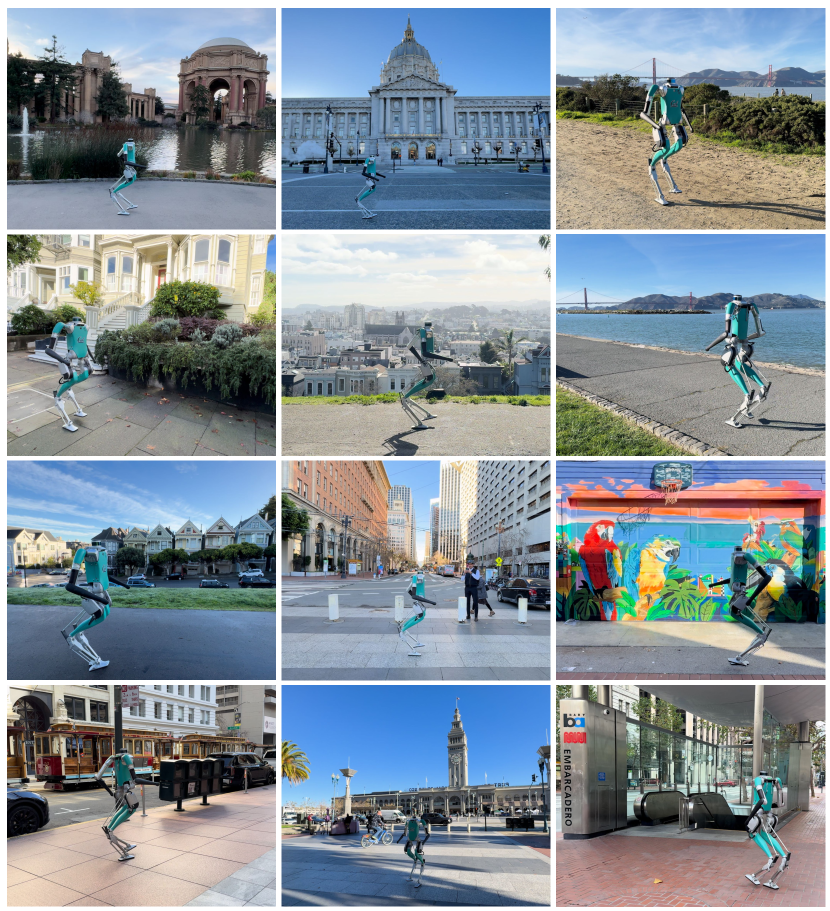
- 모델은 샌프란시스코의 다양한 표면에서 제로샷으로 전체 크기의 휴머노이드가 걸을 수 있게 한다.
- 제로샷 현실 세계 배치는 보행 데이터가 고작 27시간이어도 가능하다.
- 예측 오차는 트래킹 성능과 상관관계가 있다(r = 0.87).
- 불완전한 궤적(행동이 누락된 경우)을 포함시키면 완전 데이터만 사용하는 것보다 성능이 향상된다.
- 모달리티 예측이 정렬되면 비정렬 구성보다 트래킹 및 다음 토큰 예측 작업에서 더 우수하다.
- 이 접근법은 역주행 등 보지 못한 명령어에까지 일반화되며 데이터, 컨텍스트, 모델 크기의 증가와 함께 확장된다.
이 논문 읽기
누빈트 뷰어에서 원문을 열고, 읽으면서 궁금한 곳을 바로 물어보세요.
누빈트에서 이 논문 읽기이 리뷰는 AI가 논문 원문을 바탕으로 만들었습니다. 인용하기 전에 원문을 확인해 주세요.