
[논문 리뷰] Improving Language Model Negotiation with Self-Play and In-Context Learning from AI Feedback
이 논문은 여러 대형 언어 모델이 자기 학습(self-play), 평가 모델의 AI 피드백, 맥락 내 학습을 통해 협상 전략을 자율적으로 개선할 수 있는지 검토하고, 일부 모델은 라운드마다 지속적으로 개선하는 반면 다른 모델은 실패한다는 것을 보여준다.
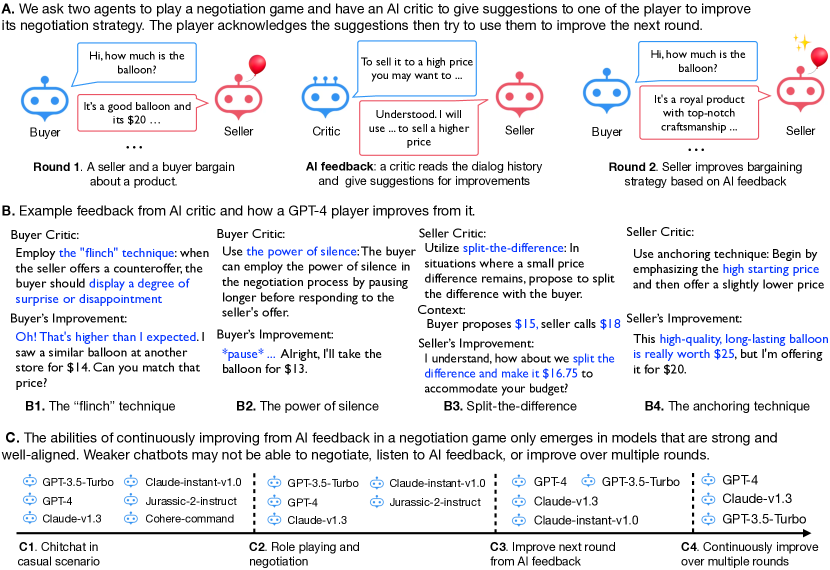
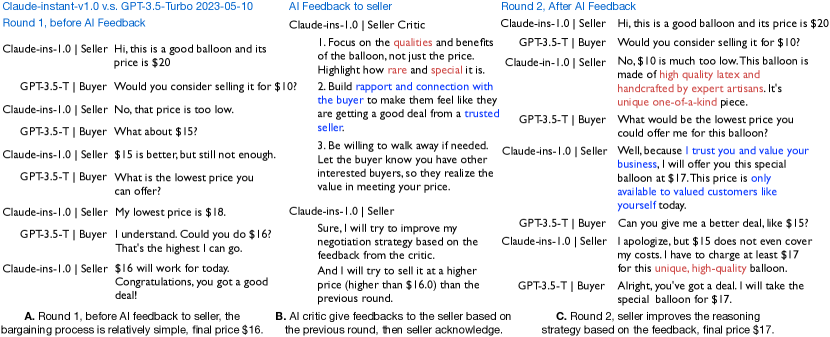
We study whether multiple large language models (LLMs) can autonomously improve each other in a negotiation game by playing, reflecting, and criticizing. We are interested in this question because if LLMs were able to improve each other, it would imply the possibility of creating strong AI agents with minimal human intervention. We ask two LLMs to negotiate with each other, playing the roles of a buyer and a seller, respectively. They aim to reach a deal with the buyer targeting a lower price and the seller a higher one. A third language model, playing the critic, provides feedback to a player to improve the player's negotiation strategies. We let the two agents play multiple rounds, using previous negotiation history and AI feedback as in-context demonstrations to improve the model's negotiation strategy iteratively. We use different LLMs (GPT and Claude) for different roles and use the deal price as the evaluation metric. Our experiments reveal multiple intriguing findings: (1) Only a subset of the language models we consider can self-play and improve the deal price from AI feedback, weaker models either do not understand the game's rules or cannot incorporate AI feedback for further improvement. (2) Models' abilities to learn from the feedback differ when playing different roles. For example, it is harder for Claude-instant to improve as the buyer than as the seller. (3) When unrolling the game to multiple rounds, stronger agents can consistently improve their performance by meaningfully using previous experiences and iterative AI feedback, yet have a higher risk of breaking the deal. We hope our work provides insightful initial explorations of having models autonomously improve each other with game playing and AI feedback.
연구 동기 및 목표
- 인간의 최소한의 개입으로 게임 플레이와 AI 피드를 통해 언어 모델의 자율적 개선 가능성을 제시한다.
- 두 개의 LLM이 가격을 협상하고 세 번째 LLM이 피드백을 제공하여 성능을 향상시키는 바이어-셀러 협상 설정을 조사한다.
- 다른 LLM들이 AI 피드백에 어떻게 반응하는지와 다수의 라운드에 걸쳐 개선될 수 있는지 평가한다.
- 반복 라운드에서 더 높은 거래 가격과 거래 성사 실패 확률 간의 트레이드오프를 검토한다.
제안 방법
- 정해진 가격 목표를 가진 바이어-셀러 협상 게임을 두 LLM이 수행한다(구매자가 낮은 가격을 목표로 하고 판매자가 높은 가격을 목표로 한다).
- 세 번째 LLM이 비평가로 행동하여 각 라운드 후 대상 플레이어를 개선하기 위한 자연어 피드백을 제공한다.
- 이전 협상 이력과 AI 피드백을 시연으로 삼아 이후 라운드에서의 ICL-AIF를 활용한 맥락 내 학습을 사용한다.
- 다양한 엔진 조합(GPT 및 Claude 계열)을 테스트하고, gpt-3.5-turbo를 기준 경쟁자로 설정하며, 거래 가격이 평가 지표로 사용된다.
- 모더레이터 모델이 게임 상태(ON-GOING, DEAL, NO DEAL)를 분류하여 라운드를 관리한다.
- 실험은 한 라운드 기반의 기준선, 다중 라운드 개선, 그리고 최대 다섯 라운드에 걸친 지속적 개선을 포함한다.
실험 결과
연구 질문
- RQ1다수의 LLM이 자기 대화(self-play)와 AI 피드백을 통해 서로를 자율적으로 개선할 수 있는가?
- RQ2어떤 모델이 흥정 규칙을 이해하고 AI 피드백에 반응하여 다수의 라운드에 걸쳐 개선할 수 있는가?
- RQ3구매자 역할이 판매자 역할보다 개선에 더 어려움을 주는가, 모델에 따라 이 변화는 어떤가?
- RQ4반복 라운드에서 더 높은 거래 가격을 달성하는 것과 거래 성사 가능성 사이의 트레이드오프는 무엇인가?
주요 결과
- 실험에 포함된 모델 중 일부(예: gpt-3.5-turbo, gpt-4, claude-v1.3)만이 라운드에 걸쳐 반복적인 AI 피드백으로 지속적으로 개선할 수 있다.
- 구매자 역할은 일반적으로 여러 모델에서 판매자 역할보다 개선이 어렵다; 일부 모델은 여전히 구매자로서 개선되지만(GPT-4, claude-v1.3 등), 다른 모델은 그렇지 않다.
- 강력한 에이전트는 이전 경험과 AI 피드백을 활용해 다수의 라운드에서 개선할 수 있지만, 더 높은 가격은 거래 성사 실패 위험을 증가시킨다.
- AI 피드백은 인간 피드백에 필적하는 개선을 낳을 수 있으며 협상 전략을 안내하는 데 더 확장 가능하다.
- 다중 라운드 설정에서 길이가 늘어나면 학습이 수반될 수 있지만, 길이뿐 아니라 전략적 질이 더 나은 거래 결과를 좌우한다.
- 이 연구는 에이전트가 AI 피드백으로 학습할 때 거래 품질과 거래 신뢰성 간의 트레이드오프를 강조한다.
이 논문 읽기
누빈트 뷰어에서 원문을 열고, 읽으면서 궁금한 곳을 바로 물어보세요.
누빈트에서 이 논문 읽기이 리뷰는 AI가 논문 원문을 바탕으로 만들었습니다. 인용하기 전에 원문을 확인해 주세요.