
[논문 리뷰] Integrating Large Language Models in Causal Discovery: A Statistical Causal Approach
논문은 통계적 인과 발견과 GPT-4를 통한 지식 기반 인과 추론을 결합한 프레임워크를 제안하여, 편향되었거나 보지 못한 데이터셋에서도 인과 그래프를 개선한다.
In practical statistical causal discovery (SCD), embedding domain expert knowledge as constraints into the algorithm is important for reasonable causal models reflecting the broad knowledge of domain experts, despite the challenges in the systematic acquisition of background knowledge. To overcome these challenges, this paper proposes a novel method for causal inference, in which SCD and knowledge-based causal inference (KBCI) with a large language model (LLM) are synthesized through ``statistical causal prompting (SCP)'' for LLMs and prior knowledge augmentation for SCD. The experiments in this work have revealed that the results of LLM-KBCI and SCD augmented with LLM-KBCI approach the ground truths, more than the SCD result without prior knowledge. These experiments have also revealed that the SCD result can be further improved if the LLM undergoes SCP. Furthermore, with an unpublished real-world dataset, we have demonstrated that the background knowledge provided by the LLM can improve the SCD on this dataset, even if this dataset has never been included in the training data of the LLM. For future practical application of this proposed method across important domains such as healthcare, we also thoroughly discuss the limitations, risks of critical errors, expected improvement of techniques around LLMs, and realistic integration of expert checks of the results into this automatic process, with SCP simulations under various conditions both in successful and failure scenarios. The careful and appropriate application of the proposed approach in this work, with improvement and customization for each domain, can thus address challenges such as dataset biases and limitations, illustrating the potential of LLMs to improve data-driven causal inference across diverse scientific domains. The code used in this work is publicly available at: www.github.com/mas-takayama/LLM-and-SCD
연구 동기 및 목표
- 도메인 지식을 통계적 인과 발견(SCD)에 통합하여 더 의미 있는 인과 모델을 얻는 것을 동기로 삼는다.
- SCD에 LLM 기반 배경 지식을 생성하고 통합하는 방법론(statistical causal prompting)을 제안한다.
- LLM이 안내하는 배경 지식이 SCD 성능과 데이터셋 편향에 대한 강건성을 향상시킬 수 있음을 보여준다.
- SCP가 여러 알고리즘과 데이터셋에서 LLM-KBCI 출력과 SCD 결과를 모두 향상시킬 수 있음을 보여준다.
제안 방법
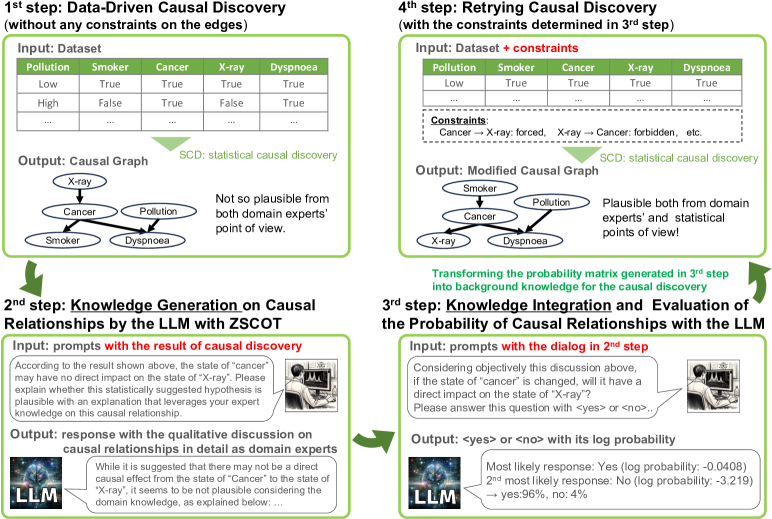
- 이전 지식 없이 데이터 X에 대해 PC, Exact Search, 혹은 DirectLiNGAM(S)으로 초기 SCD를 수행한다.
- 초기 SCD 결과(GKP)에 의해 inform된 zero-shot chain-of-thought 프롬프트를 사용하여 LLM(GPT-4)으로 모든 변수 쌍 간의 상세한 인과 지식을 생성한다.
- 인과 연결의 확률을 추정하기 위해 여러 시도로 LLM 응답을 평가한다(통계적 인과 prompting, SCP).
- LLM 유도 확률 행렬을 변환 규칙을 통해 사전 지식(PK) 행렬로 변환한 후 PK로 SCD를 재실행하여 정제된 그래프를 얻는다.
- 붓스트랩 재샘플링을 활용하여 엣지 확률을 정량화하고 규칙 기반 제약(금지/강제 엣지)을 통해 이를 사전 지식에 통합한다.
- 다양한 데이터셋(DWD 기후 데이터, 건강 선별 하위집합)과 SCD 알고리즘에서 강건성과 일반성을 평가한다.
실험 결과
연구 질문
- RQ1GPT-4에서 파생된 배경 지식이 SCP로 프롬 prompts되면 SCD가 학습한 인과 그래프의 정확도를 향상시킬 수 있는가?
- RQ2SCP가 상호 개선을 가능하게 하여 강화된 SCD 결과가 LLM-KBCI 출력을 further 개선하는가?
- RQ3제안된 LLM-지원 SCD가 GPT-4의 사전 학습 데이터에 포함되지 않은 데이터셋과 편향이 있는 경우에 효과적인가?
- RQ4LLM에 제공되는 정보의 양과 유형 등 SCP 패턴의 차이가 성능에 어떤 영향을 미치는가?
- RQ5이 접근법이 LLM 유도 사전 지식 활용하면서 통계적 타당성(CFI, RMSEA, BIC)을 유지할 수 있는가?
주요 결과
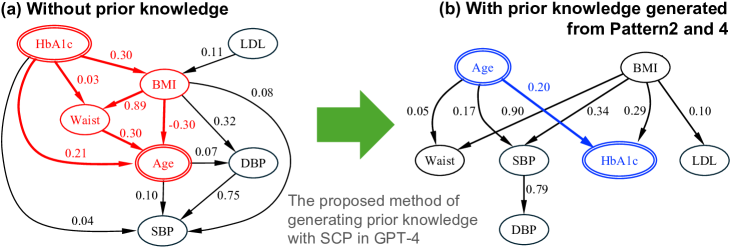
- SCP로 보강된 LLM 지향 배경 지식은 PK가 없는 SCD에 비해 Ground Truth에 더 가까운 SCD 결과를 가져온다.
- PK가 있는 SCD를 보강하면 종종 정밀도와 F1이 향상되고 BIC가 감소하여 도메인 지식으로 더 나은 모델 적합도를 보인다.
- SCP는 LLM-KBCI 출력과 다운스트림 SCD 결과 모두를 향상시켜 상호 성능 향상을 보여준다.
- 데이터셋이 GPT-4의 사전 학습 데이터에 포함되지 않았고 편향이 있을 수 있는 건강 선별 하위집합이어도 이 방법은 여전히 유익하다.
- DirectLiNGAM은 특정 프롬프트 패턴 하에서 SCP로부터 특히 이익을 얻어 패턴 의존적 개선을 보인다.
이 논문 읽기
누빈트 뷰어에서 원문을 열고, 읽으면서 궁금한 곳을 바로 물어보세요.
누빈트에서 이 논문 읽기이 리뷰는 AI가 논문 원문을 바탕으로 만들었습니다. 인용하기 전에 원문을 확인해 주세요.