
[논문 리뷰] Interlayer link prediction in multiplex social networks: an iterative degree penalty algorithm
이 논문은 다층 사회망에서의 계층 간 링크 예측을 위한 반복적 도수 페널티(Iterative Degree Penalty, IDP) 알고리즘을 제안한다. 네트워크 구조와 도수 페널티 원리를 활용하여 일치 정확도를 향상시킨다. 인접 행렬 곱셈을 통해 반복적으로 예측을 정밀화하고, 연결 수가 적은 공통 이웃을 우선시함으로써 IDP는 기존 방법들보다 뛰어나게 성능을 발휘하며, 특히 평균 도수와 공통 노드 수가 낮은 영역에서 최대 36.6%의 재현율 향상과 25.0%의 F1 점수 향상을 기록한다.
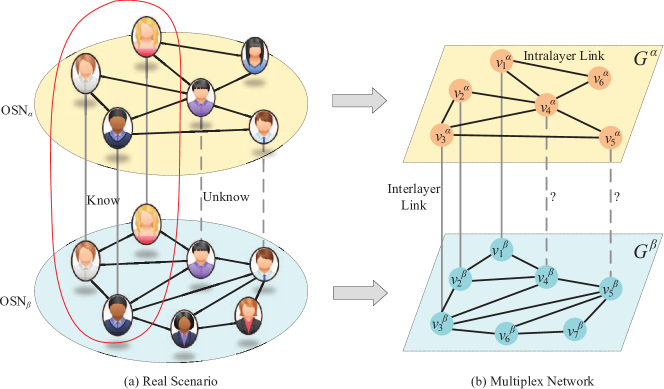
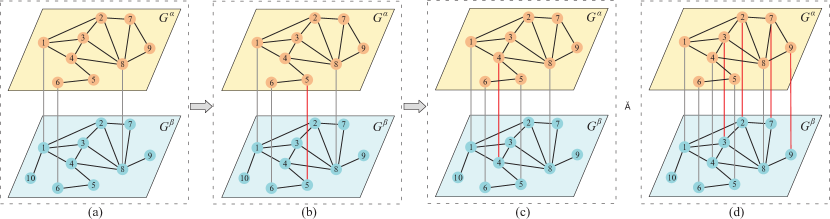
Online social network (OSN) applications provide different experiences; for example, posting a short text on Twitter and sharing photographs on Instagram. Multiple OSNs constitute a multiplex network. For privacy protection and usage purposes, accounts belonging to the same user in different OSNs may have different usernames, photographs, and introductions. Interlayer link prediction in multiplex network aims at identifying whether the accounts in different OSNs belong to the same person, which can aid in tasks including cybercriminal behavior modeling and customer interest analysis. Many real-world OSNs exhibit a scale-free degree distribution; thus, neighbors with different degrees may exert different influences on the node matching degrees across different OSNs. We developed an iterative degree penalty (IDP) algorithm for interlayer link prediction in the multiplex network. First, we proposed a degree penalty principle that assigns a greater weight to a common matched neighbor with fewer connections. Second, we applied node adjacency matrix multiplication for efficiently obtaining the matching degree of all unmatched node pairs. Thereafter, we used the approved maximum value method to obtain the interlayer link prediction results from the matching degree matrix. Finally, the prediction results were inserted into the priori interlayer node pair set and the above processes were performed iteratively until all unmatched nodes in one layer were matched or all matching degrees of the unmatched node pairs were equal to 0. Experiments demonstrated that our advanced IDP algorithm significantly outperforms current network structure-based methods when the multiplex network average degree and node overlapping rate are low.
연구 동기 및 목표
- 사용자 이름과 속성이 익명성 또는 개인정보 보호로 인해 다름에도 불구하고, 다양한 온라인 사회망(Online Social Networks, OSNs)의 사용자 계정이 동일한 개인에 속하는지 식별하는 데 어려움이 있는 상황을 해결하기 위함이다.
- 네트워크 구조가 정보의 주요 원천인 다층 네트워크에서, 특히 평균 도수가 낮고 노드 공통성이 낮은 조건에서 계층 간 링크 예측 정확도를 향상시키기 위함이다.
- 구조적 유사성과 도수 인지 가중치를 활용하여 교차 계층 노드를 효과적으로 매칭하는 효율적이고 확장 가능한 방법을 개발하기 위함이다.
- 예측된 링크를 반복적으로 통합함으로써 숨겨진 계층 간 링크를 발견하기 위해, 도수 계산과 최대값 선택을 반복하는 과정을 수행하기 위함이다.
제안 방법
- 도수 페널티 원리를 제안하여, 연결 수가 적은 공통 매칭 이웃에게 더 높은 가중치를 할당함으로써 스케일프리 네트워크에서 그 예측 능력이 더 강하다는 점을 반영한다.
- 모든 계층 간 매칭되지 않은 노드 쌍 간의 매칭 도수를 한 번의 연산으로 효율적으로 계산하기 위해 노드 인접 행렬 곱셈을 사용한다.
- 매칭 도수 행렬에서 최고 점수를 가진 계층 간 링크 예측을 추출하기 위해 승인된 최대값 방법을 적용한다.
- 예측된 링크를 사전 집합에 삽입하고, 도수 계산을 반복적으로 재실행하여 모든 매칭되지 않은 노드가 매칭되거나 모든 도수가 0이 될 때까지 반복적인 프로세스를 수행한다.
- 매칭 도수 계산에 도수 페널티를 통합하여, 공통 매칭 이웃의 수와 그 연결 수 수준의 영향을 반영한다.
- 실세계 네트워크를 활용한 자기 매칭 다층 네트워크 구축 전략을 통해 통제된 조건에서 성능을 평가한다.
실험 결과
연구 질문
- RQ1평균 도수와 노드 공통성 비율이 낮을 때, 다층 사회망에서 계층 간 링크 예측을 어떻게 향상시킬 수 있는가?
- RQ2이웃의 도수 분포가 공통 매칭 이웃의 신뢰성에 어떤 영향을 미치는가?
- RQ3진행적인 고신뢰도 예측을 매칭 과정에 점진적으로 통합함으로써 반복적 정밀화 프로세스가 예측 정확도를 향상시킬 수 있는가?
- RQ4공통 이웃의 도수 인지 가중치와 균일 가중치를 비교했을 때, 어떤 것이 계층 간 링크 예측에 더 효과적인가?
- RQ5인접 행렬 곱셈을 통해 모든 매칭되지 않은 노드 쌍 간의 매칭 도수를 효율적이고 확장 가능한 방식으로 계산할 수 있는가?
주요 결과
- IDP 알고리즘이 테스트된 모든 실세계 네트워크에서 FRUI 기준선을 초월하며, 최대 재현율 향상 36.6%와 평균 재현율 향상 7.0%를 기록했다.
- 정밀도는 최대 19.0% 향상되었고, 평균적으로 3.8% 향상되어 예측 링크에 대한 신뢰도가 높아졌다.
- F1 점수는 최대 25.0% 향상되었고, 평균적으로 5.0% 향상되어 일관된 전반적 성능 향상을 보였다.
- IDP의 성능 향상은 전통적 방법이 어려움을 겪는 평균 도수가 낮고 노드 공통성이 낮은 네트워크에서 가장 두드러졌다.
- 재현율, 정밀도, F1 점수의 향상 비율은 $ p $ 가 증가함에 따라 처음에는 증가하다가 감소하는 경향을 보이며, 노이즈 수준과 비단조화적인 관계를 보였다.
- 고도수 노드가 매칭 지표로써 신뢰도가 낮은 스케일프리 네트워크에서, 도수 페널티를 적용하여 매칭 점수에서 고도수 노드를 제거함으로써 알고리즘이 효과적으로 대처했다.
더 나은 연구,지금 바로 시작하세요
논문 읽기부터 검토까지, 연구 시간을 획기적으로 줄여보세요.
카드 등록 없음 · 무료 플랜 제공
이 리뷰는 AI가 만들고, 인간 에디터가 검토했습니다.