
[논문 리뷰] Interpreting CLIP with Sparse Linear Concept Embeddings (SpLiCE)
이 논문은 개념 레이블이나 재학습 없이도 CLIP의 조밀하고 해석하기 어려운 이미지 표현을 희박하고 비음수인 인간이 이해할 수 있는 개념들의 선형 조합으로 분해하는 후행적(post-hoc) 방법인 SpLiCE를 제안한다. 이 방법은 최소한의 성능 저하로 높은 해석 가능성과 함께, 편향 탐지, 모델 편집, 분포 이탈 모니터링 등의 응용을 가능하게 하며, 최신 기술 수준의 성능을 유지한다.
CLIP embeddings have demonstrated remarkable performance across a wide range of multimodal applications. However, these high-dimensional, dense vector representations are not easily interpretable, limiting our understanding of the rich structure of CLIP and its use in downstream applications that require transparency. In this work, we show that the semantic structure of CLIP's latent space can be leveraged to provide interpretability, allowing for the decomposition of representations into semantic concepts. We formulate this problem as one of sparse recovery and propose a novel method, Sparse Linear Concept Embeddings, for transforming CLIP representations into sparse linear combinations of human-interpretable concepts. Distinct from previous work, SpLiCE is task-agnostic and can be used, without training, to explain and even replace traditional dense CLIP representations, maintaining high downstream performance while significantly improving their interpretability. We also demonstrate significant use cases of SpLiCE representations including detecting spurious correlations and model editing.
연구 동기 및 목표
- 실제 응용에서 투명성을 제한하는 조밀한 CLIP 표현의 해석 불가능성 문제를 해결하기 위해.
- 개념 애너테이션, 재학습, 정성적 시각화 없이도 CLIP 표현의 후행적 해석을 가능하게 하기 위해.
- 다운스트림 성능을 유지하면서 CLIP 표현을 희박하고 인간이 이해할 수 있는 의미적 구성요소로 분해하는 방법을 개발하기 위해.
- 의미적으로 해석 가능한 표현의 실용적 응용을 보여주기 위해, 특히 허위 상관관계 탐지, 모델 편집, 데이터셋 분포 이탈 모니터링을 포함하여.
제안 방법
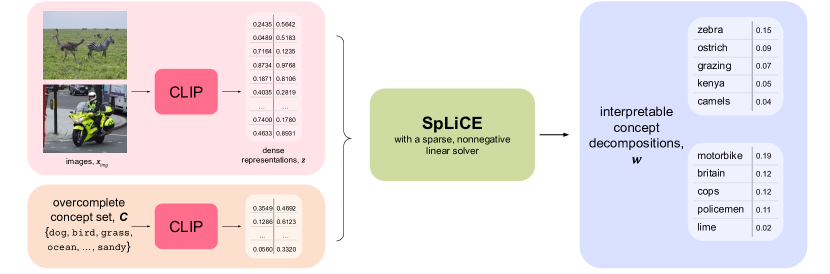
- SpLiCE는 사전 정의된 인간이 이해할 수 있는 개념들의 희박한 선형 조합을 구하는 문제로 해석 작업을 설정한다.
- 일반적인 시각적 특성(예: '자전거', '노란색', '안경')을 포함하는 초과기반(concept set)을 사용하여 의미 공간을 표현한다.
- 개념 가중치의 희박성을 확보하기 위해 ℓ₁ 정규화(Lasso)를 적용하여 ℓ₀ 정규화의 해석 가능성에 가까운 효과를 낸다.
- 볼록 최적화를 통해 최적화 문제를 해결함으로써, CLIP 특징을 개념 활성화로 효율적이고 안정적으로 분해할 수 있다.
- 이 방법은 후행적 작동 방식이므로, 원래 아키텍처를 수정하거나 재학습하지 않아도 어떤 사전 학습된 CLIP 모델에도 적용 가능하다.
- 개념 가중치는 원래 CLIP 표현과 개념의 희박한 선형 조합 간의 재구성 오차를 최소화하는 최적화를 통해 학습된다.
실험 결과
연구 질문
- RQ1CLIP의 조밀하고 고차원적인 표현은 의미적으로 해석 가능한 희박한 의미적 구성요소로 유의미하게 분해될 수 있는가?
- RQ2결과적으로 도출된 희박한 분해가 원래 CLIP 특징에 비해 다운스트림 성능을 유지하는가?
- RQ3기본 개념 레이블에 접근할 수 없더라도 SpLiCE를 사용해 데이터셋 내 허위 상관관계를 탐지할 수 있는가?
- RQ4SpLiCE를 통해 표현 공간에서 개념 가중치를 수정함으로써 효과적인 모델 편집이 가능한가?
- RQ5SpLiCE는 시간이 지남에 따라 데이터셋의 의미적 분포 이탈을 효과적으로 모니터링하고 정량화할 수 있는가?
주요 결과
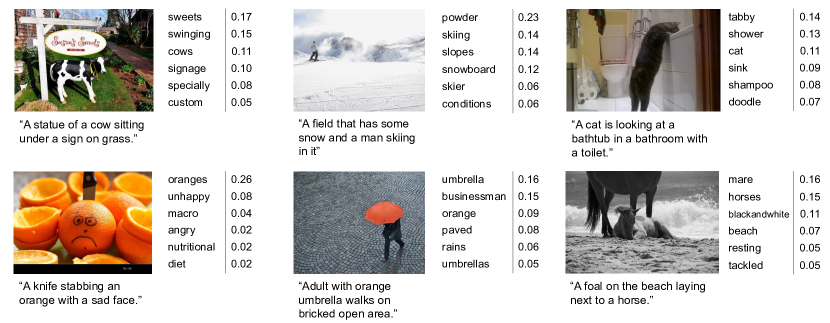
- SpLiCE는 다운스트림 작업에서 최소한의 성능 저하로 높은 희박성(평균 이미지당 10~30개의 개념)을 달성하였으며, 원래 CLIP와 거의 동일한 zero-shot 및 선형 프로브 정확도를 유지한다.
- 성별 분류 작업에서 SpLiCE를 통해 '안경' 개념에 간섭을 가함으로써 성별 분류 정확도를 0.96에서 0.69로 낮추어, 모델 편향을 드러내고 조작할 수 있음을 입증하였다.
- CIFAR100에서 SpLiCE는 여성의 수영복 착용에 대한 허위 상관관계를 성공적으로 탐지하여, 모델 정확도만으로는 드러나지 않는 문제적 데이터셋 편향을 드러내었다.
- Stanford Cars 데이터셋에서 SpLiCE의 '컨버터블' 및 '노란색' 개념 가중치는 실제 지표 개념 출현 빈도와 시간에 따라 밀접하게 일치하여 정확한 분포 이탈 모니터링이 가능함을 보였다.
- SpLiCE 표현은 효과적인 모델 편집을 가능하게 하였다: 개념 가중치를 수정함으로써 얼굴 인식에서 성별 편향을 줄이는 등의 모델 행동의 측정 가능한 변화를 유도하였다.
- 이 방법은 다양한 데이터셋과 작업에서 뛰어난 강건성을 보였으며, 해석 가능하고 희박한 개념 분해가 조밀한 CLIP 특징의 신뢰할 수 있는 대체자로 기능할 수 있음을 보여주었다.
이 논문 읽기
누빈트 뷰어에서 원문을 열고, 읽으면서 궁금한 곳을 바로 물어보세요.
누빈트에서 이 논문 읽기이 리뷰는 AI가 논문 원문을 바탕으로 만들었습니다. 인용하기 전에 원문을 확인해 주세요.