
[논문 리뷰] JADES: A large population of obscured, narrow line AGN at high redshift
이 연구는 JWST/JADES 심층 분광에서 z~10까지의 좁은 선형 AGN 후보 42개(type-2)를 식별하고, AGN 호스트 분율을 약 20%, 전체 광출력은 10^41.3−10^44.9 erg/s, 호스트 질량은 10^7.2−10^9.3 Msun로 추정하며, 이들의 UV 광도 및 별 formation 경향에 대한 기여를 보인다.
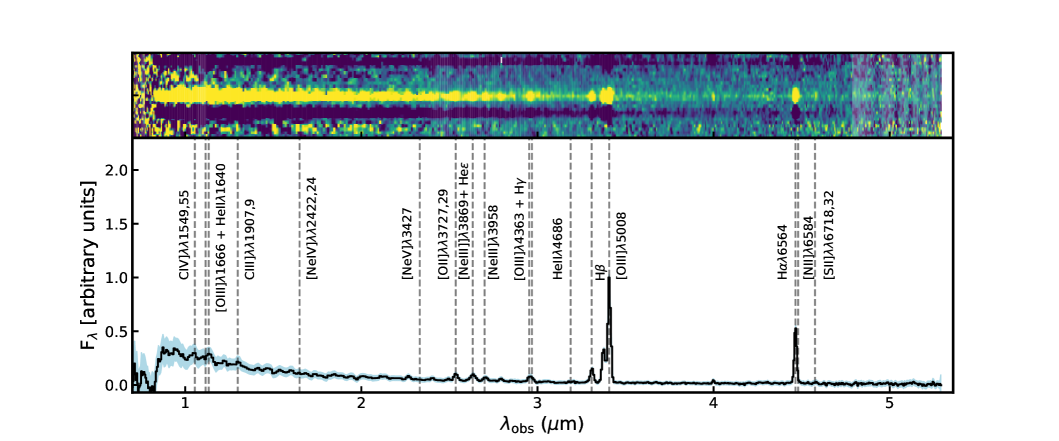
We present the identification of 42 narrow-line active galactic nuclei (type-2 AGN) candidates in the two deepest observations of the JADES spectroscopic survey with JWST/NIRSpec. The spectral coverage and the depth of our observations allow us to select narrow-line AGNs based on both rest-frame optical and UV emission lines up to z=10. Due to the metallicity decrease of galaxies, at $z>3$ the standard optical diagnostic diagrams (N2-BPT or S2-VO87) become unable to distinguish many AGN from other sources of photoionisation. Therefore, we also use high ionisation lines, such as HeII$λ$4686, HeII$λ$1640, NeIV$λ$2422, NeV$λ$3420, and NV$λ$1240, also in combination with other UV transitions, to trace the presence of AGN. Out of a parent sample of 209 galaxies, we identify 42 type-2 AGN (although 10 of them are tentative), giving a fraction of galaxies in JADES hosting type-2 AGN of about $20\pm3$\%, which does not evolve significantly in the redshift range between 2 and 10. The selected type-2 AGN have estimated bolometric luminosities of $10^{41.3-44.9}$ erg s$^{-1}$ and host-galaxy stellar masses of $10^{7.2-9.3}$ M$_{\odot}$. The star formation rates of the selected AGN host galaxies are consistent with those of the star-forming main sequence. The AGN host galaxies at z=4-6 contribute $\sim$8-30 \% to the UV luminosity function, slightly increasing with UV luminosity.
연구 동기 및 목표
- JADES 설문에서 깊은 JWST/NIRSpec 분광 데이터에서 z~12까지의 type-2 AGN 식별.
- UV 및 optical 선을 사용하여 고적주(고-Z) AGN와 별형성 은하의 진단법을 재평가.
- Feltre 2016; Gutkin 2016; Nakajima 2022의 광이온화 모델로 AGN 선택 보정.
- AGN 및 호스트 은하의 특성(볼로메트릭 광도, 별질량, SFR) 추정.
- UV 광도 함수에 대한 AGN의 기여도와 적색편이에 따른 진화를 정량화.
제안 방법
- PRISM 및 다중 그레이팅을 사용한 두 JADES 프로그램(1210 & 3215)의 심층 JWST/NIRSpec 분광.
- pPXF를 이용한 연속체 및 발산선 피팅, 선 그룹 간의 운동학 연계 및 다중선의 플럭스 비를 고정.
- BEAGLE로 SED 피팅하여 지연지수형 SFH 및 Chabrier IMF 하의 별질량 및 SFR 도출.
- 고이온화 UV 선(예: Ne IV, Ne V, N V 등)과 UV/광학 선을 사용하여 고-z에서 전통적 BPT 진단법을 넘어선 AGN 식별.
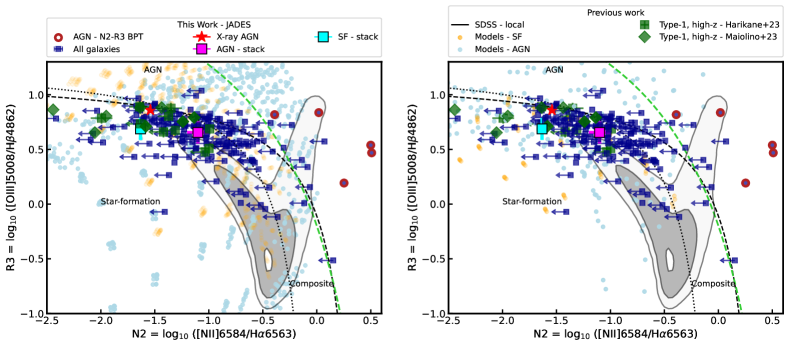
- 관측된 선 비를 광이온화 모델 격자(Feltre+2016; Gutkin+2016; Nakajima+2022)와 비교하여 AGN 대 별형성 영역 구분.
- 필요한 선에 대해 3σ 검출을 채택하고 여러 진단을 통합(N2-R3, S2-R3, He II 기반 다이어그램)하여 AGN를 선정.
실험 결과
연구 질문
- RQ1고적주 은하 중 좁은 선형(type-2) AGN의 비율은 어느 정도이며 적색편이에 따라 어떻게 변하는가(z≈2–10)?
- RQ2저금속성과 높은 이온화 매개변수에서 rest-frame UV 및 optical 라인 진단을 사용해 고적주 AGN를 별형성 은하와 신뢰성 있게 구분할 수 있는가?
- RQ3고-z의 AGN 좁은 영역은 금속성 및 이온화 매개변수 범위에서 광이온화 모델 예측과 어떻게 비교되는가?
- RQ4이 고적주 type-2 AGN의 호스트 은하의 볼로메트릭 광도, 별질량, SFR은 무엇인가?
- RQ5z≈4–6에서 AGN 호스트의 UV 광도 함수에 대한 기여도와 UV 광도에 따른 변화는 무엇인가?
주요 결과
- 209개 은하 중 42개의 type-2 AGN 후보를 식별하고 10개는 잠정 사례로, AGN 호스트 분율 20±3%를 산출.
- 선정된 AGN은 볼로메트릭 광도 L_bol ≈ 10^41.3–10^44.9 erg s^-1 및 호스트 별질량 M_* ≈ 10^7.2–10^9.3 M_sun를 포함.
- AGN 호스트의 별생성률은 별생성 주축(main sequence)과 일치한다.
- z=4–6에서의 AGN 호스트 은하는 UV 광도 함수에 대략 8–30%의 기여를 하며, UV 광도 증가에 따라 증가한다.
- 불확실성 내에서 AGN 비율은 z≈2와 z≈10 사이에 강한 진화를 보이지 않는다.
- 고-z BPT 유사 다이어그램에서 AGN과 별형성 은하 사이의 구분 선이 저금속성 및 높은 이온화 매개변수를 반영하도록 정교화되었다.
이 논문 읽기
누빈트 뷰어에서 원문을 열고, 읽으면서 궁금한 곳을 바로 물어보세요.
누빈트에서 이 논문 읽기이 리뷰는 AI가 논문 원문을 바탕으로 만들었습니다. 인용하기 전에 원문을 확인해 주세요.