
[논문 리뷰] Jupiter Mass Binary Objects in the Trapezium Cluster
연구는 JWST NIRCam 이미징을 사용하여 Trapezium Cluster에서 질량이 0.6 Jupiter masses까지의 540개의 행성질량 후보를 식별하고, 9%가 광대 이중성(JuMBOs)으로 나타나며, IMF의 행성질량 끝과 형성 기작에 대한 시사점을 논의한다.
A key outstanding question in star and planet formation is how far the initial mass function of stars and sub-stellar objects extends, and whether or not there is a cut-off at the very lowest masses. Isolated objects in the planetary-mass domain below 13 Jupiter masses, where not even deuterium can fuse, are very challenging to observe as these objects are inherently faint. Nearby star-forming regions provide the best opportunity to search for them though: while they are young, they are still relatively warm and luminous at infrared wavelengths. Previous surveys have discovered a handful of such sources down to 3--5 Jupiter masses, around the minimum mass limit established for formation via the fragmentation of molecular clouds, but does the mass function extend further? In a new James Webb Space Telescope near-infrared survey of the inner Orion Nebula and Trapezium Cluster, we have discovered and characterised a sample of 540 planetary-mass candidates with masses down to 0.6 Jupiter masses, demonstrating that there is indeed no sharp cut-off in the mass function. Furthermore, we find that 9\% of the planetary-mass objects are in wide binaries, a result that is highly unexpected and which challenges current theories of both star and planet formation.
연구 동기 및 목표
- 젊은 cluster에서 초기 질량 함수가 행성질량 규범으로까지 얼마나 확장되는지 파악한다.
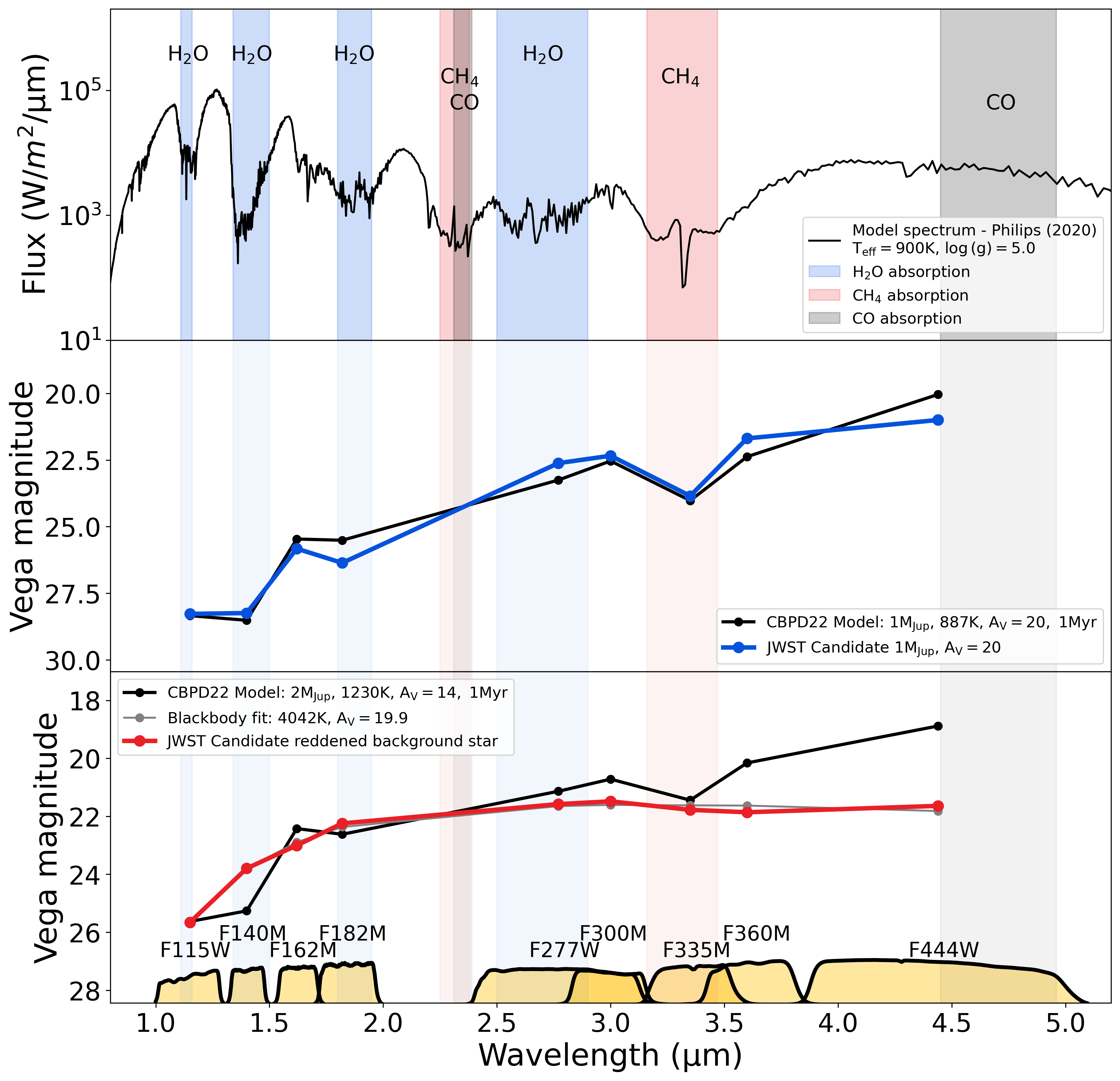
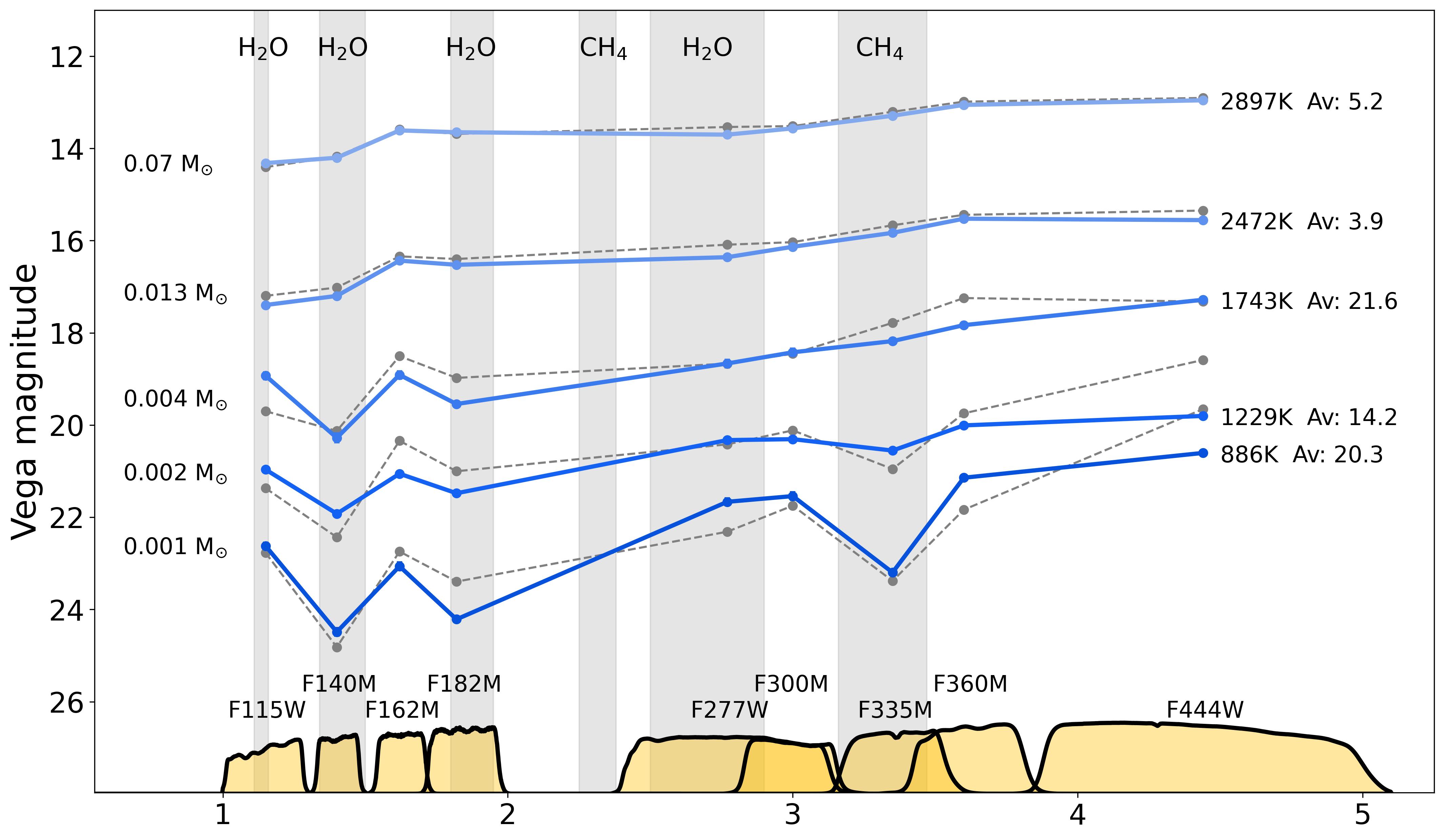
- H2O(1.4 및 1.9 μm) 및 CH4(3.35 μm) 흡수 특징을 겨냥한 JWST NIRCam 중-/광대역 photometry를 사용하여 PMO 후보를 식별한다.
- 행성질량 물체의 다중성 특성을 특징화하고 광대 이중성 비율을 정량한다.
- 관측된 PMO 인구통계를 형성 시나리오(항성 유사 분열 vs 행성 유사 추출)와 비교한다.
- PMO를 배경/전경 소스와 구별하기 위한 카탈로그 및 방법론을 밀집된 항성 형성 영역에서 제공한다.
제안 방법
- 11′ × 7.5′ 영역의 JWST NIRCam 이미징을 통한 내 오리온 성운 및 Trapezium Cluster(34.9시간, 12필터) 관측.
- 특정 필터 조합 및 정의된 지표(식(1)–(3))를 통해 H2O(1.4 및 1.9 μm) 및 CH4(3.35 μm) 흡수 특징을 이용한 PMO의 광도분류.
- 멜로트육 멀티-필터 SED를 진화 모델의 격자(ATMO 2020의 CEQ 및 NEQ)와 BHAC15를 통해 더 높은 질량 범위로 1–100의 AV(흡광) 및 1 Myr의 연령에서 모델 적합.
- 감소된 색지정 광도(dereddened photometry)를 1 Myr 진화 모델 격자와 비교하여 질량 추정(0.0004–0.015 M⊙) 및 ≈0.6 Mjup까지 PMO 식별.
- 수동 시각 검사 및 2.5 및 4.5 픽셀 구경의 반지름으로 PMO 후보 카탈로그를 540개 구성.
- 보조 자료에는 데이터 감소, 소스 탐지 및 오염 평가(은하, 배경 항성) 등의 내용이 상세히 기술되어 있다.
실험 결과
연구 질문
- RQ1JWST 광도측정으로 추적된 Trapezium Cluster의 PMO 인구의 최저 질량 한계는 어디인가?
- RQ2이 환경에서 행성질량 물체가 광대 이중성(JuMBOs)으로 존재하는가, 그 빈도와 특성은 무엇인가?
- RQ3PMO 질량 함수가 1 Mjup 아래로 어떻게 확장되며 급단 컷오프의 징후가 있는가?
- RQ4JuMBO 집단과 이들의 분리/질량비를 설명할 수 있는 형성 기작은 무엇인가(별 유사 분열 vs 행성 유사 배출)?
주요 결과
- 0.6 Mjup까지의 질량을 가진 540개의 PMO 후보를 식별했고 IMF의 매끄러운 연속성을 보여주는 급단 컷오프는 관측되지 않았다.
- PMO의 9%가 광대 이중성(JuMBOs)으로, 분리 거리 ≈25–390 au의 이중성으로 나타나며 행성질량에서의 놀라운 결과이다.
- JuMBO는 0.7–7 Mjup 범위를 가지며 분리 거리는 균일하게 분포; 평균 질량비 q = 0.66이며, q ≥ 0.8인 경우는 약 40%에 불과하다.
- 주된 질량에서의 광대 이중성 비율이 PMO 질량에서 증가하는 경향을 보였고, 더 높은 질량에서의 감소 경향과 대조되며 행성 질량에서 새로운 형성 채널이 존재할 수 있음을 시사한다.
- CEQ 대기/화학 모델은 PMO를 2 Mjup까지 잘 맞았고, NEQ는 2 Mjup 아래에서 약한 모델이 더 선호되어 수직 혼합 효과를 시사한다.
- PMO와 JuMBO의 온도, 분광형 및 화학 성분을 개선하기 위한 JWST Cycle 2의 NIRSpec 분광학 추후 관찰이 계획되어 있다.
이 논문 읽기
누빈트 뷰어에서 원문을 열고, 읽으면서 궁금한 곳을 바로 물어보세요.
누빈트에서 이 논문 읽기이 리뷰는 AI가 논문 원문을 바탕으로 만들었습니다. 인용하기 전에 원문을 확인해 주세요.