
[논문 리뷰] Knowledge Enhanced Machine Learning Pipeline against Diverse Adversarial Attacks
이 논문은 도메인 지식—특히 보조 모델의 예측과 주 DNN 간의 논리적 규칙—을 확률적 그래픽 모델에 통합하여 다양한 적대적 공격에 대한 모델의 강건성을 향상시키는 지식 강화 기계학습 파이프라인(KEMLP)을 제안한다. KEMLP는 적대적 훈련과 같은 최신 기법보다 유의미하게 높은 강건한 정확도를 달성하며, 실제 공격에서는 +16.72%의 강건한 정확도 향상과 예측 불가능한 공격에서는 +10.95%의 향상을 기록했으며, 청소된 정확도를 유지한다.
Despite the great successes achieved by deep neural networks (DNNs), recent studies show that they are vulnerable against adversarial examples, which aim to mislead DNNs by adding small adversarial perturbations. Several defenses have been proposed against such attacks, while many of them have been adaptively attacked. In this work, we aim to enhance the ML robustness from a different perspective by leveraging domain knowledge: We propose a Knowledge Enhanced Machine Learning Pipeline (KEMLP) to integrate domain knowledge (i.e., logic relationships among different predictions) into a probabilistic graphical model via first-order logic rules. In particular, we develop KEMLP by integrating a diverse set of weak auxiliary models based on their logical relationships to the main DNN model that performs the target task. Theoretically, we provide convergence results and prove that, under mild conditions, the prediction of KEMLP is more robust than that of the main DNN model. Empirically, we take road sign recognition as an example and leverage the relationships between road signs and their shapes and contents as domain knowledge. We show that compared with adversarial training and other baselines, KEMLP achieves higher robustness against physical attacks, $\mathcal{L}_p$ bounded attacks, unforeseen attacks, and natural corruptions under both whitebox and blackbox settings, while still maintaining high clean accuracy.
연구 동기 및 목표
- 딥 뉴럴 네트워크(DNNs)가 다양한 적대적 공격, 즉 실제 공격, $ε$-유계 공격, 그리고 예측 불가능한 공격에 취약한 점을 해결하기 위해.
- 예측 간 논리적 관계를 포함한 도메인 지식 통합이 청소된 정확도를 희생시키지 않고도 강건성을 향상시킬 수 있는지 조사하기 위해.
- 약한 보조 모델을 논리적 제약 조건과 체계적으로 통합하여 공동 추론의 강건성을 향상시키는 원칙적인 프레임워크를 개발하기 위해.
- 지식 통합이 주 DNN 모델만 사용할 경우보다 강건성이 향상되는 조건을 이론적으로 증명하기 위해.
- 흰색 상자, 검은 상자, 자연적 손상 환경에서 최신 기법과 비교하여 KEMLP의 우수성을 경험적으로 검증하기 위해.
제안 방법
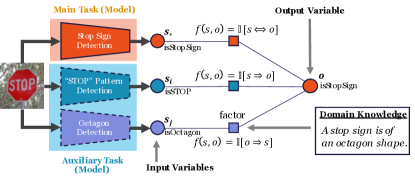
- KEMLP는 주 DNN의 출력과 보조 모델의 출력을 랜덤 입력 변수로 모델링하고, 최종 예측을 랜덤 출력 변수로 설정하는 요소 그래프를 구성한다.
- 도메인 지식은 일阶 논리 규칙(예: '정지 표지판은 8각형이다')으로 표현되며, 이는 요소 그래프 내 관련 랜덤 변수를 연결하는 요소 함수로 변환된다.
- 통계적 추론을 요소 그래프 상에서 수행하여 출력 변수의 주변 확률을 계산하며, 이 과정에서 논리적 제약 조건을 예측 시에 통합한다.
- 프레임워크는 허용 규칙(B ⇒ A)과 방지 규칙(A ⇒ B)을 모두 지원하여 보조 지식의 탄력적인 통합이 가능하다.
- 강건성은 청소된 예제와 적대적 예제의 성능를 균형 잡은 가중 강건 정확도를 사용하여 평가한다.
- KEMLP는 흰색 상자 및 검은 상자 환경에서 실제 공격, $ε$-유계 변형, 자연적 손상 상황을 포함한 도로 표지판 인식 작업에서 평가된다.
실험 결과
연구 질문
- RQ1논리적 규칙을 통한 도메인 지식 통합이 기계학습 모델의 강건성을 향상시키는 조건는 무엇인가?
- RQ2KEMLP의 지식 통합이 다양한 공격 유형에서 적대적 훈련과 같은 최신 기법을 초월할 수 있는가?
- RQ3논리적 제약 조건과 함께 보조 모델을 통합할 경우 강건성과 청소된 정확도 사이의 상호 보완적 관계는 어떠한가?
- RQ4허용 규칙(B ⇒ A)과 방지 규칙(A ⇒ B)의 서로 다른 유형의 논리적 규칙이 KEMLP의 공동 추론 강건성에 어떤 영향을 미치는가?
- RQ5KEMLP는 예측 불가능한 공격과 실제 공격에 대해 뛰어난 강건성을 확보하면서도 높은 청소된 정확도를 유지하는가?
주요 결과
- KEMLP는 실제 공격에서 91.46%의 가중 강건 정확도를 기록했으며, 주 DNN 대비 +16.72% 향상되었고, 적대적 훈련 대비 +10.95% 향상되었다.
- 예측 불가능한 공격에서는 KEMLP가 78.37%의 강건 정확도를 달성했으며, 주 DNN 대비 +9.72% 향상되고, 적대적 훈련 대비 +6.46% 향상되었다.
- 검은 상자 환경에서는 KEMLP가 청소된 정확도 84.95%를 유지하면서 $ε$-유계 공격에서 79.09%의 강건 정확도를 기록했으며, 적대적 훈련을 초월했다.
- 자연적 손상 상황에서는 KEMLP가 표준 테스트 세트에서 84.95%의 강건 정확도를 기록했으며, 주 DNN와 적대적 훈련을 크게 능가했다.
- 이론적 분석 결과, 온건한 조건 하에서 KEMLP의 예측은 주 DNN의 예측보다 더 강건하며, 특히 다수의 약한 보조 모델을 통합할 경우 더욱 두드러진다.
- KEMLP의 성능는 다양한 공격 유형, 예를 들어 5x5 및 7x7 실제 공격 상황에서도 안정적이었으며, 청소된 정확도의 감소가 최소한이었다(예: DOA 5x5에서 -0.02%), 강력한 일반화 능력을 보였다.

이 논문 읽기
누빈트 뷰어에서 원문을 열고, 읽으면서 궁금한 곳을 바로 물어보세요.
누빈트에서 이 논문 읽기이 리뷰는 AI가 논문 원문을 바탕으로 만들었습니다. 인용하기 전에 원문을 확인해 주세요.