
[논문 리뷰] Label-Retrieval-Augmented Diffusion Models for Learning from Noisy Labels
이 논문은 학습을 노이즈가 있는 라벨에서의 확률적 조건부 라벨 생성 문제로 재구성하고 LRA-diffusion을 도입한다. 이는 이웃-라벨 검색과 사전 학습된 인코더(CLIP, SimCLR 등)를 활용하는 확산 모델을 통해 노이즈 라벨 벤치마크에서 최첨단 성능을 달성한다.
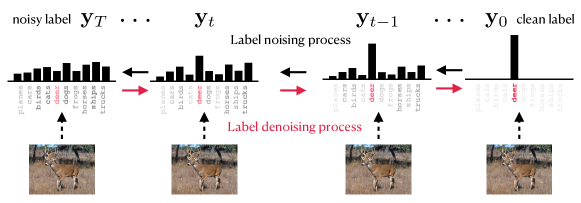
Learning from noisy labels is an important and long-standing problem in machine learning for real applications. One of the main research lines focuses on learning a label corrector to purify potential noisy labels. However, these methods typically rely on strict assumptions and are limited to certain types of label noise. In this paper, we reformulate the label-noise problem from a generative-model perspective, $ extit{i.e.}$, labels are generated by gradually refining an initial random guess. This new perspective immediately enables existing powerful diffusion models to seamlessly learn the stochastic generative process. Once the generative uncertainty is modeled, we can perform classification inference using maximum likelihood estimation of labels. To mitigate the impact of noisy labels, we propose the $ extbf{L}$abel-$ extbf{R}$etrieval-$ extbf{A}$ugmented (LRA) diffusion model, which leverages neighbor consistency to effectively construct pseudo-clean labels for diffusion training. Our model is flexible and general, allowing easy incorporation of different types of conditional information, $ extit{e.g.}$, use of pre-trained models, to further boost model performance. Extensive experiments are conducted for evaluation. Our model achieves new state-of-the-art (SOTA) results on all the standard real-world benchmark datasets. Remarkably, by incorporating conditional information from the powerful CLIP model, our method can boost the current SOTA accuracy by 10-20 absolute points in many cases.
연구 동기 및 목표
- 전통적인 판별적/유지보수 방법이 아니라 생성 프로세스 관점에서 노이즈 라벨 학습의 동기를 부여한다.
- 노이즈 하에서 조건부 라벨 생성을 모델링하는 확산 기반 프레임워크를 개발한다.
- 라벨 검색을 통한 이웃 일관성을 활용하여 확산 학습용 의사-클린 타깃을 생성한다.
- 확산 과정을 조건화하고 성능을 높이기 위해 CLIP, SimCLR 등 강력한 사전 학습 인코더를 도입한다.
- 실세계 노이즈 라벨 벤치마크에서 최신 성능을 입증하고 가속 추론으로 효율성을 평가한다.
제안 방법
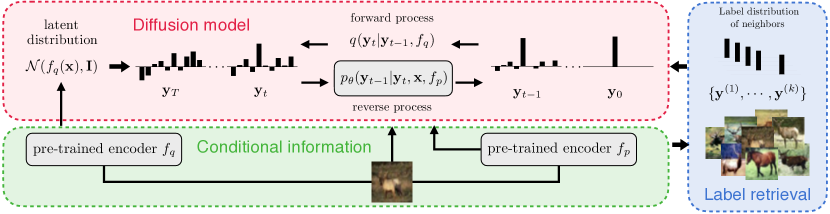
- 이미지 주어진 라벨의 조건부 분포를 학습하기 위해 확산 모델 백본(CARD)을 채택한다.
- 학습 가능한 특징 공간에서 k-최근접 이웃으로부터 라벨을 검색하여 의사-클린 타깃을 형성하는 라벨 검색 증강을 도입한다.
- 두 개의 인코더를 사용한다: f_q(y_T의 평균 추정치, 가능하면 0)와 f_p(고차원 특징 추출기)로 확산 과정을 조건화한다.
- 확산 단계에서 예측된 노이즈를 실제 노이즈와 일치시키는 간단한 손실을 사용하는 ELBO 목적함수로 학습한다.
- 일반화된 DDIM 기반 샘플링으로 보폭을 줄이면서 주변 분포를 보존해 추론 속도를 높인다.
- f_q = f_p를 강제하지 않아 유연한 조건화를 허용하고 CLIP와 같은 대형 사전 학습 모델을 f_p로의 통합을 가능하게 한다.
실험 결과
연구 질문
- RQ1노이즈 하에서 라벨 생성을 확률적으로 모델링하기 위해 확산 모델을 어떻게 활용할 수 있는가?
- RQ2학습된 특징 공간에서 이웃 라벨을 검색하는 것이 확산 기반 분류기를 학습할 때 노이즈 라벨에 대한 강인성을 향상시키는가?
- RQ3사전 학습 인코더(예: CLIP, SimCLR)가 조건화를 통해 노이즈 라벨 학습의 확산 기반 학습을 향상시킬 수 있는가?
- RQ4확산 기반 라벨 추론에서 DDIM과 같은 가속 기법의 효율성 향상은 정확도에 어떤 영향을 미치는가?
- RQ5LRA-diffusion은 합성 노이즈 벤치마크와 실제 노이즈 벤치마크에서 최신 방법과 비교하여 어떻게 성능을 나타내는가?
주요 결과
- LRA-diffusion은 일반적인 실제 노이즈 라벨 벤치마크에서 최첨단 성능을 달성한다.
- CLIP 조건부 특징을 도입하면 정확도가 크게 향상되며 기존 방법에 비해 눈에 띄는 개선이 나타난다.
- 라벨 검색 증강으로 확산 모델이 이웃 라벨로부터 학습하여 노라벨 노이즈에 대한 강인성이 향상된다.
- 일반화된 DDIM을 통한 가속 추론은 단계 수를 줄이면서도 성능을 유지한다(예: 더 적은 단계 사용).
- 합성 노이즈 벤치마크(CIFAR-10/100)에서 CLIP과 함께 사용한 LRA-diffusion은 PMD 및 혼합 노이즈 설정에서 베이스라인보다 현저히 우수하다.
- 실세계 결과는 WebVision, ILSVRC2012, Food-101N 데이터셋에서 기존 방법보다 강한 개선을 보인다.
이 논문 읽기
누빈트 뷰어에서 원문을 열고, 읽으면서 궁금한 곳을 바로 물어보세요.
누빈트에서 이 논문 읽기이 리뷰는 AI가 논문 원문을 바탕으로 만들었습니다. 인용하기 전에 원문을 확인해 주세요.