
[논문 리뷰] Language Models Enable Simple Systems for Generating Structured Views of Heterogeneous Data Lakes
본 논문은 Evaporate라는 프로토타입 시스템을 제시한다. 이 시스템은 대형 언어 모델을 이용해 이종 데이터 레이크에서 구조적 뷰를 생성하며, 직접 추출, 코드 합성, 약한 감독 앙상블을 비교한다. 이 앙상블은 낮은 비용으로 높은 품질을 달성하고 문서 처리를 서브선형으로 수행한다.
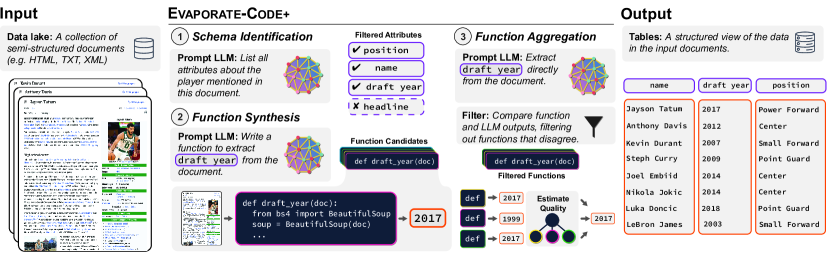
A long standing goal of the data management community is to develop general, automated systems that ingest semi-structured documents and output queryable tables without human effort or domain specific customization. Given the sheer variety of potential documents, state-of-the art systems make simplifying assumptions and use domain specific training. In this work, we ask whether we can maintain generality by using large language models (LLMs). LLMs, which are pretrained on broad data, can perform diverse downstream tasks simply conditioned on natural language task descriptions. We propose and evaluate EVAPORATE, a simple, prototype system powered by LLMs. We identify two fundamentally different strategies for implementing this system: prompt the LLM to directly extract values from documents or prompt the LLM to synthesize code that performs the extraction. Our evaluations show a cost-quality tradeoff between these two approaches. Code synthesis is cheap, but far less accurate than directly processing each document with the LLM. To improve quality while maintaining low cost, we propose an extended code synthesis implementation, EVAPORATE-CODE+, which achieves better quality than direct extraction. Our key insight is to generate many candidate functions and ensemble their extractions using weak supervision. EVAPORATE-CODE+ not only outperforms the state-of-the art systems, but does so using a sublinear pass over the documents with the LLM. This equates to a 110x reduction in the number of tokens the LLM needs to process, averaged across 16 real-world evaluation settings of 10k documents each.
연구 동기 및 목표
- 일반 목적의 LLM이 도메인 특화 학습 없이도 다양한 반구조화 문서로부터 구조적 뷰를 생성할 수 있음을 입증한다.
- 이러한 뷰를 구축하기 위한 두 가지 구현 전략(직접 추출 대 코드 합성)을 비교한다.
- 다수의 합성 함수들에 대한 약한 감독을 통해 추출 품질을 향상시키는 Evaporate-Code+를 소개한다.
- 여러 데이터세트와 모델에 걸친 비용-품질 트레이드오프와 확장성을 정량화한다.
제안 방법
- 정의된 작업 정의: 반구조화 문서 세트를 입력으로 받아 속성과 문서별 레코드를 가진 표를 출력한다.
- 16개 실제 설정에서 Evaporate-Direct(LLM이 값을 직접 추출)와 Evaporate-Code(LLM이 재사용 가능한 추출 코드를 합성)를 평가한다.
- Evaporate-Code+가 다수의 후보 함수와 약한 감독을 이용해 추출을 앙상블하고 정확도를 향상시킴을 보여준다.
- 스키마 합성을 위한 소규모 샘플을 활용하고 속성에 대해 다수의 후보 함수를 생성한 후 맞춤형 약한 감독 알고리즘으로 집계한다.
- 스키마 발견과 추출을 전체 문서 세트로부터 비동기화하여 서브선형 LLM 처리를 달성함을 시현한다.
- 강건성을 확인하기 위해 세 LLM 공급자의 네 모델로 성능을 평가한다.
실험 결과
연구 질문
- RQ1일반적이고 프롬프트 중심의 LLM 시스템이 도메인 특화 학습 없이도 이질적인 문서에서 구조적 뷰를 생성할 수 있는가?
- RQ2이 작업에서 직접 추출과 코드 합성 접근법 간 비용-품질 트레이드오프는 무엇인가?
- RQ3다수의 합성 함수에 걸친 약한 감독 앙상블이 낮은 비용을 유지하면서 추출 품질을 향상시키는가?
- RQ4다른 LLM 공급자 및 문서 유형에 대해 결과의 강건성은 어느 정도인가?
주요 결과
- Evaporate-Direct는 일부 설정에서 경쟁력 있는 품질을 달성하지만 데이터 레이크 크기에 따른 선형 토큰 처리로 인해 규모 확장에 문제가 있다.
- Evaporate-Code는 스키마를 위한 소규모 문서 샘플을 처리하고 추출을 위한 함수들을 합성함으로써 서브선형 비용을 제공하지만, 초기에는 직접 추출보다 품질이 낮다.
- Evaporate-Code+는 약한 감독이 적용된 설정에서 평균 페어 F1 점수 67.5를 달성했고, Evaporate-Direct 대비 12.1포인트의 향상을 보인다.
- 정의된 스키마에 대해 Evaporate-Code+의 추출 성능이 Evaporate-Direct에 비해 평균적으로 22% 향상된다.
- 본 접근 방식은 평가된 설정들에서 데이터 레이크당 1만 문서 기준으로 LLM이 처리하는 토큰 수를 110배 감소시킨다.
- 결과는 세 LLM 공급자의 네 모델에서 검증되었으며, Evaporate-Direct와 Evaporate-Code+ 간의 상대적 품질이 일관되게 유지된다.
이 논문 읽기
누빈트 뷰어에서 원문을 열고, 읽으면서 궁금한 곳을 바로 물어보세요.
누빈트에서 이 논문 읽기이 리뷰는 AI가 논문 원문을 바탕으로 만들었습니다. 인용하기 전에 원문을 확인해 주세요.