
[논문 리뷰] Large Language Model based Situational Dialogues for Second Language Learning
이 논문은 제2외국어 학습자의 대화 기술을 향상시키기 위해 상황 기반 대화에 맞춤설정된 대규모 언어 모델(Large Language Models, LLMs)을 제안하며, 개방형 상호작용과 시나리오 기반 집중을 결합한다. 이 방법은 도메인 내 및 도메인 외 주제에서 뛰어난 성능을 달성하며, LLM을 평가자로 사용하는 새로운 자동 평가 방법을 통해 효율적이고 신뢰할 수 있는 평가를 가능하게 하여, 수동으로 설계된 대화 시스템을 초월한 일반화 및 확장성의 가능성을 입증한다.
In second language learning, scenario-based conversation practice is important for language learners to achieve fluency in speaking, but students often lack sufficient opportunities to practice their conversational skills with qualified instructors or native speakers. To bridge this gap, we propose situational dialogue models for students to engage in conversational practice. Our situational dialogue models are fine-tuned on large language models (LLMs), with the aim of combining the engaging nature of an open-ended conversation with the focused practice of scenario-based tasks. Leveraging the generalization capabilities of LLMs, we demonstrate that our situational dialogue models perform effectively not only on training topics but also on topics not encountered during training. This offers a promising solution to support a wide range of conversational topics without extensive manual work. Additionally, research in the field of dialogue systems still lacks reliable automatic evaluation metrics, leading to human evaluation as the gold standard (Smith et al., 2022), which is typically expensive. To address the limitations of existing evaluation methods, we present a novel automatic evaluation method that employs fine-tuned LLMs to efficiently and effectively assess the performance of situational dialogue models.
연구 동기 및 목표
- 자격을 갖춘 지도자나 모국어 사용자에게 접근할 수 없는 제2외국어 학습자들이 대화 연습 기회가 부족한 문제를 해결하기 위해.
- 광범위한 전문가가 정의한 상태 및 동작 공간이 필요한 작업 중심 대화 시스템에 대한 융통성 있고 확장 가능한 대안을 개발하기 위해.
- 수동 재구성 없이도 새로운 대화 주제에 대해 제로샷 또는 희소샷 성능을 낼 수 있도록 LLM의 일반화 능력을 활용하기 위해.
- 대화 모델에 대한 신뢰할 수 있고 효율적인 자동 평가 프레임워크를 제안하여 높은 비용이 드는 인간 평가에 의존도를 줄이기 위해.
- 학습자의 수준에 맞게 적응하면서도 교육적 맥락에서 안전성과 일관성을 유지할 수 있도록 대화 시스템을 설계하기 위해.
제안 방법
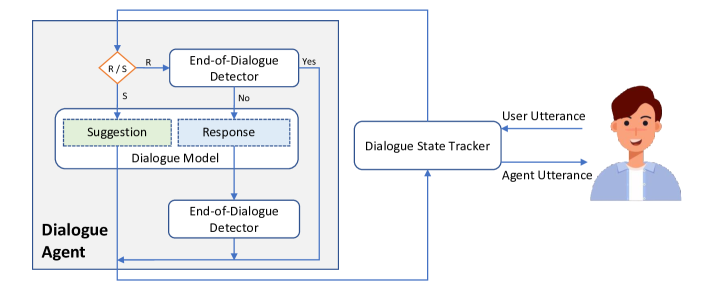
- 상황 기반 대화 데이터로 LLM(Qwen-1.8B, Qwen-7B, Qwen-14B)을 미세조정하여 맥락에 적절한 응답을 생성하는 대화 에이전트를 구축한다.
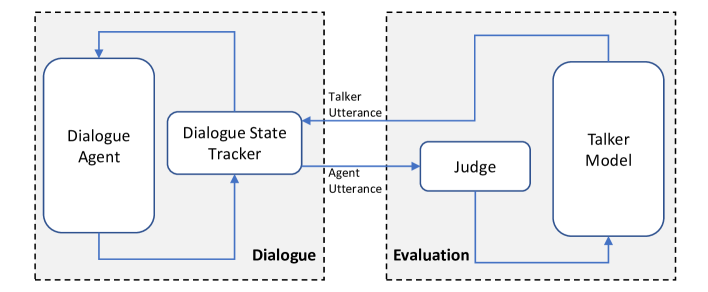
- 사용자 측 응답을 생성하는 별도의 '대화자(talker)' 모델을 훈련시켜, 0.5의 비율로 제안 기능을 포함한 완전한 양방향 대화 시뮬레이션을 가능하게 한다.
- 미세조정된 LLM을 심사위원으로 사용하는 새로운 자동 평가 프레임워크를 설계하여 응답 성공률, 제안 성공률, 세션 성공률을 평가한다.
- 응답 성공률은 개별 응답 품질을 평가하고, 제안 성공률은 모델이 제공한 힌트의 유용성을 평가하며, 세션 성공률은 전체 일관성과 일관성을 측정한다.
- LLM 기반 심사위원을 활용해 도메인 내 및 도메인 외 주제를 평가함으로써, 스케일러블하고 비용 효율적인 모델 반복을 가능하게 한다.
- 성능 및 추론 비용의 상충 관계를 평가하기 위해, 미세조정된 LLM을 GPT-3.5-turbo 프롬프트 기반 베이스라인과 비교한다.
실험 결과
연구 질문
- RQ1미세조정된 LLM은 재학습이나 수동 설계 없이 도메인 외 대화 주제에 일반화할 수 있는가?
- RQ2미세조정된 LLM 심사위원을 사용하는 제안된 자동 평가 방법은 인간 평가에 비해 얼마나 효과적인가?
- RQ3다양한 주제에 적응하면서도 전체 대화 동안 일관성과 관련성을 유지할 수 있는가?
- RQ4모델 크기(예: 1.8B 대비 14B 파라미터)가 상황 기반 대화 작업에서 성능과 신뢰성에 어떤 영향을 미치는가?
- RQ5시스템은 언어 출력을 복잡하게 만들지 않으면서도 다양한 수준의 학습자에게 얼마나 잘 지원할 수 있는가?
주요 결과
- Qwen-14B 기반 대화 에이전트는 가장 높은 세션 성공률을 기록했으며, 주제당 30회의 세션에서 대부분의 대화가 오류 없이 일관성 있게 유지되었다.
- Qwen-7B 및 Qwen-14B 모델은 도메인 외 20개 주제에 대해 효과적으로 일반화되었으며, 도메인 내 주제와 비교해 성능 저하가 최소한이었다.
- 미세조정된 LLM 심사위원은 도메인 내 및 도메인 외 대화 평가에서 안정적인 성능을 보였으며, 인간 평가에 비해 확장 가능한 대안을 제공했다.
- GPT-3.5-turbo 프롬프트 기반 베이스라인은 Qwen-7B 모델보다 성능이 뛰어났지만 Qwen-14B 모델에 비해 열등했으며, 이는 비용과 품질 사이의 상충 관계를 시사했다.
- 대화자 모델은 적절한 제안 비율로 학습자 유사 응답을 성공적으로 생성했으며, 오류 없이 대화 흐름을 유지했다.
- 제안된 지표인 응답 성공률, 제안 성공률, 세션 성공률은 응답 수준과 대화 수준의 품질을 효과적으로 측정했다.
이 논문 읽기
누빈트 뷰어에서 원문을 열고, 읽으면서 궁금한 곳을 바로 물어보세요.
누빈트에서 이 논문 읽기이 리뷰는 AI가 논문 원문을 바탕으로 만들었습니다. 인용하기 전에 원문을 확인해 주세요.