
[논문 리뷰] Large Language Models as Urban Residents: An LLM Agent Framework for Personal Mobility Generation
본 논문은 의미 패턴 추출, 자기 일관성 평가, 동기 부여 기반의 검색 강화 생성을 결합하여 개인 이동 궤적을 생성하는 LLM 에이전트 프레임워크인 LLMob를 제시하며, 실제 도쿄 데이터를 활용해 검증됩니다.
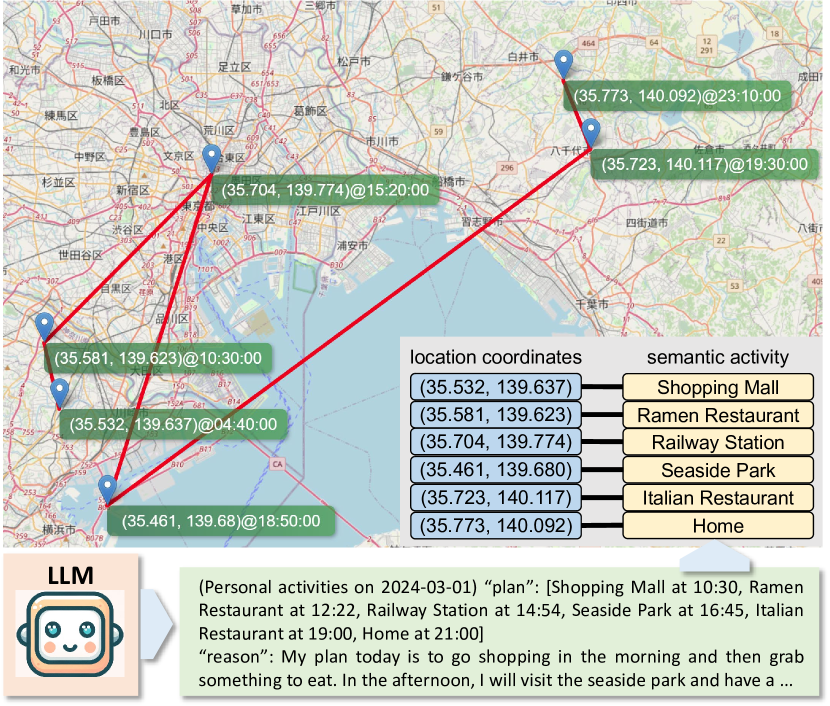
This paper introduces a novel approach using Large Language Models (LLMs) integrated into an agent framework for flexible and effective personal mobility generation. LLMs overcome the limitations of previous models by effectively processing semantic data and offering versatility in modeling various tasks. Our approach addresses three research questions: aligning LLMs with real-world urban mobility data, developing reliable activity generation strategies, and exploring LLM applications in urban mobility. The key technical contribution is a novel LLM agent framework that accounts for individual activity patterns and motivations, including a self-consistency approach to align LLMs with real-world activity data and a retrieval-augmented strategy for interpretable activity generation. We evaluate our LLM agent framework and compare it with state-of-the-art personal mobility generation approaches, demonstrating the effectiveness of our approach and its potential applications in urban mobility. Overall, this study marks the pioneering work of designing an LLM agent framework for activity generation based on real-world human activity data, offering a promising tool for urban mobility analysis.
연구 동기 및 목표
- 개인 mobility 생성을 위한 LLM을 의미적으로 풍부한 활동 데이터와 정렬시키는 것.
- 활동 궤적 생성을 위한 신뢰할 수 있고 해석 가능한 전략을 개발하는 것.
- 일상 습관 패턴과 동적인 동기를 반영하여 도시 모빌리티를 시뮬레이션하는 것.
- 실제 데이터로 프레임워크를 검증하고 전통적 모델과 비교하는 것.
제안 방법
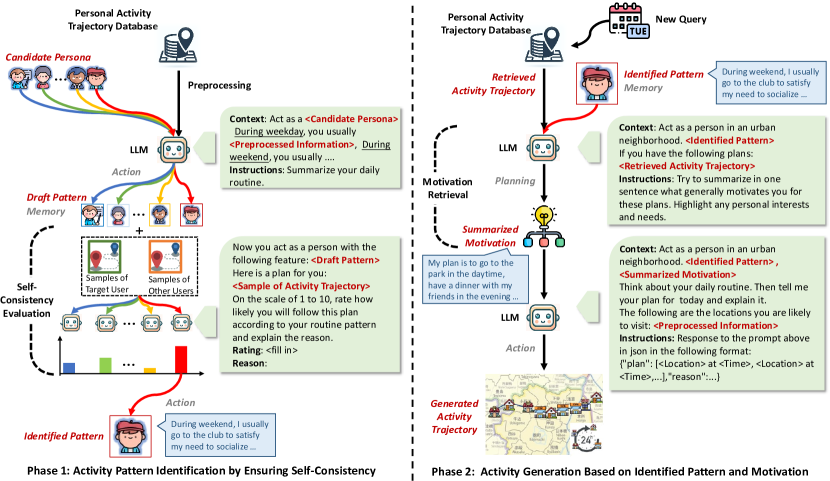
- 두 단계 파이프라인: (i) 과거 데이터에서 LLM과 퍼소나 유도 프롬프트를 사용한 자기 일관성 있는 활동 패턴 식별; (ii) 검색 강화 프롬프트를 활용한 동기 부여 기반 활동 생성.
- 자기 일관성 점수는 후보 패턴을 대상 패턴 및 다른 사용자와 비교하여 최적의 패턴을 선택합니다.
- 동기에 대한 두 가지 검색 전략: 진화 기반 및 학습 기반, 날짜 유사성을 추정하는 대조 학습 모델 f_theta 포함.
- 패턴과 요약된 동기를 통합하여 일일 활동 궤적 생성.
- 생성과 분석의 LLM 코어로 GPT-3.5-Turbo-0613 사용.
실험 결과
연구 질문
- RQ1RQ1: LLM을 일상적 개인 활동에 대한 의미적으로 풍부한 데이터와 어떻게 정렬할 수 있는가?
- RQ2RQ2: LLM을 이용한 신뢰할 수 있고 의미 있는 활동 생성을 위한 효과적 전략은 무엇인가?
- RQ3RQ3: 도시 모빌리티를 향상시키는 데 있어 LLM의 잠재적 응용은 무엇인가?
주요 결과
- LLMob은 Markov, LSTM, DeepMove와 같은 baselines에 비해 우수한 시간적 패턴 생성(ST-ACT, ST-LOC)을 달성합니다.
- 프레임워크는 경쟁력 있는 공간 패턴을 유지하고 이상적 팬데믹 유사 시나리오에서 강건함을 보여줍니다.
- 동기 부여 인식 생성은 LLM 에이전트가 현실적 일일 궤적을 생성하고 외부 요인(예: 팬데믹 프롬프트)에 적응하도록 합니다.
- 검색 강화 전략은 생성된 활동 궤적의 해석 가능성과 신뢰성을 향상시킵니다.
- 자기 일관성 평가가 LLM 출력과 실제 일일 활동 데이터 간의 정합성을 돕습니다.
이 논문 읽기
누빈트 뷰어에서 원문을 열고, 읽으면서 궁금한 곳을 바로 물어보세요.
누빈트에서 이 논문 읽기이 리뷰는 AI가 논문 원문을 바탕으로 만들었습니다. 인용하기 전에 원문을 확인해 주세요.