
[논문 리뷰] Large Language Models for Time Series: A Survey
대규모 언어 모델(LLM)을 시간 시계열 분석에 적용하는 포괄적 조사로, 프롬퓨팅(prompting), 양자화(quantization), 정렬(alignment), 다리로서의 비전(vision-bridge), 도구 통합 접근법, 데이터셋, 도전과제 및 향후 방향을 상세히 다룹니다.
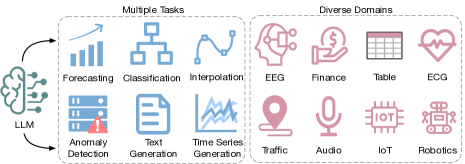
Large Language Models (LLMs) have seen significant use in domains such as natural language processing and computer vision. Going beyond text, image and graphics, LLMs present a significant potential for analysis of time series data, benefiting domains such as climate, IoT, healthcare, traffic, audio and finance. This survey paper provides an in-depth exploration and a detailed taxonomy of the various methodologies employed to harness the power of LLMs for time series analysis. We address the inherent challenge of bridging the gap between LLMs' original text data training and the numerical nature of time series data, and explore strategies for transferring and distilling knowledge from LLMs to numerical time series analysis. We detail various methodologies, including (1) direct prompting of LLMs, (2) time series quantization, (3) aligning techniques, (4) utilization of the vision modality as a bridging mechanism, and (5) the combination of LLMs with tools. Additionally, this survey offers a comprehensive overview of the existing multimodal time series and text datasets and delves into the challenges and future opportunities of this emerging field. We maintain an up-to-date Github repository which includes all the papers and datasets discussed in the survey.
연구 동기 및 목표
- 텍스트로 학습된 LLM과 수치 형태의 시간 시계열 데이터 간의 모달리티 격차를 해소하려는 연구를 고취한다.
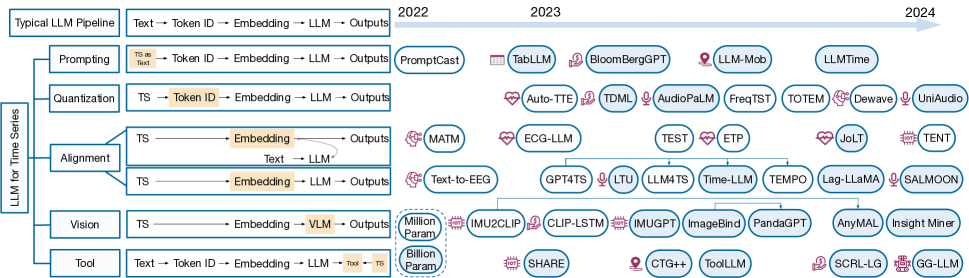
- 시간 시계열 분석을 위한 LLM 기반 방법 다섯 가지의 분류 체계(프롬퓨팅, 양자화, 정렬, 다리로서의 비전, 도구 통합)를 제시한다.
- 기후, IoT, 의료, 교통, 금융 등 다양한 도메인에서 대표적인 모델, 정식화, 데이터세트를 조사한다.
- LLM 기반 시간 시계열 연구를 발전시키기 위한 도전과제와 향후 방향을 식별한다.
제안 방법
- 시간 시계열을 텍스트나 프롬프트로 취급하여 LLM을 직접 프롬프트한다.
- 수치 시퀀스를 LLM 처리용 이산 토큰으로 변환하는 시간 시계열 양자화(VQ-VAE, K-Means).
- 시간 시계열 임베딩을 언어 공간에 매핑하는 정렬 기법(대조 손실, 백본) 또는 엔드투엔드 LLM 백본을 사용.
- 시각적 표현과 다중모달 모델을 활용하여 시간 시계열을 LLM과 연결하는 비전-브리지.
- 도구 통합: LLM이 보조 도구(코드, API 호출)를 생성하여 시간 시계열 작업을 지원한다.
실험 결과
연구 질문
- RQ1텍스트로 훈련된 LLM을 수치적 시간 시계열 분석에 효과적으로 활용하려면 어떻게 해야 하는가?
- RQ2시간 시계열 데이터와 언어 모델 간의 모달리티 격차를 해소하는 가장 효과적인 분류 체계와 기법은 무엇인가?
- RQ3도메인 전반에 걸쳐 강건한 LLM 기반 시간 시계열 분석을 가능하게 하는 데이터 세트와 다중모달 구성은 무엇인가?
- RQ4프롬프트, 양자화, 정렬, 비전-브리지, 도구 기반 접근법의 데이터 효율성과 작업 측면에서의 트레이드오프는 무엇인가?
- RQ5다중 모달 및 다중 작업 LLM 기반 시간 시계열 연구의 주요 도전과제와 향후 방향은 무엇인가?
주요 결과
- 다섯 가지 범주로 구성된 분류 체계가 제안된다: 프롬퓨팅, 시간 시계열 양자화, 정렬, 다리로서의 비전, 그리고 도구 통합.
- 양자화 및 정렬 접근법은 프롬프트만으로는 불가능한 긴 시퀀스와 다변량 시간 시계열에 대해 더 확장성이 높다.
- 비전 기반의 다리 기능은 시각-언어 모델을 활용하여 시간 시계열을 텍스트 및 시각적 표현과 연결할 수 있게 한다.
- 도구 통합은 LLM이 코드나 API 호출을 출력하여 전체 엔드투엔드 미세조정 없이도 시간 시계열 작업을 지원하게 한다.
- IoT, 금융, 헬스케어, 오디오 등 다중모달 시간 시계열 및 텍스트 데이터 세트의 선별된 모음이 분류 체계와 함께 제공된다.
이 논문 읽기
누빈트 뷰어에서 원문을 열고, 읽으면서 궁금한 곳을 바로 물어보세요.
누빈트에서 이 논문 읽기이 리뷰는 AI가 논문 원문을 바탕으로 만들었습니다. 인용하기 전에 원문을 확인해 주세요.