
[논문 리뷰] Large Language Models(LLMs) on Tabular Data: Prediction, Generation, and Understanding -- A Survey
본 설문조사는 예측, 데이터 생성, 표 이해 작업 전반에 걸쳐 LLM이 표 형식 데이터에 어떻게 적용되는지 다루고, 기법, 데이터셋, 지표 및 향후 방향의 분류 체계를 제시한다.
Recent breakthroughs in large language modeling have facilitated rigorous exploration of their application in diverse tasks related to tabular data modeling, such as prediction, tabular data synthesis, question answering, and table understanding. Each task presents unique challenges and opportunities. However, there is currently a lack of comprehensive review that summarizes and compares the key techniques, metrics, datasets, models, and optimization approaches in this research domain. This survey aims to address this gap by consolidating recent progress in these areas, offering a thorough survey and taxonomy of the datasets, metrics, and methodologies utilized. It identifies strengths, limitations, unexplored territories, and gaps in the existing literature, while providing some insights for future research directions in this vital and rapidly evolving field. It also provides relevant code and datasets references. Through this comprehensive review, we hope to provide interested readers with pertinent references and insightful perspectives, empowering them with the necessary tools and knowledge to effectively navigate and address the prevailing challenges in the field.
연구 동기 및 목표
- 표 형식 데이터의 특성과 전통적인 방법의 특징과 도전을 요약한다.
- 예측, 생성, QA 및 이해와 같은 작업 전반에 걸쳐 표 데이터에 적응시키기 위한 LLM 기법의 분류 체계를 제안한다.
- 표 데이터에서 LLM을 위한 데이터셋과 평가 지표를 검토하고 작업에 매핑한다.
- 이 분야의 한계, 격차 및 향후 연구 방향을 식별한다.
- 실무자를 위한 관련 코드 및 데이터셋에 대한 참조를 제공한다.
제안 방법
- 표 데이터에서 LLM에 사용되는 데이터셋, 지표 및 방법론에 대한 조사와 분류 체계 제시.
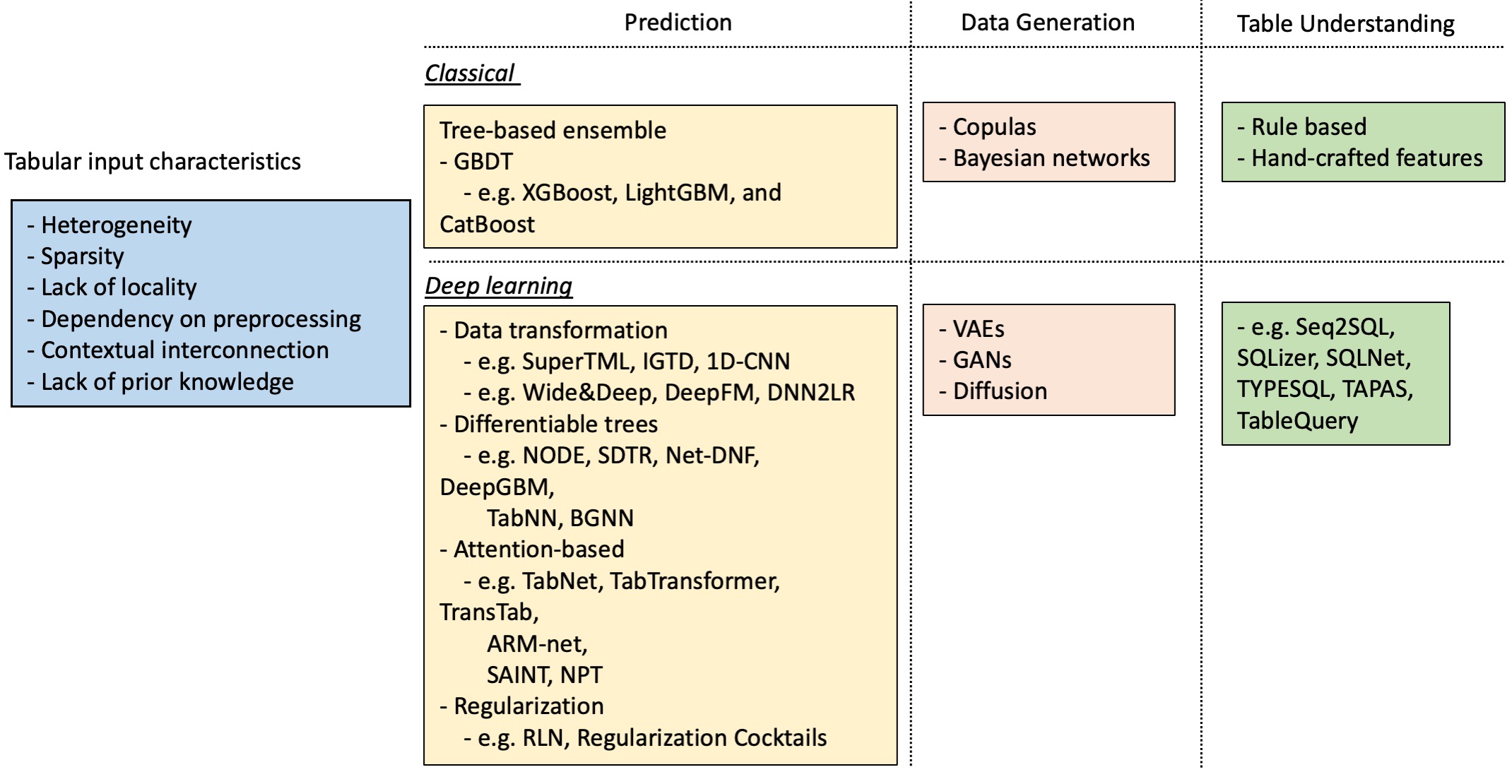
- 기법을 직렬화(serialization), 표 조작(table manipulation), 프롬프트 엔지니어링(prompt engineering), 엔드투엔드 시스템 설계로 분류한다.
- 예측, 데이터 확증/생성, 질문 응답/표 이해를 위해 LLM이 어떻게 활용되는지에 대한 논의.
- 강건성, 섭동, 표 구조 및 전처리가 LLM 성능에 미치는 영향 분석.
- 실용적인 참고문헌과 함께 개방된 문제 및 향후 연구 방향의 종합.

실험 결과
연구 질문
- RQ1어떤 기법이 태스크 전반에서 표 데이터에 대한 LLM의 효과적인 활용을 가능하게 하는가?
- RQ2표 데이터가 포함된 예측, 생성, QA 작업에서 LLM의 성능은 데이터 세트별로 어떤가?
- RQ3어떤 데이터셋과 지표가 LLM 기반 표 데이터 방법을 가장 잘 벤치마크하는가?
- RQ4표 데이터에서 LLM의 주요 한계와 향후 방향은 무엇인가?
주요 결과
- LLMs offer in-context learning and instruction-following capabilities that can be harnessed for tabular data tasks.
- Serialization format and input representation choices significantly influence performance and token efficiency, with HTML/XML formats sometimes aiding GPT-style models but increasing token usage.
- Prompt engineering, chain-of-thought strategies, self-consistency, and retrieval-augmented generation improve performance on tabular tasks, especially with larger models.
- Traditional tabular baselines like gradient-boosted trees remain strong benchmarks for prediction, though deep learning approaches can excel on very large or highly categorical datasets.
- The paper provides a structured taxonomy of datasets, metrics, and techniques and highlights open problems such as bias, hallucination, representation of numerical data, interpretability, and standardized benchmarks.
이 논문 읽기
누빈트 뷰어에서 원문을 열고, 읽으면서 궁금한 곳을 바로 물어보세요.
누빈트에서 이 논문 읽기이 리뷰는 AI가 논문 원문을 바탕으로 만들었습니다. 인용하기 전에 원문을 확인해 주세요.