
[논문 리뷰] LDM3D: Latent Diffusion Model for 3D
LDM3D는 텍스트 프롬프트에서 RGB 및 깊이 맵을 공동 생성하도록 잠재 확산을 확장하여 RGBD 출력과 DepthFusion 및 TouchDesigner를 통한 몰입형 360° 경험을 가능하게 한다.
This research paper proposes a Latent Diffusion Model for 3D (LDM3D) that generates both image and depth map data from a given text prompt, allowing users to generate RGBD images from text prompts. The LDM3D model is fine-tuned on a dataset of tuples containing an RGB image, depth map and caption, and validated through extensive experiments. We also develop an application called DepthFusion, which uses the generated RGB images and depth maps to create immersive and interactive 360-degree-view experiences using TouchDesigner. This technology has the potential to transform a wide range of industries, from entertainment and gaming to architecture and design. Overall, this paper presents a significant contribution to the field of generative AI and computer vision, and showcases the potential of LDM3D and DepthFusion to revolutionize content creation and digital experiences. A short video summarizing the approach can be found at https://t.ly/tdi2.
연구 동기 및 목표
- 텍스트 프롬프트로부터 RGB 이미지와 깊이 맵을 포함한 일관된 RGBD 출력을 생성하도록 동기를 부여한다.
- Stable Diffusion에서 적응된 KL-regularized 잠재 확산 프레임워크를 이용하여 RGBD 합성을 수행한다.
- 잠재 공간에서 연결된 RGB 및 깊이 입력을 처리하도록 KL-autoencoder를 미세조정한다.
- 생성된 RGBD 데이터를 활용하는 몰입형 360° 파이프라인(DepthFusion)을 시연한다.
- 품질을 검증하기 위해 기존 기준선과 대조하여 이미지 충실도와 깊이 정확도를 평가한다.
제안 방법
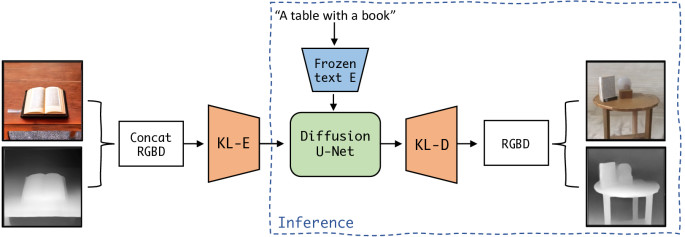
- RGBD 출력을 생성하도록 수정된 Stable Diffusion v1.4에서 파생된 1.6B 매개변수의 KL-regularized 확산 모델을 사용한다.
- 데이터 전처리: 16비트 깊이 맵을 3채널 RGB 유사 배열로 변환하고 이를 RGB 이미지와 연결하여 6채널 입력(512x512x6)을 형성한다.
- 다운샘플링 계수 8 및 공동 지각/적대적 손실을 사용하여 RGBD 튜플(image, depth, caption)에 대해 KL-autoencoder를 미세조정한다.
- 고정된 autoencoder 표현(64x64x4)을 사용하여 잠재 공간에서 확산 모델을 미세조정하고 예측된 노이즈로 손실 L_LDM3D를 적용하며 Stable Diffusion v1.4 가중치에서 시작한다.
- 고정된 CLIP-text 인코더를 사용하여 텍스트를 조건화하고 교차 주의(attention)를 적용하여 프롬프트를 U-Net 계층에 매핑한다.
- MS-COCO FID, IS, CLIP 및 ZoeDepth에 정렬된 깊이 지표를 사용하여 평가하고 SD 기초선 및 DPT-Large 깊이 추정치와 비교한다.
실험 결과
연구 질문
- RQ1단일 텍스트 프롬프트에서 고품질 RGB 이미지와 정확한 깊이 맵을 생성할 수 있는 RGBD 확산 모델이 있는가?
- RQ2RGB-전용 확산 모델과 비교하여 RGBD 동시 학습이 깊이 품질과 이미지 충실도에 어떤 영향을 미치는가?
- RQ3가이던스 스케일(조건 강도), DDIM 스텝 및 학습 진행이 RGBD 출력에 미치는 효과는 무엇인가?
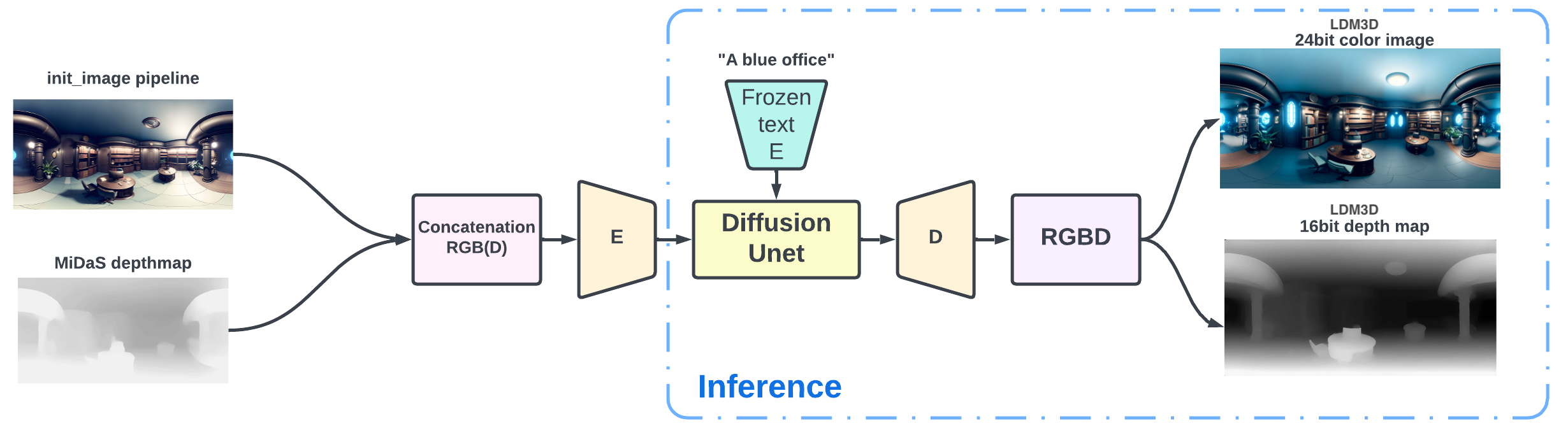
- RQ4생성된 RGBD 출력이 TouchDesigner에서 몰입형 360° 경험(DepthFusion)을 효과적으로 생성하는 데 사용될 수 있는가?
- RQ5표준 데이터셋에서 이미지 및 깊이 평가 지표에서 LDM3D가 기준선과 어떻게 비교되는가?
주요 결과
- LDM3D는 같은 매개변수 수로 MS-COCO(512x512)에서 50 DDIM 스텝을 사용하여 Stable Diffusion 베이스라인과 비교해 경쟁력 있는 FID 및 CLIP 점수를 달성한다.
- ZoeDepth에 정렬된 깊이 평가에서 LDM3D는 AbsRel 0.0911 및 RMSE 0.334 미터를 달성하여 DPT-Large의 0.0779 AbsRel 및 0.297 RMSE에 근접하다.
- RGBD 입력으로 autoencoder 미세조정은 상대적 FID 저하를 초래하지만 (사전 학습된 KL-AE, RGB rFID 0.763 대 미세조정 KL-AE, RGBD rFID 1.966) 효과적인 RGBD 생성을 가능하게 한다.
- LDM3D는 입력 프롬프와 정렬된 고품질 깊이 맵을 출력하며 CLIP 유사도 향상 및 질적 깊이 시각화로 나타난다.
- DepthFusion 파이프라인은 생성된 RGBD 출력을 TouchDesigner를 사용하여 몰입형 360° 뷰로 실질적으로 변환하고 대화형 경험을 가능하게 한다.
이 논문 읽기
누빈트 뷰어에서 원문을 열고, 읽으면서 궁금한 곳을 바로 물어보세요.
누빈트에서 이 논문 읽기이 리뷰는 AI가 논문 원문을 바탕으로 만들었습니다. 인용하기 전에 원문을 확인해 주세요.