
[논문 리뷰] Learning a Decision Tree Algorithm with Transformers
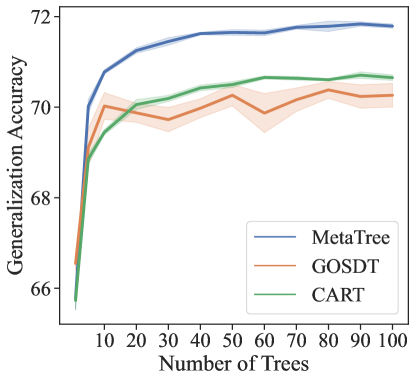
MetaTree는 탐욕적 및 최적화 기반 의사결정나무 알고리즘의 출력을 학습 데이터로 사용하여 고성능의 의사결정나무를 생성하도록 학습하는 트랜스포머 기반 모델이다. 데이터셋의 맥락에 따라 전략을 적응적으로 조정함으로써, 미리 보지 못한 표형 데이터셋에 대해 뛰어난 일반화 성능을 보이며, 특히 분산을 줄이고 복잡한 상호작용을 다룰 때 기존의 CART 및 GOSDT와 같은 전통적 방법들을 능가한다.
Decision trees are renowned for their ability to achieve high predictive performance while remaining interpretable, especially on tabular data. Traditionally, they are constructed through recursive algorithms, where they partition the data at every node in a tree. However, identifying a good partition is challenging, as decision trees optimized for local segments may not yield global generalization. To address this, we introduce MetaTree, a transformer-based model trained via meta-learning to directly produce strong decision trees. Specifically, we fit both greedy decision trees and globally optimized decision trees on a large number of datasets, and train MetaTree to produce only the trees that achieve strong generalization performance. This training enables MetaTree to emulate these algorithms and intelligently adapt its strategy according to the context, thereby achieving superior generalization performance.
연구 동기 및 목표
- 기존 히우리스틱 또는 최적화 기반 방법보다 더 나은 일반화 성능을 보이는 학습 가능한 적응형 의사결정나무 알고리즘을 개발하는 것.
- 딥러닝 모델이 예측을 넘어서 구조적인 기계학습 모델(특히 의사결정나무)을 생성하도록 하는 것.
- 다양한 나무 구축 전략에서 학습함으로써, 새로운 표형 데이터셋에서의 일반화 성능 향상.
- 탐욕적 접근와 전역 최적화 접근 방식 간의 동적 전환 전략을 통해 예측의 분산을 줄이고 편향은 낮게 유지하는 것.
- 딥러닝 모델을 사용해 알고리즘적 행동을 학습하고 개선하여 모델 생성의 가능성을 탐색하는 것.
제안 방법
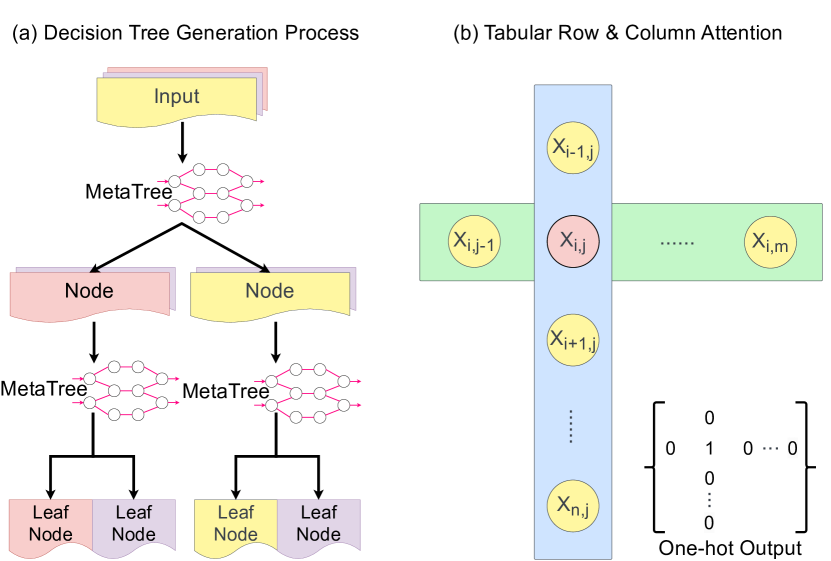
- MetaTree는 표형 데이터를 처리하기 위해 가로 및 세로 주의를 번갈아 적용하는 트랜스포머 아키텍처를 사용하여 샘플과 특징을 함께 모델링한다.
- 표형 구조를 유지하기 위해 가로적 절대 위치 편향을 학습 가능한 방식으로 적용하여 데이터 포인트와 특징 간의 순서와 관계를 보존한다.
- 모델은 탐욕적 의사결정나무(예: CART)와 최적화 기반 의사결정나무(예: GOSDT)의 필터링된 출력을 기반으로 학습하여, 이를 모방하고 초월하는 일반화 능력을 습득한다.
- MetaTree는 재귀적으로 자신을 적용하여 나무를 구축하며, 백트래킹 없이 현재 상태에 기반해 각 노드에서 분할 결정을 내린다.
- 다양화 가능한 주의 메커니즘을 사용하여 각 노드에서 최적의 분할 특징과 임계값을 나타내는 원핫 마스크를 생성한다.
- 학습 목표는 MetaTree가 단지 학습 알고리즘을 재현하는 것뿐만 아니라 다양한 데이터셋에서 잘 일반화되는 나무를 생성하도록 유도한다.
실험 결과
연구 질문
- RQ1트랜스포머 모델이 기존 히우리스틱 또는 최적화 기반 알고리즘보다 더 나은 일반화 성능을 보이는 의사결정나무를 학습하여 생성할 수 있는가?
- RQ2트랜스포머 기반 모델이 데이터셋 특성에 따라 탐욕적 접근과 전역 최적화 접근 간의 전략을 얼마나 잘 적응시킬 수 있는가?
- RQ3MetaTree는 표준 의사결정나무 알고리즘과 비교해 더 낮은 분산과 더 나은 편향-분산 트레이드오프를 달성하는가?
- RQ4MetaTree는 깊이 2 나무만으로 훈련되었음에도 불구하고, 깊이가 깊고 더 복잡한 작업(예: 프롬프트의 나무 추론)으로 일반화할 수 있는가?
- RQ5MetaTree의 내부 결정 과정은 레이어 간에 어떻게 변화하며, 조기 종료 전략을 지원하는가?
주요 결과
- MetaTree는 깊이 2 및 3 나무 모두에 대해 훈련 시 깊이 2 나무만으로 학습되었음에도 불구하고 91개의 미리 보지 못한 데이터셋에 대해 잘 일반화되며, 강력한 인덕티브 바이어스와 이식 가능성을 보여준다.
- 13개의 프롬프트의 나무 데이터셋에서 MetaTree는 높은 테스트 정확도를 달성하여, 계층적 나무 구조가 필요한 복잡한 추론 작업을 지원할 수 있음을 보여준다.
- MetaTree의 레이어 간 분할 간 상관관계는 레이어 1에서 9로 갈수록 점차 증가하여 약 1에 도달하며, 레이어 10~11에서 감소하는 경향을 보이며, 이는 레이어 9에서 조기 종료 가능성을 시사한다.
- 91개의 왼쪽 데이터셋에서 MetaTree는 CART 및 GOSDT보다 유의미하게 낮은 경험적 분산을 기록하여 데이터 변동성에 더 강건함을 보여준다.
- MetaTree는 GOSDT 및 CART보다 略로 낮은 편향을 보이며, 동시에 뛰어난 분산 감소 성능 유지를 통해 더 유리한 편향-분산 트레이드오프를 달성한다.
- 모델은 데이터셋 맥락에 따라 탐욕적 접근과 전역 최적화 전략을 동적으로 전환함으로써, 일반화 성능 향상에 기여한다.
이 논문 읽기
누빈트 뷰어에서 원문을 열고, 읽으면서 궁금한 곳을 바로 물어보세요.
누빈트에서 이 논문 읽기이 리뷰는 AI가 논문 원문을 바탕으로 만들었습니다. 인용하기 전에 원문을 확인해 주세요.