
[논문 리뷰] Learning Interactive Real-World Simulators
이 논문은 UniSim을 제안합니다. UniSim은 다양한 인터넷 데이터셋을 통합하여 현실 세계의 상호작용을 시뮬레이션하고, 추가 실데이터 학습 없이도 현실 세계로 이전 가능한 시각-언어 및 강화 학습 정책을 학습하는 보편적 행동-조건 영상 확산 모델입니다.
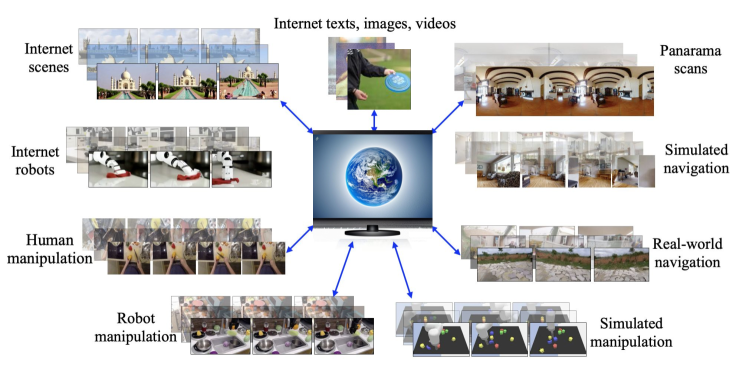
Generative models trained on internet data have revolutionized how text, image, and video content can be created. Perhaps the next milestone for generative models is to simulate realistic experience in response to actions taken by humans, robots, and other interactive agents. Applications of a real-world simulator range from controllable content creation in games and movies, to training embodied agents purely in simulation that can be directly deployed in the real world. We explore the possibility of learning a universal simulator (UniSim) of real-world interaction through generative modeling. We first make the important observation that natural datasets available for learning a real-world simulator are often rich along different dimensions (e.g., abundant objects in image data, densely sampled actions in robotics data, and diverse movements in navigation data). With careful orchestration of diverse datasets, each providing a different aspect of the overall experience, we can simulate the visual outcome of both high-level instructions such as "open the drawer" and low-level controls from otherwise static scenes and objects. We use the simulator to train both high-level vision-language policies and low-level reinforcement learning policies, each of which can be deployed in the real world in zero shot after training purely in simulation. We also show that other types of intelligence such as video captioning models can benefit from training with simulated experience, opening up even wider applications. Video demos can be found at https://universal-simulator.github.io.
연구 동기 및 목표
- 다양한 데이터 소스를 융합할 수 있는 보편적이고 행동 조건이 있는 현실 세계 시뮬레이터의 필요성을 동기 부여합니다.
- 예측 관찰 모델을 학습하기 위한 통합된 행동-비디오 입력 프레임워크를 제안합니다.
- 장시간-다중모달 시뮬레이션이 현실 로봇에 이전 가능한 고수준 및 저수준 정책을 학습시킬 수 있음을 보여줍니다.
- 시뮬레이션 데이터를 활용한 비디오 자막 생성 및 광범위한 비전-언어 모델과 같은 추가 응용을 시연합니다.
제안 방법
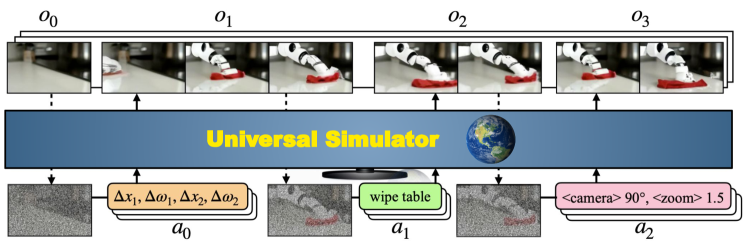
- 텍스트, 언어 설명, 모터 제어를 연속 임베딩으로 변환하여 통합된 행동 공간을 형성합니다.
- epsilon_theta 소 denoising 네트워크를 갖춘 비디오 확산 모델을 사용하여 관측-예측 모델 p(o_t|h_{t-1},a_{t-1})로 UniSim을 학습합니다.
- 최근 히스토리 프레임으로 확산 모델을 조건화하여 자가회귀적 장시간 비디오 생성을 가능하게 합니다.
- 확산 과정에 행동 조건을 포함시키기 위해 분류자-없는 가이드를 사용합니다.
- 조건 프레임을 미래 단계로 복제하고 상호 간 간극 시간 및 공간 주의력을 갖춘 비디오 U-Net 아키텍처를 적용합니다.
- 도메인 식별자를 활용하여 데이터가 적은 도메인을 돕도록 실제 로봇, 인간 활동, 파노라마 및 인터넷 이미지-텍스트 데이터셋의 조합으로 학습합니다.
실험 결과
연구 질문
- RQ1단일의 행동 조건 영상 확산 모델이 다양한 데이터셋을 융합하여 현실 세계의 상호작용을 현실적으로 시뮬레이션할 수 있을까요?
- RQ2장시간 시뮬레이션이 현실 세계 작업으로 이전 가능한 고수준 비전-언어 정책과 저수준 RL 컨트롤러를 효과적으로 학습시키게 할 수 있을까요?
- RQ3시뮬레이션 데이터가 비 embodied 작업인 비디오 자막 생성과 광범위한 비전-언어 모델에 도움이 될 수 있을까요?
- RQ4메모리, 행동의 현실성, 도메인 밖 일반화에서 현재의 보편 시뮬레이터의 한계는 무엇인가요?
주요 결과
- UniSim은 조작 및 내비게이션 과제에서 행동이 풍부하고 긴 시간 축 시뮬레이션을 수행할 수 있습니다.
- 자기회귀 확산 기반의 관측 예측은 행동에 조건화된 시간적 일관된 비디오 시퀀스를 산출합니다.
- 시뮬레이션에서 완전히 비전 정책 및 강화 학습 컨트롤러를 학습해 제로샷 배포에서 실제 로봇에 이전할 수 있습니다.
- 시뮬레이션 데이터가 비디오 자막 생성 모델을 개선할 수 있으며 장시간 과제에 대한 시뮬레이션 되돌보기 데이터의 가치가 있습니다.
- 히스토리 프레임을 조건화하면 생성 품질이 향상되지만, 너무 먼 과거 히스토리는 성능을 해칠 수 있습니다.
이 논문 읽기
누빈트 뷰어에서 원문을 열고, 읽으면서 궁금한 곳을 바로 물어보세요.
누빈트에서 이 논문 읽기이 리뷰는 AI가 논문 원문을 바탕으로 만들었습니다. 인용하기 전에 원문을 확인해 주세요.